Neutrality is not passive: Dr Anwar Gargash explains the UAE’s diplomatic stance
The adviser to the UAE president explains how Abu Dhabi earned the trust to host conversations between Washington, Moscow and Kyiv.
In a week when many capitals have traded threats, Abu Dhabi has quietly played host to trilateral talks between Washington, Moscow and Kyiv. At the World Governments Summit in Dubai, Dr Anwar Gargash spoke to Monocle Radio about why the UAE now occupies that narrow diplomatic space – and why the world increasingly needs it.
Gargash, diplomatic adviser to the UAE president and a central figure in brokering last week’s unprecedented US-Ukraine-Russia meeting, frames the breakthrough as the product of long-term credibility rather than opportunism and confirms that a second round is due in Abu Dhabi “in a few days”. When Russia invaded Ukraine in February 2022, the UAE chose to uphold international law, while refusing to sever relations with either country. “Everybody wanted us to take sides,” he says. “Our argument was clear: what we really want to do is to be helpful.” That approach, which attracted heavy criticism at the time, has since delivered results. Abu Dhabi has facilitated the exchange of more than 4,000 prisoners between Russia and Ukraine and maintained open channels with all three capitals.
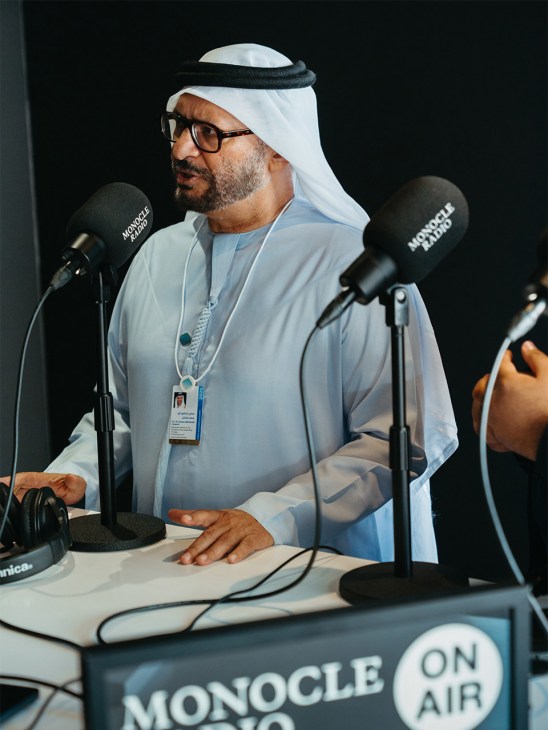
The World Governments Summit itself, he acknowledges, has landed at a moment of heightened regional tension. From the Gaza crisis and the renewed presence of US military power in the Gulf to rising international pressure on Iran, the atmosphere is febrile. But Gargash is notably measured. “The region is always tense,” he says. “If it’s not one issue, it’s another.” The task for diplomacy is not to amplify anxiety but to contain it.
As US rhetoric hardens, Gargash is explicit about the UAE’s position on Iran. “As a neighbour, the last thing that we want to see is a military confrontation,” he says, adding that the UAE is “very concerned” about the prospect of escalation. War, he warns, would further destabilise a region already exhausted by conflict.
Instead, Gargash urges Tehran to seize what he describes as a narrowing diplomatic window. “This is an opportunity to negotiate directly with the US,” he says, pointing to Iran’s nuclear programme as a central issue. Failure to address this, he cautions, could result in an escalation “not in favour of Iran or any of us”.
The UAE’s neutrality is not passive. “You have to have enough distance from this party and that party,” he says. “And you have to be seen to say the same thing in public and behind closed doors.” In today’s geopolitical climate, where lines of communication are closing faster than conflicts are ending, that consistency is a form of leverage. The UAE’s growing role as a convenor is not accidental, nor is it ideological. It’s the product of deliberate restraint in an era that often rewards escalation. As the next round of US-Ukraine-Russia talks approaches and as pressure builds over Iran, the UAE is positioning itself not as a commentator on global crises but as a calming voice in the middle of them.
For now, when rivals need a neutral room, a reliable phone line and a host willing to absorb criticism from all sides, they are not looking to traditional diplomatic capitals. They are calling the Gulf.
Inzamam Rashid is Monocle’s Gulf correspondent. You can listen to our interview with Gargash on yesterday’s episode of ‘The Briefing’ and learn more about Monocle’s presence at the World Governments Summit here.