‘Everyone is terrified of US sanctions.’ What might Nouri Al-Maliki’s leadership nomination mean for US-Iraq relations?
With more than a decade of experience reporting on the Middle East for ‘The Washington Post’, Loveday Morris speaks with senior news editor Chris Cermak about Al-Maliki’s possible return as Iraq prime minister.
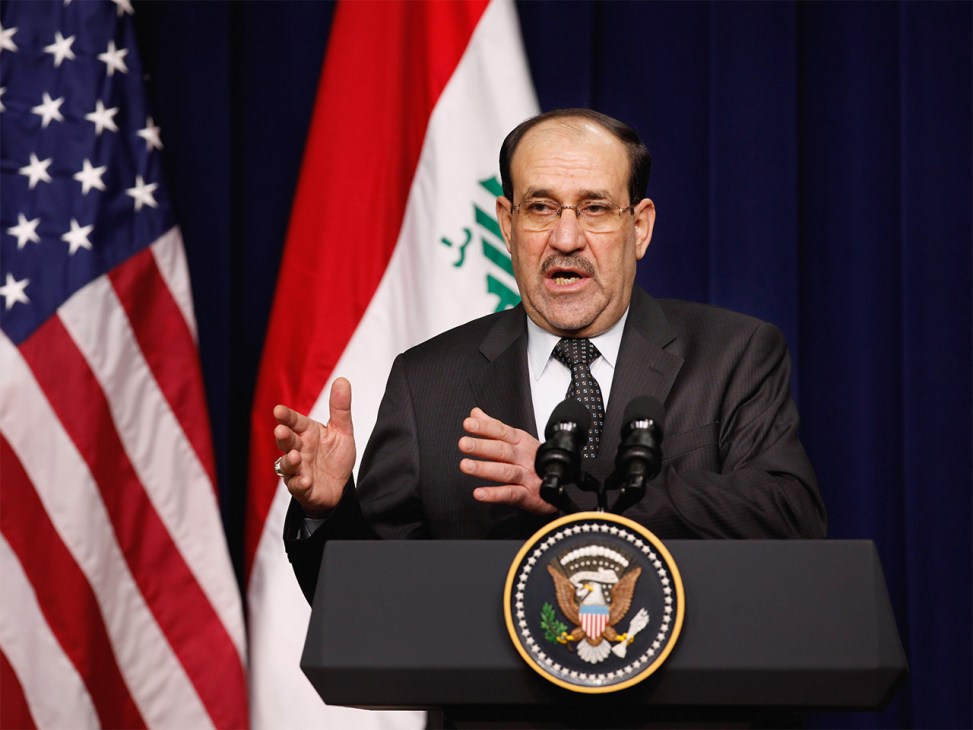
In Iraq, the re-emergence of former prime minister Nouri al-Maliki as the country’s next potential leader has caused something of a stir. Al-Maliki has been nominated by the country’s dominant political party to retake the prime ministership that he was first handed just a few years after the 2003 US-led invasion that deposed Saddam Hussein.
Al-Maliki is remembered as much for allowing the emergence of Islamic State as anything he did to revive the country itself. His resurgence today appears to have less to do with his record in office and more with some internal political shenanigans. And it’s very much without American support: Donald Trump this week has warned that the US would pull its financial backing out of Iraq if Al-Maliki does in fact become the next prime minister. Iraq’s parliament has in turn postponed a vote on the country’s president, a ceremonial post and the person who would officially install Al-Maliki as prime minister. All of this is happening as Trump’s declared armada sails towards Iran, putting serious pressure on Iraq’s neighbour. Al-Maliki himself is accused of having too close a relationship with Iran – another reason for US opposition to his nomination.
Loveday Morris covered the Middle East for a decade and was the Baghdad bureau chief for The Washington Post from 2014 to 2017. She is currently its Berlin bureau chief. Morris spoke with Monocle Radio’s Christopher Cermak on The Briefing – the following is a transcript of their conversation, which has been edited for length and clarity.
Let’s start with Nouri al-Maliki’s legacy and his first time in office. What was he known for?
Al-Maliki served two terms as prime minister between 2006 to 2014. It was a period marred by sectarianism and he was broadly blamed for laying the ground for the rise of the Islamic State and the so-called caliphate in 2014. There were complaints of arbitrary arrests and harassment by security forces, which led to big protests in Anbar and a real sense of disaffection among the Sunni population. People saw all of that as a reason for the rise of Isis and why things collapsed so quickly in the face of the militants. There were other reasons, of course, but Al-Maliki’s sectarian policies were seen as one of the main causes.
Which then begs the question: why is he having a resurgence now and who are his supporters?
I wouldn’t call it a resurgence – it seems to be more of an accidental situation. [Al-Maliki’s return] came out of wranglings within the umbrella group that won the highest number of seats in November’s elections. While he and the incumbent prime minister, Mohammed Shia’ al-Sudani, were both gunning for the top seat, other members of the coalition sent them off and basically said, ‘You guys decide among yourselves and we’ll go with whoever you choose.’ Al-Sudani ended up stepping aside and backing Al-Maliki.
Some people see the decision as political play. He made the choice to step aside knowing that Al-Maliki is a deeply unpopular figure in some circles, so there would be some resistance to him becoming prime minister. After which, [Al-Sudani], who is also disfavoured in other circles, would be able to step in. But Al-Maliki’s nomination remained unchallenged until the Trump administration’s public reaction.
I wanted to get to that reaction, which responds to the internal political intrigue that you’re describing. Why has the Trump administration made such a big deal of this nomination?
Washington has experience dealing with Al-Maliki. Though the US backed him for his second term in 2014, other powers were rounding against him to remove him as he clung to the position.
But [to answer the question of] why the Trump administration is so opposed now, we must look at the bigger geopolitical situation. The US is trying to isolate Iran and Iraq is one of the key stages [that will allow them] to do so. Much of American policy is focused on rolling back Iranian influence, so when our reporting and others’ [showed] that Al-Maliki was given Iran’s blessing at one point, it didn’t help his position in the eyes of the US. Besides the public reaction from Trump, we also saw a quieter one: a call from Marco Rubio to Al-Sudani, voicing concerns about an Iran-influenced government. US policy here is about disarming the Iran-backed militias. I suppose there are some questions about whether Al-Maliki would do that, though it’s also worth asking whether any other prime minister will be capable or willing to do it.
Al-Maliki has rejected US interference as an attack on Iraq’s sovereignty but at the end of the day, it’s not really up to him. As you’ve alluded to, there are a lot of internal dynamics here – how does this play out?
Al-Maliki looks like he’s digging in; he has put out very strong statements rejecting this interference and politicians in his bloc have talked about being able to win Trump over. While he hasn’t made any public statements about giving up the nomination, we all realise that Iraq cannot afford to go up against the Trump administration. Everyone is terrified of US sanctions. Washington effectively controls Iraq’s purse strings because oil revenues go to the US Federal Reserve. So there is a real fear that if it went up against the US administration, the dollar flow to Iraq could be potentially cut off. It’s very hard to see how Al-Maliki’s nomination can continue while facing these pressures.
Now the question is, who will step in? Al-Sudani is also quite unpopular among members of his coalition who will be discussing the path forward. It’s possible that they’ll have a consensus candidate of some kind; someone who is a little more in the shadows, who they can come to an agreement on. We’ll have to wait and see.
Finally, there is an ‘armada’ approaching, as Trump calls it. Iran is facing its own demands from the US to negotiate on a nuclear deal. Is Iraq watching closely, even if it might not be supporting Al-Maliki anymore?
There is a great amount of nervousness here, due to the proximity to Iran and the fear of being sucked into any conflict. And a large factor that [plays into the anxiety] is the presence of Iranian-backed militias in Iraq, which might feel the need to become involved should there be a strike on Iran. Even here in Baghdad, some of the militias that are closest to Iran, such as Kataib Hezbollah, are signing up fighters who plan to cross the border in the scenario that the regime is threatened in any way.
For more insight on the US’s intervention into Iraqi affairs, listen to the full conversation on ‘The Briefing’ from Monocle Radio.