Brown University shooting proves that no campus is safe, further deterring international students
Another day, another school shooting in the USA. This time, my son was inside. As we try to process the tragedy, we must ask what this persistent violence is doing to American universities.
In the afternoon of Saturday, 13 December, a gunman walked into the engineering building at Rhode Island’s Brown University, entered a classroom where students were preparing for exams and opened fire, killing two students and injuring nine others. My son, a first-year student at Brown, was in that engineering building – but he was in the design workshop, where machinery such as laser cutters and 3D printers had muffled the sound of gunfire. Moments later, he walked a friend out and saw backpacks and computers strewn about, abandoned by their owners. After someone said shots had been fired, he ran back to the workshop to tell everyone to evacuate.
Outside the building, a police officer ordered the students to seek shelter immediately. They ran across the street to a dorm, headed upstairs to the fourth floor and barricaded the doors. That’s where my son spent his Saturday night. At 08.00 the next morning, after campus lockdowns were slowly lifted, a police car took my son back to his dorm.
At the time of writing, the latest news on this tragedy is that the suspect is still at large. Brown has few surveillance cameras, so police officers went door to door in the upscale neighbourhood next to the university to ask its residents for any available video footage. You can now view the masked, stocky man ambling along the tree-lined street, about to shatter the lives of so many.
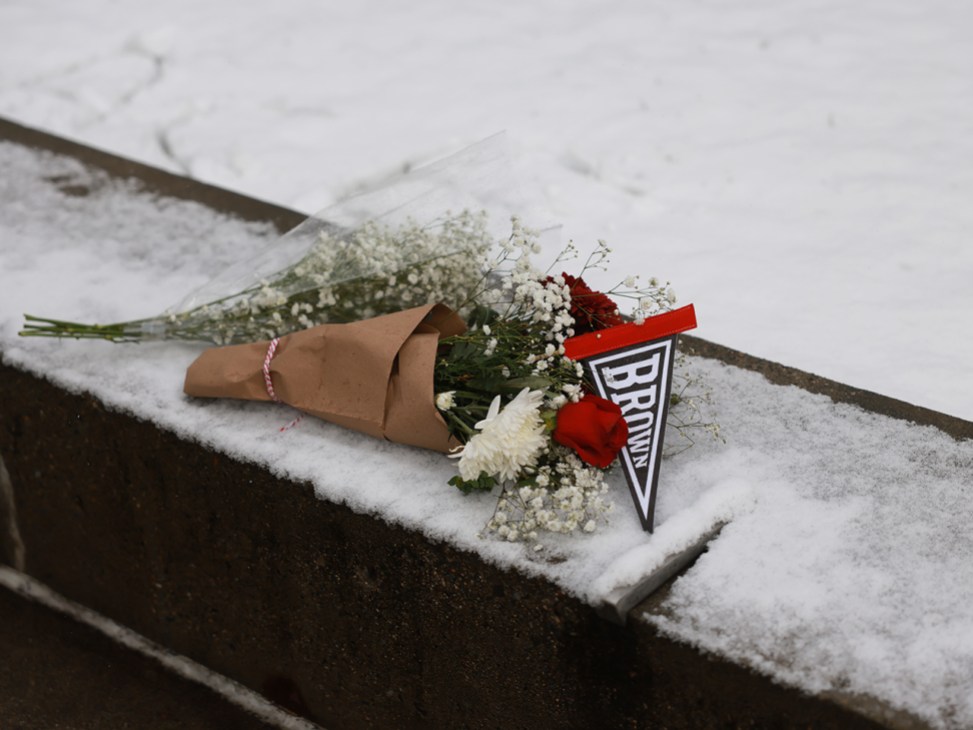
The names of the victims have also been released. Mukhammad Aziz Umurzokov was a naturalized US citizen from Uzbekistan who was studying to become a neurosurgeon. Ella Cook came from a small town in Alabama and, in a left-leaning university, was vice president of Brown’s Republican Club. Kendall Turner from North Carolina, who my son knows well, is in a critical but stable condition.
This incident has shocked the hilly, picturesque city of Providence, where the last time residents felt so shaken was after a 2003 nightclub fire that killed several people. It’s all the more distressing for those who believed that, somehow, elite universities in Democratic states, where gun laws are stricter, would be spared from this type of senseless violence that has become common in so many parts of the country.
It also leaves us wondering whether any young people from abroad will still make the choice to study in the US. Enrollment by international students had dropped 17 per cent this autumn compared to previous years, as many prospective students were unable to secure visas under the Trump administration’s ever-tightening restrictions; my son’s roommate from Sri Lanka was one of those for whom obtaining a visa was uncertain. At the same time, Washington has been cutting funding to the country’s research institutions, particularly targeting universities in blue states and leaving researchers worldwide questioning whether to take their intellects and inventions elsewhere.
American universities are unique, offering educational experiences unlike anywhere else. Students needn’t declare their course of study until halfway through the four years of a bachelor’s degree programme, giving them time to decide how they want to focus the rest of their lives. The residential experience – coupled with hundreds of academic, artistic and athletic clubs – produces well-rounded students with time-management and leadership skills. These graduates are, arguably, better prepared for the working world than students who’ve had a more narrow, academic experience.
International students bring so much to US universities in turn, adding diverse viewpoints to campuses. And America’s elite institutions have also been part of the nation’s soft power. But, for many international families who had been considering a US education for their child, the calculus might have changed for good – just another lasting consequence of Saturday’s devastating tragedy.
Noelle Salmi is a Zürich-based writer. You can hear her discuss the tragic events at Brown University on ‘The Globalist’ from Monocle Radio.