Budge up JD Vance, Marco Rubio is sitting second in command
There’s a meme going around. It features US secretary of state Marco Rubio facing an improbable future as the president of Venezuela, the leader of Cuba and the shah of Iran – all at the same time. It’s a cheeky take on the current political condition but one that reflects the former senator from Florida’s unexpected position as the most powerful man in Washington, besides his boss of course.
Rubio is now far more than a mere senior cabinet member – he’s the physical manifestation of the most muscular foreign policy agenda since the Cold War. This week’s workout? He’s trying to lift the mineral-rich island of Greenland out of the Danes’ hands. It’s heavy stuff. Indeed, despite campaigning as a president to “end wars”, Trump has become one of the most aggressive and adversarial American leaders since Ronald Reagan. And he has Marco Rubio, in many ways, to thank for it. Trump even suggested the US strike on Venezuela might have been “Marco’s revenge” against Maduro, who had lavished the communist regime in Havana with vast supplies of oil. Even if this betrays barely a shred of truth, the level of antipathy felt by Cuban Americans such as Rubio to Havana makes him ideally suited for the White House’s new hawkish course.
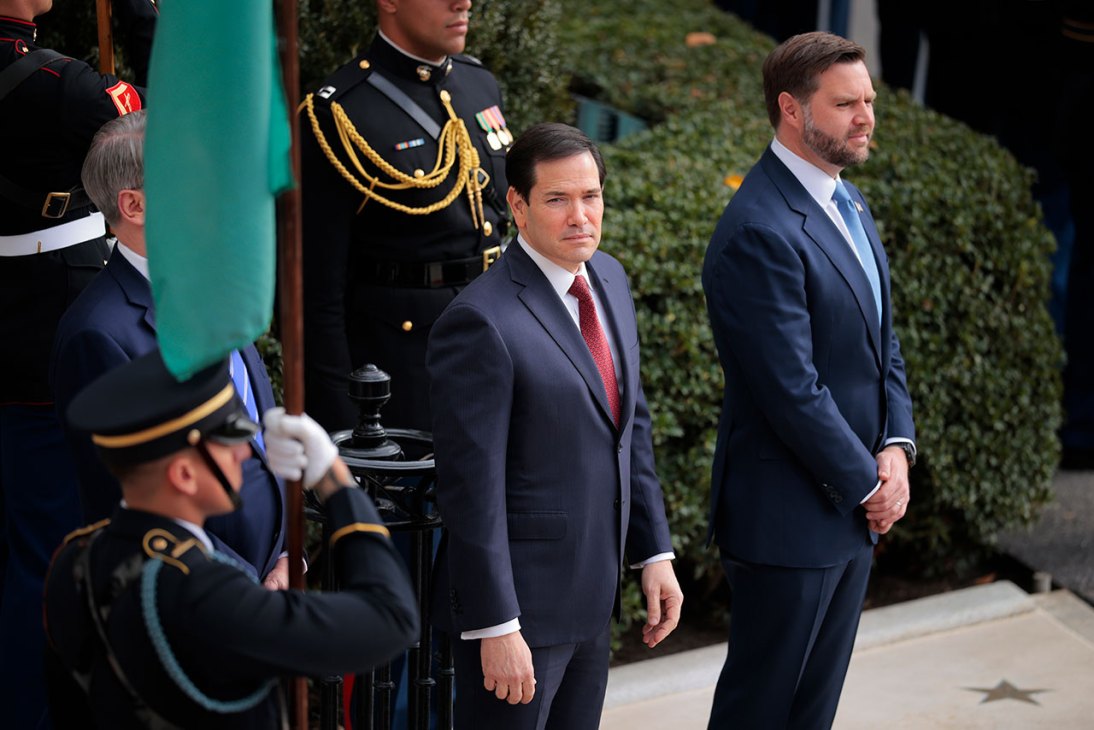
The question is how much of this is Trump and how much Rubio? The likely answer is a whole lot of both. And as Iran continues to convulse – and Trump threatens to attack drug cartels in Mexico as he has done off the coast of Venezuela – can Rubio contain his boss’s ambitions amid an increasingly outraged global community?
There are few more seasoned politicians in the Trump administration than Rubio, the son of Cuban immigrants who spent a quarter of a century in public service. At just 54, he is among the elder statesmen in Trump World and a clear political rival to vice-president JD Vance, more than a decade his junior. The pair have been engaged in a not-so-subtle pas de deux over who will next assume the Oval Office and carry on Trump’s Maga legacy.
Rubio has shown impressive restraint and consummate team player deftness in allowing Vance to stand as Trump’s presumed successor. But Rubio’s highly prominent public profile suggests his ambitions are far more aggressive than his baby-faced demeanour might reveal. Rubio is the modern incarnation of Henry Kissinger but whereas Kissinger was barred from the presidency owing to his foreign birth, Rubio seems like the most organic fit possible.
Despite his impressive wins, Rubio’s most difficult days are still ahead of him. Hamas might be vanquished and Nicolás Maduro imprisoned in New York but the new Iranian revolution has only just begun and Denmark – if not all of Nato and the EU – will not stand idle as Trump eyes Greenland. Claudia Sheinbaum, Mexico’s leader, has repeatedly declared that she will not tolerate a US violation of Mexican sovereignty and Colombian president Gustavo Petro – despite recent signs of warming – has yet to back down from the White House’s posturing.
Rubio has so far managed to get most things right. But even a mild military confrontation with an American neighbour – and an existential crisis within the country’s most strategic military alliance – would be both unprecedented and perhaps insurmountable. Worst of all, both would be highly unnecessary, raising the spectre of a still pliant global community fully turning its back on Trump’s borderless land grabs.
The US, of course, is too powerful to become a nation isolated or alone. But even powers that cannot be ignored by the global community can be shut out of the rites and rhythms – look at Israel following the war in Gaza. Considering that he has essentially declared that he is beyond international law, Trump might not care. But ultimately, it will be Rubio who’s dispatched to do the dirty work. His goal will be to keep his hands clean as the world order shifts. It’s not an easy task and it’s likely that Trump sees him as a potential scapegoat for any problems along the way. If he can avoid calamity, he will be rewarded handsomely in 2028.
Kaufman is a New York-based journalist and regular Monocle contributor. Read more from him here.