Denmark has never had it so good. So why are its voters so unhappy?
There’s a paradox (or several) behind the Danes heading to the polls. Think the grass is always greener in Denmark? Think again.
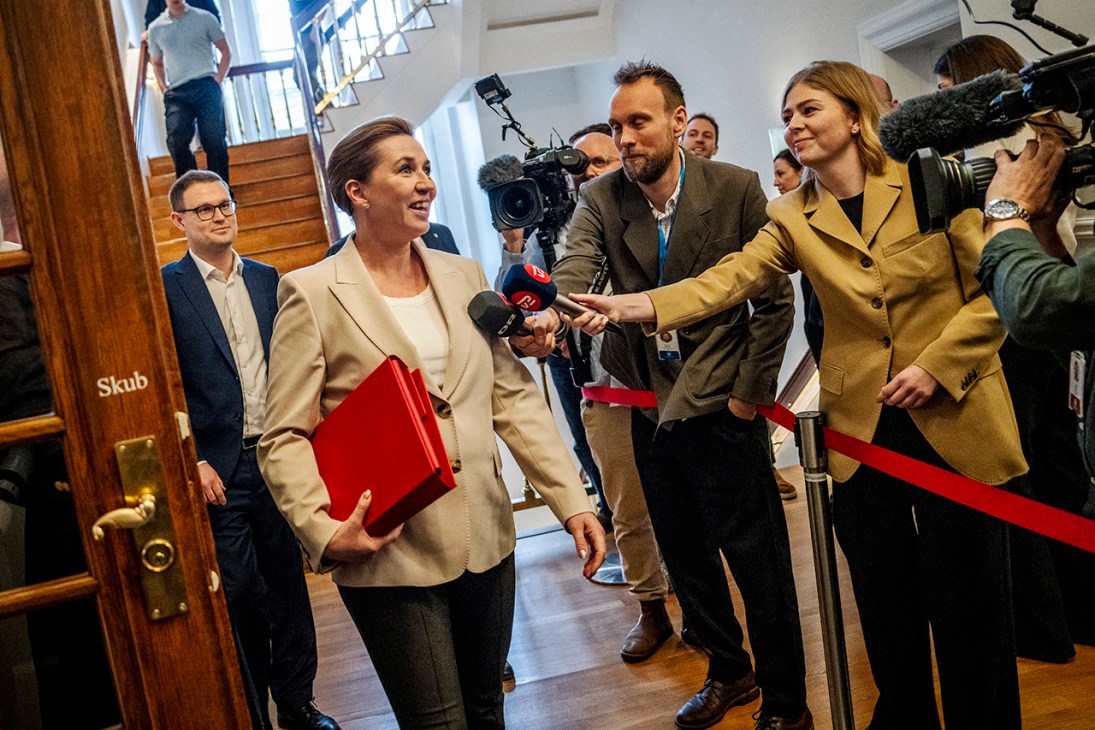
The Danish prime minister, Mette Frederiksen, visited parliament with two items on her agenda last week. The first was to enact a one-off, tax-free payment of DKK2,500-DKK5,000 (€335-€669) to be paid to roughly two million households to help with the cost of living. Her second task was to announce that Denmark will hold a general election on 24 March, its first since 2022.
Is it cynical to see a connection between the two items on Frederiksen’s to-do list? The opposition parties branded the payment “valgflæsk” or “election pork” (most things in Denmark can be explained with pork metaphors), pointing out that her Social Democrats party has dropped by nearly 7 points in the polls since the last election.
The other two parties in her governing coalition have also plummeted in popularity: the cent-right Venstre is polling below 9 per cent. Moderaterne, led by former Venstre prime minister and current foreign minister, Lars Løkke Rasmussen, has fallen to just 4.2 per cent. This is despite Rasmussen’s recent diplomatic success in Washington over Greenland negotiations. But Greenland is simply not a decisive issue for many Danish voters. In the party-leader debate, televised on the evening that the election was announced, Greenland was not mentioned once.
Danish general elections are always confusing. The country’s four million or so voters have a bewildering 12 parties from which to choose, yet it is often difficult to define policy differences between them. All will make pledges that they and the electorate know can never be delivered on because no party will ever have an outright majority. Danish election campaigns thus take on the air of an optimistic child’s Christmas wish list, except instead of “Dear Santa, I would like a drum kit”, you get “I would like to spend another 1 per cent of GDP on defence”. The inevitable conclusion will be a coalition of compromise and backroom deals. For a nation that prides itself on its democracy and openness, it’s usually a bit of a stitch-up.
This particular general election seems even more paradoxical than usual. Here’s why:
1.
In one of the most quantifiable egalitarian nations on earth, the prime minister’s first priority, she says, is reducing (further) inequality.
2.
In a country that has some of the highest taxes in the world, several parties want to raise taxes and even create new ones. Two are being proposed: a wealth tax of 1 per cent on those with more than DKK35m (€4.6m) and a capital-gains tax on people’s homes.
3.
Denmark has experienced relatively low levels of immigration and granted comparatively few asylum claims over the past 10 years (if we exclude Ukrainian refugees). Some parties are nevertheless campaigning exclusively on reducing immigration. Several have now hopped on the remigration bandwagon – the growing right-wing movement across Europe to “send migrants home”. They justify this stance by pointing to crime rates, even though Denmark’s are among the lowest globally and the country ranks as the world’s eighth most peaceful.
4.
In a nation where financial surpluses have grown by billions of kroner in recent years and where the retirement age is already set to rise to 70, there are politicians who claim that there isn’t enough money to fund, say, another school reform or decent hospitals.
5.
Despite having 10 national holidays – two more than the UK – several parties are campaigning to reinstate Store Bededag (Great Prayer Day), a holiday that was abolished three years ago that no one really understood anyway. I repeat: nobody is mentioning the still rather real threat of losing 98 per cent of Danish territory to the US.
6.
Copenhagen has almost tripled its total defence-related outlays, including Ukraine aid, since Russia’s full-scale invasion but there are parties that believe that the most important issue is to further increase defence spending.
7.
Having reduced its CO2 emissions by half since 1990 and outpacing most nations in terms of the green transition, Denmark is nevertheless home to parties that feel that it is not going fast or far enough. Danes are eating too much meat, flying too much, driving too many diesel cars and living in unnecessarily large houses. That all has to stop, apparently.
Let me end with yet another paradox: the Danish state has never been richer and Danes enjoy virtually full employment; they really never have had it so good. Yet as things currently stand, they are about to reward the government that is responsible for this by voting it out of office. And just one more paradox: Frederiksen might well stay on as prime minister.
You might think that the grass is greener over here. For the Danes, apparently, it isn’t nearly green enough.
Michael Booth is Monocle’s Copenhagen correspondent. For more opinion, analysis and insight, subscribe to Monocle today.