Mark Carney’s Davos address put world leaders – and their speechwriters – on notice
The Canadian prime minister’s speech stood out not just for its polish but also its provenance. In an age of outsourced language, Carney showed leaders why writing for yourself is worthwhile.
Mark Carney didn’t just deliver a good speech at Davos, he wrote it himself – a lesson in the optics of authenticity for other leaders keen to shine on a fiercely lit world stage. Granted, some of its highlights might not have sounded so fresh to the Canadian press corps or anyone who was already in the thrall of the “Carneyval” spirit. But the speech was nevertheless a resounding hit and made Trump’s rambling follow-up sound incoherent by comparison.
The sugar high of the address is now dissipating but as a rhetorical lesson it resonates still. In an age of outsourced language – when leaders tend to speak with caution, preferring flat-pack political jargon to nuanced perspective – Carney’s confident account of the new world order didn’t just point out the elephant in the room, it also described the global predicament in fine detail. It just goes to show the power of writing your own words, refining your own ideas, coming to your own conclusions.
Done well, writing isn’t the transcription of thought so much as the interrogation of it. The craft crystallises ideas into irreducible and irrefutable clarity. On the page, ideas must arrive in order, find a rhythm, develop a narrative and – most labouriously – mean something. This discipline has fallen out of fashion. At a time of flooded news feeds, economic uncertainty and seemingly continuous crises, Carney hit the geopolitical moment on the head, and like a nail, his point sank in.
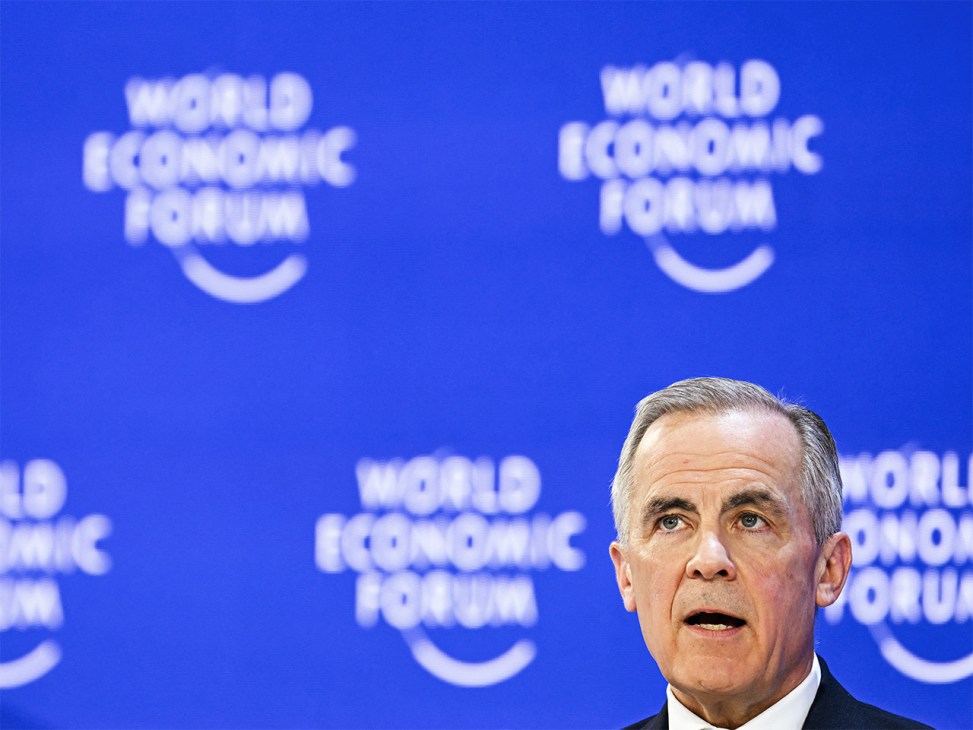
World leaders take notice, coherence creates credibility. His arguments were lucid, his sentences sanded and shaped, his tone firm but understanding (particularly toward similar middle powers). Take, for instance, his description of the weaponisation of global integration by the might-is-right mentality: “You cannot live within the lie of mutual benefit through integration, when integration becomes the source of your subordination.” Where other politicians speak with the confusing cacophony of committee, Carney comes across with a singular voice. You could feel his conclusions arising organically from the natural logic of his own perspective.
And yet, the address did leave this recovering classicist with one lingering question: how did Carney manage to open his speech with a quote from Thucydides and not seem pretentious or lose his audience? Of course, the room was full of the world’s elite, many of whom (we assume) have read and learned the lessons of the Peloponnesian Wars. But still, quoting ancient historians at the World Economic Forum risked becoming the rhetorical equivalent of bringing a lute to a networking lunch. And yet it was the confidence with which Carney breezed past the quotation (“The strong will do what they can and the weak suffer what they must”) that gave him the cachet to continue. Invoking Thucydides spoke to more than the moment. It also cast the present standoff in classical relief: the Periclean Carney versus the Cleonic Trump.
It is forgivable, without context, to confuse Thucydides’s line for a concession to realpolitik. In fact, the Greek writer and general was talking about Athenian hubris. Trump will do what he can and middle powers such as Canada will suffer what they must. But history teaches us that the Athenian empire was a poor hegemon – and relatively short lived.
Then, unwilling to restrict his frame of reference to antiquity, Carney doubled down. He turned to Václav Havel’s The Power of the Powerless, an essay in which he explains how communist regimes perpetuated through the small, individual capitulations that sustain large lies – namely the unconvinced grocer who hangs a “Workers of the World, Unite!” sign in his window. If Carney’s example is to be followed, leaders should start hanging up their own signs or, at the very least, a new rallying cry, “Write your own signs!” Because the more politicians, broadcasters and power brokers who write for themselves – who develop a voice of their own rather than hiding in the absence of one – the less room there is for hot air to rise to the top of our news feeds.
These undercurrents carried the Canadian prime minister’s speech forward because he didn’t censor himself for the ignorance of others. He simply strode from sentence to sentence, trusting the crowd to follow, assuming intelligence rather than pandering to the illiterati. In uncertain times such confidence is magnetic. Trump’s grip on attention is of another nature but audacity doesn’t convey authority and his meandering rehearsal of grievances was about as compelling as Amazon’s new Melania documentary.
Carney’s digressions into political philosophy, far from placing too high a brow on the speech, were the source of its rhetorical power. By giving himself the space to historicise and the patience to assemble his points against the backdrop of a crisis as confusing as it was concocted – Greenland – he gave his speech a framework and a narrative.
The “rupture” Carney spoke of but never outright named – because he didn’t have to – can no longer be ignored. His obituary for the old world order was necessary for the grieving process. Denial did nothing to help, anger and bargaining played into Trump’s hands and depression dragged on for way too long. But acceptance through clear understanding, well, now we’re getting somewhere. What is more, the Carney doctrine also provided Democrats with a blueprint for how to combat Trumpism in the coming midterms: don’t stoop to the president’s level, rise to the occasion. Hear that, Gavin Newsom?
Blake Matich is Monocle’s digital sub editor and a regular contributor.