Who is Rob Jetten, the Netherlands’ new prime minister?
On his first full working day as the Netherlands’ youngest prime minister, Rob Jetten did not reach for the phone to call Brussels, Berlin or Paris. He called Kyiv. The conversation with Volodymyr Zelensky, brief but pointed, carried a message that needed no elaboration: whatever had recently happened in The Hague – the collapse of a populist experiment, 11 months of dysfunction, three governments in four years – Dutch support for Ukraine was not among the casualties. It was a well-chosen opening move and it showed something about Jetten that his predecessor rarely managed to convey: a sense of where he stands.
A different wind is blowing through The Hague. Whether it builds into momentum or fades into the familiar fog of coalition politics will define the coming months, not only for the Dutch but for a continent searching for credible, pro-European leadership. This feels less like a revolution and more like a recalibration.
Jetten, the social-liberal D66 party’s 38-year-old leader, is many things his predecessor was not. He is articulate, telegenic and, crucially, competent. A low bar, given that Dick Schoof was widely regarded, by allies and adversaries alike, as the most inept premier that the Netherlands has produced in living memory. Schoof’s populist experiment collapsed under the weight of its own contradictions, leaving Geert Wilders’ far-right PVV party diminished and divided. Following January’s parliamentary split into two rival factions, it is considerably defanged.
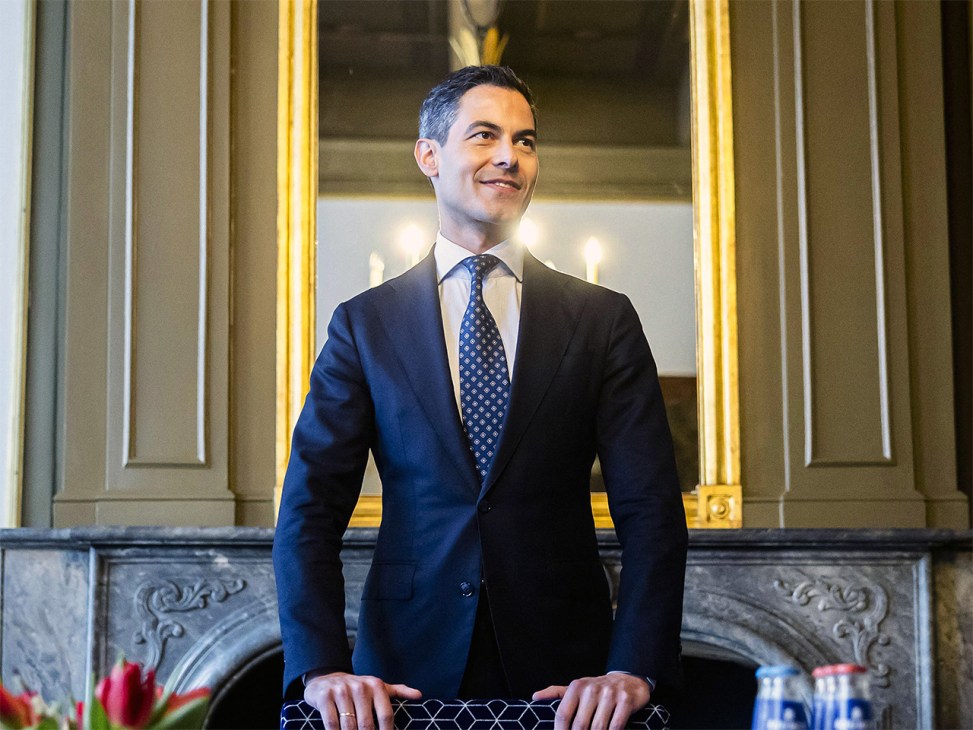
Yet the nagging irony of Jetten’s opening days is this: at a moment when Europe’s leadership constellation looks tarnished, with Merz, Macron and Meloni locked in a triangular dispute over the continent’s direction, the new Dutch premier is reportedly not travelling to Brussels and Paris until next week. For a politician who could plausibly position himself as a fresh pro-European voice, his hesitation reads like a missed opportunity.
At home the parliamentary arithmetic is sobering. The coalition commands just 66 of the 150 seats in the Tweede Kamer, the first minority government since 1939. Every significant piece of legislation will require the cultivation of ad hoc majorities from an opposition that has already signalled its intention to extract its price. This is not necessarily fatal; minority governments in Scandinavia have produced durable policies. But it demands political dexterity and Dutch coalition culture does not always reward boldness. The Netherlands – just like the rest of Europe – needs an injection of optimism and pro-business policy.
The governing challenges are formidable. The country faces a housing crisis of near-structural severity, a shortage so acute that urban planners speak of it in the same breath as climate adaptation: systemic, expensive and generational. The target of 100,000 new homes a year remains politically popular and practically elusive. Defence spending must rise sharply to meet Nato obligations. Infrastructure investment has been deferred for too long. All of this against a fiscal backdrop demanding restraint, despite the Netherlands remaining one of Europe’s more robust economies. Austerity and ambition make uneasy partners.
But Jetten’s broader significance should not be understated. A pro-European, pro-business, pro-Nato and socially liberal party has emerged – narrowly but decisively – as the largest in the Netherlands after a populist implosion. Across Europe this is being read as a recipe for reversal. If his call to Kyiv was about certainty abroad, the real uncertainty lies at home. Governing by minority demands stamina and if Jetten possesses it, then it’s Europe’s gain as well as that of the Dutch.
Stefan de Vries is an Amsterdam-based journalist.