Have you heard of ski ballet? You will – the forgotten sport is due for a comeback
The freestyle discipline of ski ballet originated in the 1960s as an expression of creativity on the slopes, trading the thrills and spills of raing for elegant spins and acrobatic flips.
With its graceful spins, bright costumes and music played against mountain backdrops, ski ballet was once considered the most expressive alpine sport. Born in the 1960s, it rose to fame with demonstrations at the 1988 and 1992 Winter Olympics, only to disappear with a flick of powdery snow. What made it so wonderful to watch and why did it vanish? And could a comeback be on the horizon?
Three freestyle alpine sports – mogul skiing, aerials and ski ballet – emerged in the 1960s. In the first, athletes race down bumpy slopes lined with snow mounds. The second focuses on acrobatics: skiers speed towards a steep ramp, launching themselves into the air and performing flips. In ski ballet, competitors perform jumps and turns to music.
“I saw a clip about the 1986 World Ski Ballet Championship and immediately knew that it was my sport,” says Swedish athlete Annika Johansson. She remembers standing transfixed in front of the TV in her parents’ living room, watching the ballet skiers on the screen. Johansson tried all three freestyle disciplines before choosing ski ballet as her specialism. For the first time, skiing wasn’t about merely racing downhill; moving with the music was what mattered.
Ski ballet can broadly be described as gymnastics on snow. Athletes perform to music for between 90 seconds and two minutes, presenting a series of “elements”. These include flips (with or without added spins), cartwheels, spins, steps and leverage moves. The sport uses shorter skis and longer poles than downhill skiing. The challenge is to make the performance look effortless – no small feat when you have 6kg of equipment on your feet and a pole in each hand. Its sense of freedom made it a unique spectator sport with seemingly endless possibilities.
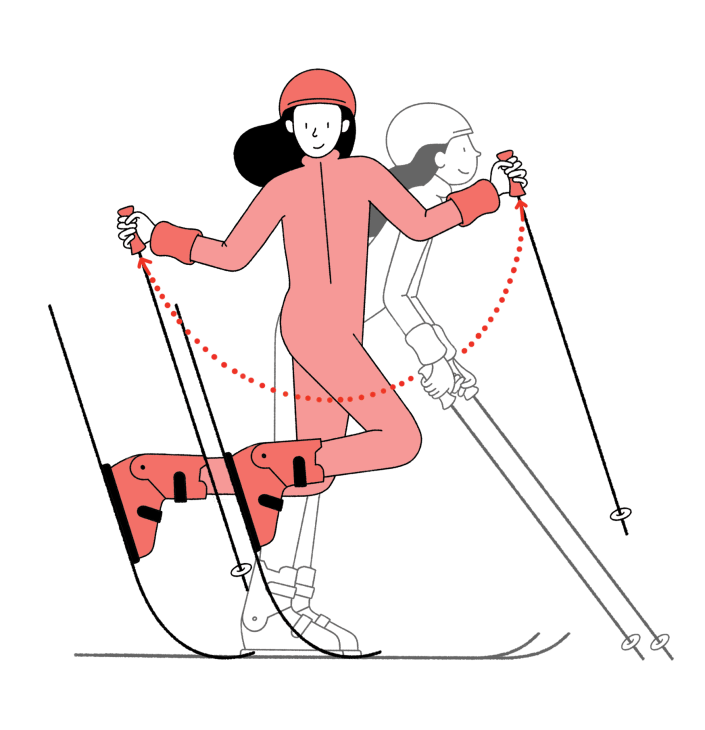
A relatively simple but impressive move that involves using your skis to leverage yourself up on the tips, balancing on your poles.
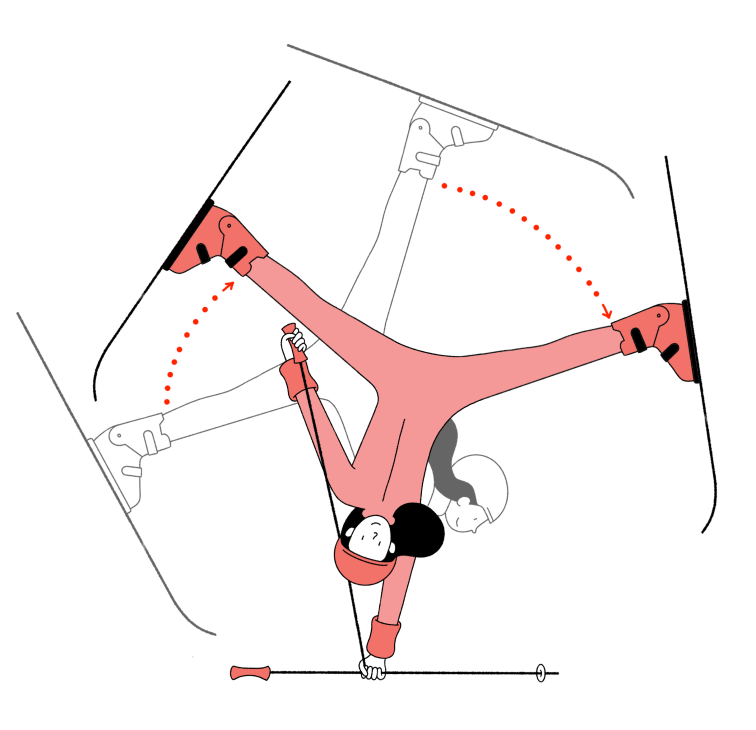
Once you have gained some serious confidence, try tackling this fairly tricky move. Cartwheels are no mean feat on skis.
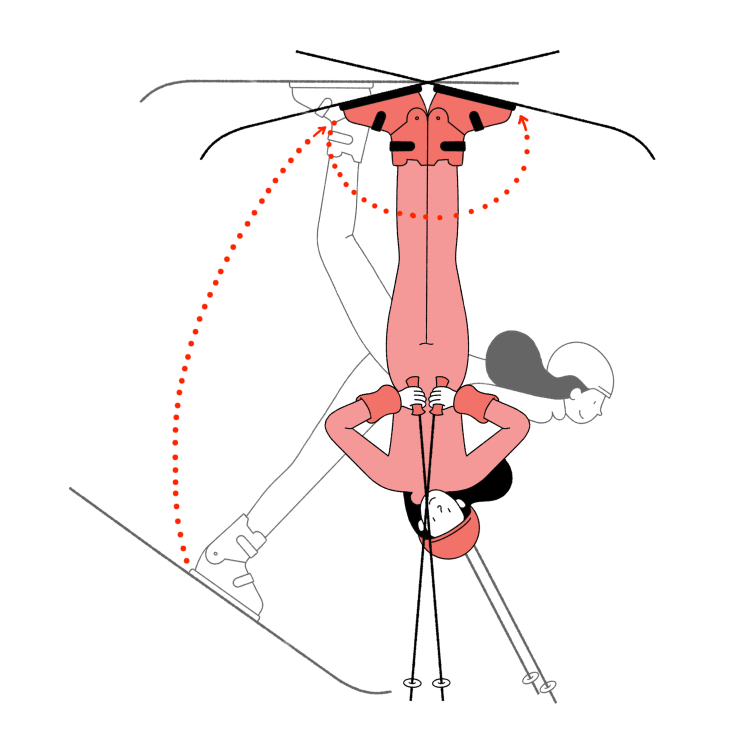
This difficult move involves flipping over your poles and adding a full twist in mid-air. Perhaps leave this one to the professionals.
In the early 1990s, about 200 athletes from across the three freestyle disciplines would travel from one competition to another. Funds would often be limited but they found ways around this. “We were the S-Team,” says Johansson, who joined her national squad in 1991. “Sweden, Switzerland and Spain shared a coach.” There was a strong sense of community and the freestyle family lived, trained and competed side by side. Johansson went on to become one of ski ballet’s most decorated competitors. She was a member of Sweden’s team for almost a decade, collecting six national gold medals and three World Championship bronzes.
Hermann Reitberger, one of the sport’s biggest names, loved the adrenaline that it gave him. He discovered the freestyle scene in his teenage years, when mogul skiing, aerials and ballet were taking shape as new disciplines. Drawn to its artistry, he focused on ballet and went on to help define its expressive style. A multiple World Cup winner and 1989 world champion, he dominated the circuit in the late 1980s and early 1990s. “When I skied to music, I stopped thinking,” he says. “Everything became one – the rhythm, the snow, my body. That was the feeling I always chased.”
But as the sports developed, more rules were introduced to make judging easier and scoring fairer, especially as there was a push for Olympics inclusion. In 1992 mogul skiing gained Olympic status, followed by aerials in 1994. Ski ballet, however, struggled to find its place and faded from the spotlight. “It felt as though the carpet had been pulled out from under us,” says Johansson. Ski ballet was renamed “acroski” in the mid-1990s and stricter scoring rules were implemented to modernise its image. Such efforts, however, couldn’t save it. Without Olympic status, funding disappeared and so came the abrupt end of a sport cherished by a small but loyal group of people.
But ski ballet hasn’t vanished completely. Recently, its combination of freedom and playfulness caught the attention of Thomas Archer Bata and his Verbier-based brand MGG. The company makes sturdy, elegant mountain garments inspired by Alpine design. “Ski ballet is authentic,” says Bata. “It brings back skiing’s purer nature and that’s what drew us to it.” MGG brought together the discipline’s original stars for a series of showcases and gatherings, and made two short films about ski ballet.
Reitberger now mentors Aline Bot, a 26-year-old from Bern. They met after the latter reached out to the sexagenarian skier, hoping to learn from him. Bot’s style of freeskiing is faster and less choreographed than ski ballet; she uses ordinary skis and poles, and performs on natural terrain rather than the flatter stages used in the past. “It’s not about perfect moves,” she says. “It’s about feeling the rhythm of the slope and the music.”
Bot sees herself as practising a more spontaneous form of ski ballet. Alongside Reitberger, she hopes to turn it into a widely recognised discipline. Whether it’s called ski ballet, acroski or something else entirely, a central idea endures – that skiing can be an art as much as a sport. “It’s still there,” says Johansson. “Maybe not as a competition but as a spirit. You can’t erase that.”
Illustration: Clo’e Floirat