Are city kids safer than those in the countryside? The walk to school matters more than you might think
Whether it’s sending your kids on their first walk to school or teaching them to survive the perils of a boiling pot, the independence you give your children helps build a lifetime of resilience.
I often daydream about life in the countryside. I picture my children ambling along lanes flanked with wildflowers, perhaps with a pony in tow, and spending time roaming fields, blackberrying and climbing oak trees. The Cotswolds childhood that Laurie Lee describes in Cider with Rosie leaps to mind as I find myself scanning the property pages, looking for a bucolic alternative to my townhouse. Who knew that perusing detached villas that you’ll never buy in the Inner Hebrides could be such a pleasure?
But this romanticism evaporates whenever I visit the country and attempt to walk anywhere. As a committed pedestrian and keen urban cyclist, I’m plunged into panic when countryside vehicles hurtle towards me on byways without pavements, their drivers taking hairpin bends at speed and missing you by a few inches. During a recent weekend trip to Gloucestershire, I was gripped with fear as my young family walked in single file along a narrow lane to the village shop, while cars sped past at 60km/h.
Town mice are not used to this kind of velocity. With pedestrian-friendly low speed limits in London, my children are far freer to roam. “Bye, love you,” they holler as they leave for school every morning, still holding pieces of buttered toast. They set off on foot and sometimes bike, usually with gaggles of friends. Though our east London neighbourhood is far from serene, I feel that they’re safer here than on any rural lane.
Being a parent of pre-teen children involves having a little faith in community. London might be a city of almost 10 million people but its boroughs are made up of village-like hubs: a market street, a grassy green planted with plane trees, usually one or two Victorian schools. The porters, park rangers and corner-shop owners we know and chat to are part of a social infrastructure keeping an eye on youngsters who have a remarkable amount of freedom. With its traffic-limiting policies and 30 per cent car ownership, our area can sometimes hint at Cider with Rosie’s idyll.
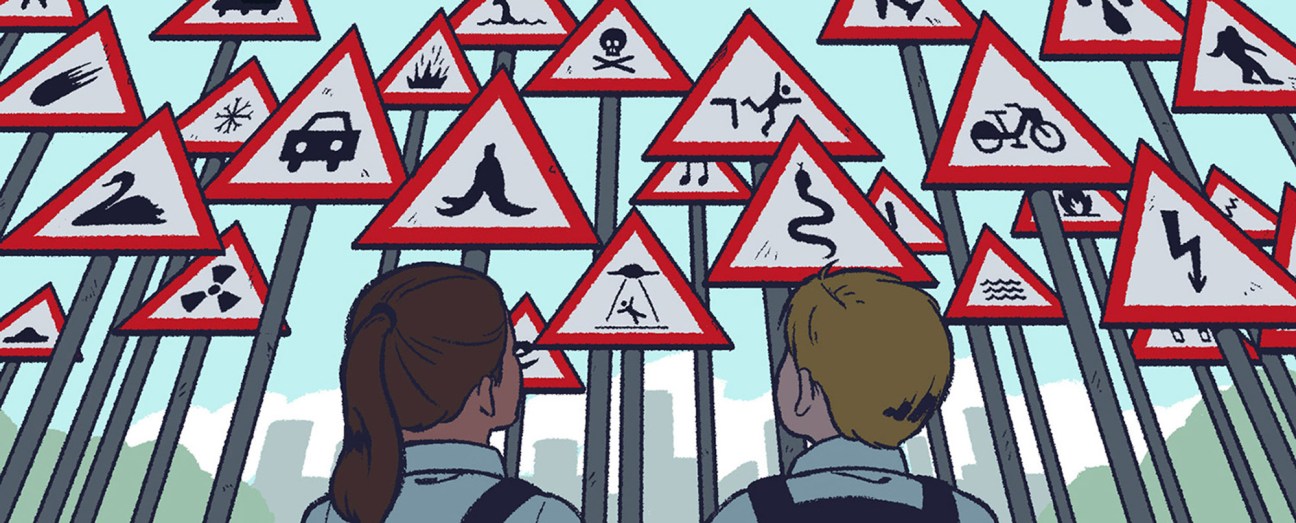
London’s state schools encourage children to walk to school independently. There’s a shared sense that kids have the right to go somewhere without being trailed or tracked and that it’s society’s responsibility to support them as they travel in uniforms with rucksacks laden with water bottles and books. They are ushered through the urban community, with parents of younger children (who they usually know) keeping an eye on them and lollipop ladies marshalling difficult crossings. The biggest challenge is the scores of commuters belting along on Lime bikes with the grace and spatial awareness of runaway trains.
There are fierce debates about whether children should be given devices and access to social media but most kids I know are still smartphone-free. Instead, parents arrange their 10-year-olds’ living-room computer-game sessions on group chats. Some mums and dads hover around their children more than others; meanwhile, it’s striking that boys seem to have freer rein.
Voices always whisper reasons to bring children home, lock the door and batten down the hatches but it often feels that the biggest parenting challenge today is how to quieten those worries. After helicoptering our children through their early years, it can come as a shock to find out that the next step is to set them free and teach them how to live in a big city without your supervision.
I was thinking about risk the other day as I taught my nine-year-old daughter how to make pasta. The process of chopping onions with a new Sabatier knife and then watching her manoeuvre vats of boiling water into our sink tested my ability to resist the urge to zoom in and whisk it all out of her hands. I had to stop myself shouting, “Be careful!” at strategic intervals that would have only served to increase the likelihood of trips and spills.
Of course, I could have done all of these tasks myself. But seeing the pride that my daughter took from navigating the dangers of a large colander reminded me how significant such moments are to her sense of self. It was immediately evident in her face (and even stance) that this was an important part of growing up.
To show that I trust her was also vital. Risk doesn’t come naturally to me when it comes to parenting. I could see her stern determination to contend with the task – an urge to be considered old enough to deal with scalding hazards. This is what’s needed in life and love. You won’t find it sitting in front of the TV.
That’s not to say that I would sling my child a Sabatier to play with – for the record, my position on whittling with Swiss penknives has changed after a couple of trips to the accident and emergency department with my 10-year-old son. Even so, I’m constantly pushing myself to trust them more and curb my instinct to shadow their every move. I realise that I can’t solve their problems and that resilience comes from navigating rocky friendships and sinks full of washing up.
With all of this in mind, the six-minute walk to school takes on a greater meaning. It seems that policymakers are increasingly aware of its importance and are giving more thought to shaping children’s pedestrian experiences in cities and villages alike. At a time when children are playing outside less and less, when mental health in the young is declining, creating safe corridors to green spaces where they can scramble up trees and kick a ball is rightly climbing up the political agenda.
I recently asked my son why he likes walking to school and he said that it makes him feel free, grown-up and happy. (Also “sick”, which isn’t a malady but rather London “tween” parlance for “cool”.) In that moment, I realised that our cities have the potential to create young people who feel safe and confident in their surroundings – to the benefit of all. Child-friendly streets aren’t just about slowing down and restricting cars but rather creating environments that support the freedom of youngsters to exist without their parents. This creates diverse, balanced communities that make us all aim to be better and more open.
Cities have a remarkable chance to get it right. So, despite the litter and the noise, the speeding Lime bikes and the theft (I can go on), I realise that my corner of the Big Smoke is closer to Laurie Lee’s vision of childhood than I thought – and that perhaps I need to stop scrolling for houses on countryside lanes.
About the writer: Sophie Grove is the editor of Konfekt, Monocle’s immaculately turned-out quarterly sister publication. If you haven’t subscribed yet, why not? It’s an education in living well.