As threats rise, the Gulf turns to Ukraine’s war-tested expertise
Zelensky’s Gulf tour suggests a shift from dependency to leverage, as Ukraine markets the defence capabilities that it has learned through war.
Ukrainian president Volodymyr Zelensky’s swing through Saudi Arabia, the UAE and Qatar this past weekend was billed as diplomacy. It was, more importantly, a sales trip and a rather deft one at that. In Jeddah, Abu Dhabi and Doha, Zelensky was not simply asking for sympathy, cash or a few more polite communiques. He was offering something rarer in 2026: a war-tested security product that these wealthy states suddenly need. Saudi Arabia signed a defence-co-operation arrangement with Kyiv; the UAE agreed a security and defence deal; and Qatar went further, signing a 10-year intergovernmental defence partnership that includes coproduction facilities and technological partnerships.
All of this matters because the Gulf is no longer insulated by distance, balance sheets or American hardware. Iranian attacks and the disruption around the Strait of Hormuz have made the region feel more vulnerable than it has in many years, while global oil markets have again been reminded that geography, not confidence, sets the terms. In Abu Dhabi, Zelensky and the UAE’s president, Sheikh Mohamed bin Zayed, discussed Iranian strikes, the Strait of Hormuz blockade and the effects on the oil market. In Doha, Zelensky and the Qatari leadership explicitly framed their talks around protecting life and preventing the regional war from expanding. Zelensky’s wager is that Ukraine can now market itself not just as a front-line democracy worth defending but also as a security donor in its own right. That is a notable shift.
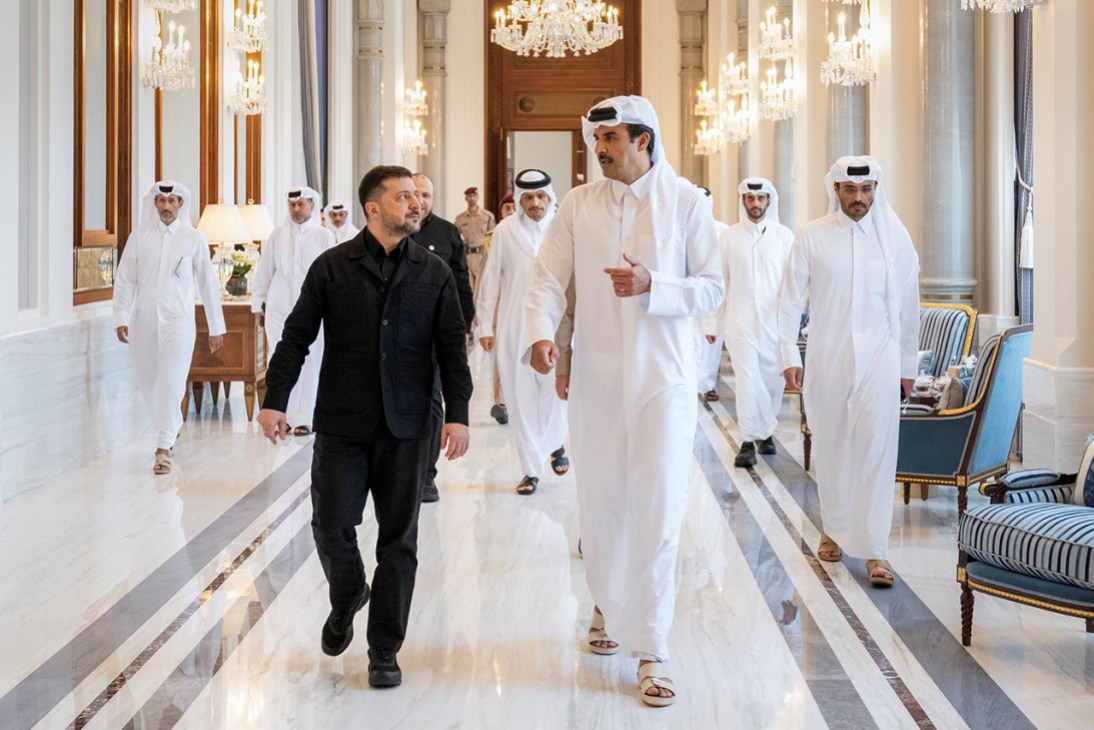
Zelensky’s own formulation is blunt. “As a result of the war we are going through,” he wrote, “and because our enemy is extensively using the Iranian ‘Shahed’ drone technology, we have developed our own system.” He added that Ukraine is now sharing what it has built with countries in the Middle East and that “we have shifted the geopolitical landscape”. That might sound grandiose but it’s broadly true.
The real story is not that Zelensky has discovered what the Gulf can do for Ukraine. It is that the Gulf has discovered Ukraine in a new register. Riyadh, Abu Dhabi and Doha are accustomed to buying finished systems from Washington, Paris and London. Ukraine is pitching something different: battlefield know-how, fast adaptation, cheaper interception and production partnerships. Qatar’s agreement is the clearest sign of where this is heading. Coproduction is not diplomatic theatre – it is industrial policy. It suggests that at least some Gulf capitals have concluded that in an era of drones, missiles and uncertain supply chains, sovereignty depends as much on manufacturing lines and software integration as on flashy procurement announcements.
There is, admittedly, a moral queasiness to all this. Zelensky is effectively arbitraging one war into leverage for another. He is doing so while the Middle East is already under attack and while Ukraine still depends on outside support to survive Russia’s invasion. Yet it would be naive to pretend that there is a better option. The West is distracted, arsenals are stretched and Kyiv needs cash, investment and air-defence depth. If Europe has been slow and the US erratic, then Zelensky is right to look for buyers and benefactors.
Still, charm offensives can curdle into overreach. Ukraine’s greatest asset is its credibility, earned at a terrible cost. If Kyiv begins to sound too pleased with its new role as a merchant of wartime expertise, it risks blurring the line between resilience and commodification. Zelensky should be careful here. The pitch works best when it is sober: Ukraine understands the Shahed threat because it has lived under it and it can help others to prepare.
Even so, the Gulf tour looks like one of Zelensky’s most intelligent diplomatic gambits. He arrived not as a supplicant but as the head of a country that has turned necessity into exportable expertise. And in an age when wars bleed into markets, infrastructure and logistics, this is a practical form of statecraft. Kyiv is still fighting for survival. But in Saudi Arabia, the UAE and Qatar, Zelensky has shown that survival, if managed properly, can itself become a business model.
Inzamam Rashid is Monocle’s Gulf correspondent. Here he considers whether Pakistan can broker the peace that Washington and Tehran cannot.