As AI reshapes the job market, a new trove of apprenticeships is in demand
As the world of work contends with technological disruptions and widening skills gaps, it is crucial to equip young workers with hands-on expertise. Craftspeople in cobbling, boatmaking and plumbing are doing just that.
Apprenticeships are back on the agenda. In June, Josh Shapiro, the governor of Pennsylvania, signed an agreement with Germany’s US ambassador to learn from the country’s approach to bolstering vocational training. Meanwhile, the UK’s new prime minister, Andy Burnham, is said to be seeking similar reforms and the Chinese government has urged young people to pursue blue-collar careers to help overturn a centuries-old stigma against vocational training in favour of academia.
This isn’t an ideological shift. There’s a pressing need to fill labour shortages. The skills gap in the US will leave as many as two million manufacturing jobs unfilled by the early 2030s. Add to this the threat that artificial intelligence represents to the job market and you’re left with a peculiar situation: graduates with no jobs, while manufacturing and trade positions are vacant. There’s also the matter of job satisfaction. There’s a feel-good factor to traditional apprenticeships: in the UK, research has shown that young adults on such training schemes have the highest levels of happiness and life satisfaction in their age bracket.
To find out what’s motivating the next generation, Monocle meets some of the apprentices embarking on these schemes – from trainees in Tokyo’s cobbling district to aspirant plumbers in Zürich – as well as the masters guiding their way. We find that learning on the job offers not just fresh skills but also enormous job satisfaction.
Teppei Yoshimi
Shoemaking
Tokyo


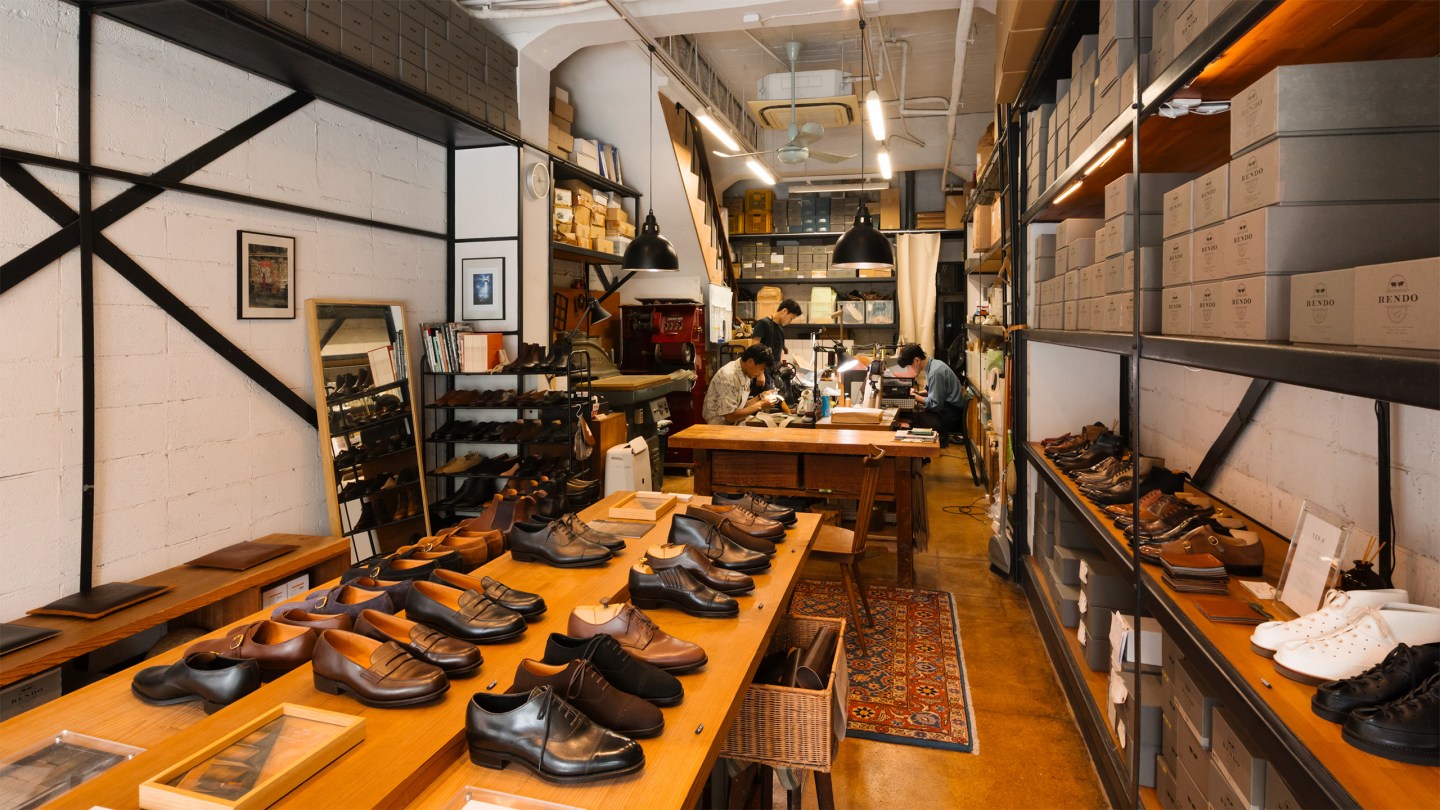
After Kobe-born Kenta Miyamoto graduated from secondary school and completed a course at a local shoemaking school, there was only one place where he wanted to study next: Rendo in Tokyo’s Asakusa district. “I have always enjoyed making things,” says Miyamoto. “It feels natural to create something with your hands.” In school, I learnt about Rendo’s technique. It’s the most renowned leather shoemaker in Tokyo and I wanted to work there.
When Monocle visits the shoe brand’s shop, we find Miyamoto working under the instruction of Rendo’s founder, renowned designer Teppei Yoshimi. The shoemaking master has himself been on a long craftsmanship journey – he began as a pattern maker, before starting to repair leather shoes in his shop and then creating his own Oxfords, loafers, monk straps and Tyrolean suede shoes. Pairing classic British silhouettes with Japanese tailoring methods, he earned an enviable reputation for his skilful patternmaking. It was this that inspired Miyamoto to seek out a position under Yoshimi. “I have learnt a lot from him about pattern design,” says the student. “One day I want to develop my own style too, also learning from Europe’s traditional shoemaking culture.”
Despite Yoshimi’s success and Miyamoto’s enthusiasm, the outlook for Japan’s wider craft sector isn’t particularly rosy. In step with elsewhere in the world, Japan’s shoemaking schools have fallen in number. In 2000, Asakusa, Tokyo’s traditional shoemaking centre, had three schools with 70 students graduating a year. Today just one remains, with fewer than 20 students.
In the world of luxury fashion, however, provenance and skilled craftsmanship remain highly sought after. Japan’s shokunin (artisan) culture is defined by a patient commitment to perfection, making the country’s craft products desirable to high-end brands seeking to differentiate their products from those of their competitors.
This has emboldened Miyamoto to broaden his career aspirations. He is currently putting the finishing touches on his application to train under a European shoemaker. Though that means Yoshimi will lose a helping hand in the workshop, the master is supportive of his young apprentice’s ambitions. “He needs to get out there and learn,” he says.
Reto Stähli
Plumbing
Zürich


“In 2025 we had more apprenticeship applications than we could accommodate,” says Reto Stähli, the co-owner and managing director of Swiss plumbing and heating service provider Stähli Haustechnik. Based just outside Zürich, Stähli’s apprentices learn everything from how to provide maintenance services to how new-build housing projects come together.
Interest in his firm remains consistent. “Last year we had more than 100 applications,” he says. “It was quite remarkable. I advertised on two or three job platforms again and the response was incredible.”
When Monocle meets Stähli, he is training one of his recruits, Hakim Beloukarif, in the intricacies of kitchen piping. Beloukarif is among the 70 per cent of teenage Swiss school leavers to opt for an apprenticeship following compulsory education – something that sets the country apart from other wealthy nations. There are more than 200,000 apprentices in training in Switzerland and about a third of all companies here offer training programmes of this kind.
Every year, Stähli’s team welcomes an average of four new apprentices. “Some professions are disappearing – in large companies such as banks and insurance providers, they have been using AI telephone systems for a long time,” says Stähli. “There are fewer service counters too. People will have to reorient themselves somehow.” Stähli believes that there will long continue to be a healthy appetite among the younger generation for experience at his type of business. “There are many people exploring the prospect of a career in the construction industry. This kind of labour still has a future.”
In countries where apprenticeships aren’t as widespread, employers often fear making financial losses by taking on new starters. Stähli has a pragmatic approach to the issue. “We have to train young people,” he says. “They are our future.”
Tim Phillips
Boatmaking
Sorrento, Australia


A 90-minute drive from Melbourne, boatbuilding business the Wooden Boatshop is an epicentre for apprenticeships. “We are flooded with requests from people who want to work here,” says its director, Tim Phillips. A shipwright who was himself once an apprentice, Phillips set up the company in the Australian seaside resort of Sorrento more than 40 years ago. Since then, trainees have travelled from far and wide to study with him, including those from the US, France and the UK. “We build everything by hand, from the wood for the shell to the sails and upholstery.”
With a rise in digital work, craft-led skills now have an appeal that goes beyond mere job security. At the age of 40, Andrea Rothwell is halfway into her four-year apprenticeship in sailmaking and upholstery. “I wanted a career change,” she says. “I had an e-commerce craft-supply business and a small shop. I grew up around boats and sailing most of my life, so the Wooden Boatshop was on my radar.” Others echo her enthusiasm, including Tim’s son, Will Phillips, who is also part of the business. “It’s a creative outlet,” he says. “You think about complexity and see things progressing – with everyone contributing – and in the end, you have a boat.”
Tim says that the latest technology has a place in his business but not in the workshop itself. “We use AI in the office, because it helps us with admin and daily tasks,” he says. “But it can’t be used for work on the floor.” Tim walks Monocle out onto the latest addition to his facilities: a 13-metre-tall boat storage shed by local architecture practice March Studio. A façade consisting of hundreds of weathered-steel rhombuses tinkles in the wind.
The Wooden Boatshop’s influence extends beyond its buildings. “We are the largest business of our kind in Victoria,” says Tim. A handful of smaller businesses have started up around the state in recent years, some run by his former apprentices or workers. “We trained them,” he adds, with a smile.