How Dubai, New York, Paris and Shenzhen are building their flying-taxi networks
With flying taxis on the cusp of becoming a reality, cities are scrambling to ensure that they can handle the demands of an airborne class.
During a recent flying-taxi demonstration between Manhattan and New York’s John F Kennedy International Airport, I glimpsed the potential future of this heavily hyped mode of transport: an electric aircraft taking of downtown, effortlessly crossing waterways, highways and urban blocks and reaching its destination in about seven minutes. For anyone who has sat in traffic, nervous about missing a flight, it will feel like liberation.
But this isn’t just a New York story. Dubai is preparing to launch air-taxi services too. In Japan, a demo flight offered the striking image of a flying machine sailing across the sky against the backdrop of Mount Fuji. South Korea and China have also held trial flights, with planned routes and early operational frameworks in place. The flying taxi no longer exists exclusively in sci-fi or a technology company’s promotional video. It is becoming a pressing question for cities. Can the sky become a part of civic infrastructure?
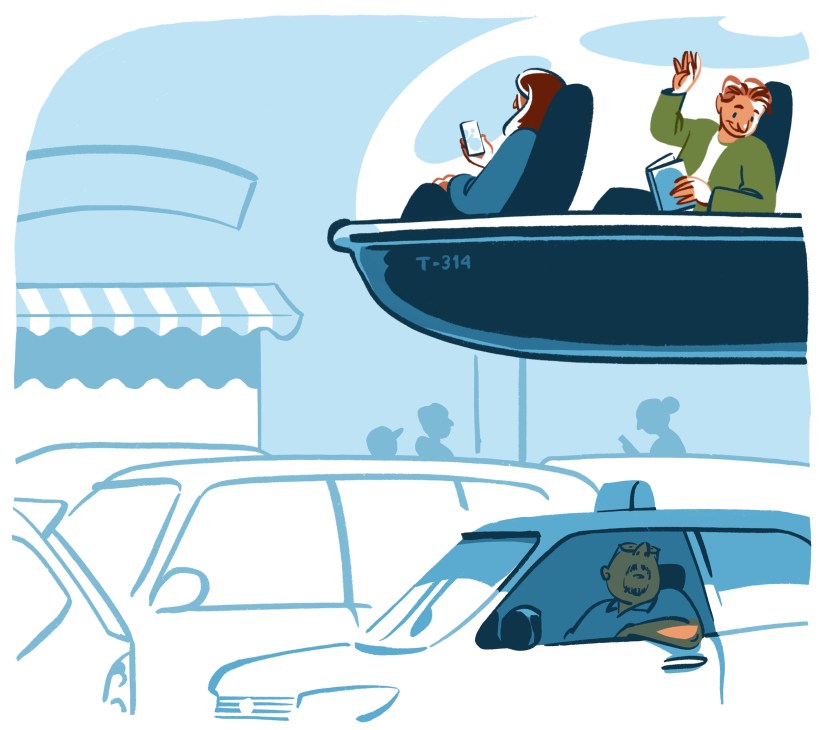
The answer to that question is complicated. If flying taxis only serve a few wealthy people, leaving everyone else on the ground, they’ll become a new form of urban privilege. Those below will continue to sit in traffic, while the rich pass silently over their heads. That’s not an improvement in a city’s overall quality of life. It’s inequality lifted into the sky.
Dubai is expected to be the first to launch an integrated commercial air-taxi network with California-based Joby Aviation, linking the airport, the marina, downtown and leisure districts. It’s a very Dubai move: make the future bookable and close to a hotel lobby. The project’s lesson is that the aircraft is just the most visible part. The harder work takes place below: regulation, creating airport links, dealing with noise, ensuring safety and gaining public trust.
The US is taking a broader, perhaps more useful route. Its Advanced Air Mobility (AAM) pilot programme is spread across multiple states, instead of focusing on a single launch city. New York and New Jersey provide the urban airport-and-heliport nous; Texas offers regional ambition; Florida and North Carolina bring cargo, medical response and local connectivity to the table, while Albuquerque is focusing on autonomous flight.
At Delta Air Lines’ centenary event last year, Joby’s aircraft sat quietly beside decades of commercial aviation history. It was an unusual but telling image: a small electric air taxi placed within the story of one of the US’s oldest carriers. Delta’s investment in Joby and its planned airport connections in cities such as New York and Los Angeles suggest that flying taxis are moving out of start-up renderings and into the infrastructure, passenger-experience and branding strategies of mainstream aviation.
China’s technology-fuelled metropolis Shenzhen offers a different kind of beginning. Ehang’s autonomous passenger aircraft are likely to appear first on short, controlled routes: scenic flights, local demonstrations, tourism loops; journeys that feel more like a cable-car in the sky than a taxi in the clouds. It might sound modest but that’s a useful trait in aviation. Before a city turns the sky into a street, it needs routes that are safe and limited.
Paris offers another useful lesson: patience. Its Olympic air-taxi dream with German aerospace company Volocopter was delayed by certification issues. That failure might be more instructive than another glossy video. After all, cities can announce the future quickly but aviation certifies it slowly.
Together, these examples suggest that the leading cities aren’t simply asking whether taxis can fly. They are asking whether a city can absorb these vehicles: into its airports, roads, regulations and insurance systems, as well as the public imagination. Mobility becomes useful when it stops being exciting. Nobody applauds a lift ride, a ferry crossing or an airport train. They matter because they are reliable and predictable. The flying taxi of the future should be the same: not a spectacle but a quiet function within the city’s transport system. In other words, they’ll truly take off when they come back down to earth.
About the writer:
Eding Yi is a Hong Kong-based aviation law scholar, legal adviser, pilot instructor and advanced air mobility researcher. His work connects aviation, law, finance and urban systems, exploring how cities and airspace are set to evolve.