‘The Winter Warriors’ by Olivier Norek tells the unknown stories of Finnish soldiers and their quiet heroism
The French author travelled to Finland’s icy forests to get closer to his subject – sniper Simo Häyhä and the Finnish soldiers whose bravery helped to change the course of the Second World War.
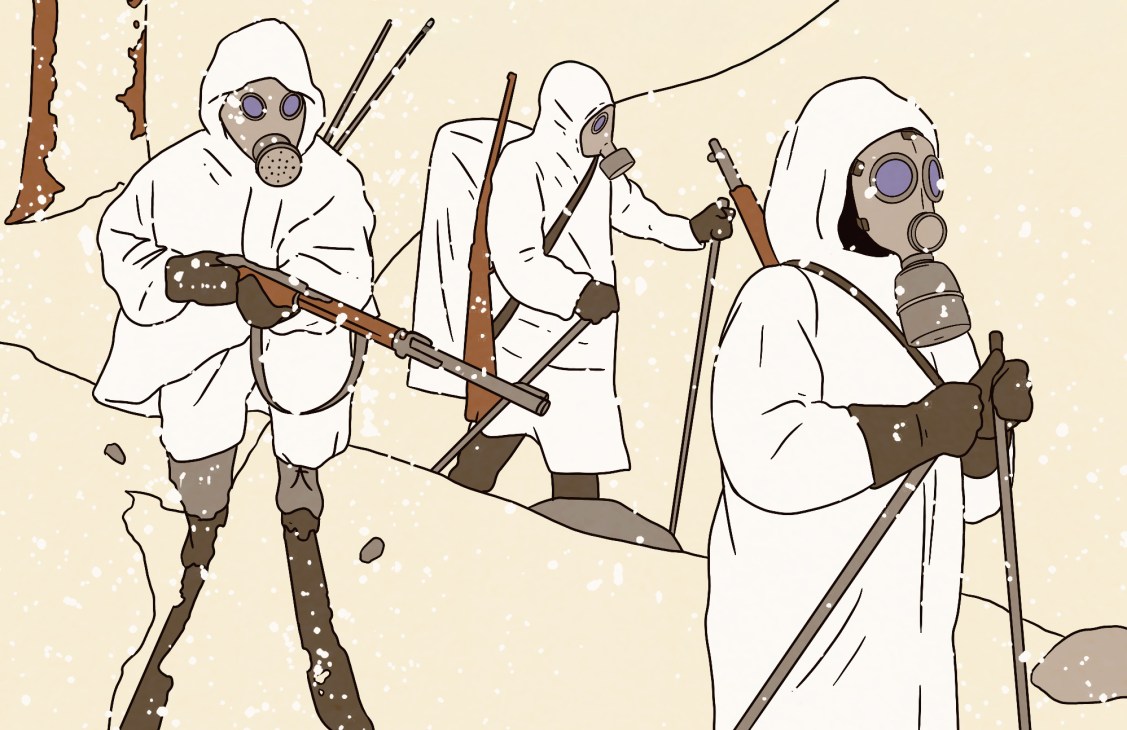
The Winter Warriors, French writer Olivier Norek’s first historical novel, tells the story of ordinary Finns who fought during the 1939 Soviet invasion of their country, taking up positions across icy plains and forests. Despite the harsh conditions, they managed to repel the enemy’s winter advance, relying on white camouflage outfits, ingenuity and the skills of a brilliant sniper, Simo Häyhä. Norek spoke to Monocle about the deep research that the book required and why this front of the war – little known internationally – was so historically important.
To write ‘The Winter Warriors’, you travelled to Finland to experience living there during the winter months. What did you learn?
It helped me to understand that the Finnish soldiers were in an impossible situation. When the temperature drops to minus 40C, you become paralysed. The cold doesn’t just make you shake – it attacks you. You can’t protect yourself, you can’t think. And yet the Finns were able to come up with strategies and stay in the snow to fight for hours without moving.
I was a field cop and like to think of myself as a field author today, so I wanted to know how the Finnish snipers were able to stay in the snow for so long. One thing that I had to do was get drunk on the same alcohol that the soldiers did – it helped to keep them warm in the snow. I also got hold of the same gun that they used and went into the forest to practise shooting with it. I knew that to write about it I had to know the bang of the gun going off, how it recoils and the smell of the powder.
What first inspired you to write about this war?
Not so long ago I was in the south of France and heard Vladimir Putin’s voice on the radio. He was kindly reminding us that he had nuclear weapons and that he wouldn’t hesitate to use them if we supported Ukraine. It scared me but I knew that fear was fed by ignorance, so I wanted to find out more about Russia’s relations with the rest of the world in the last century. That’s when I learned about this forgotten war that took place over 105 days in minus 51C weather. I also discovered the name of Simo Häyhä, who was apparently the best sniper of all time. I knew that I had the ingredients for an incredible story.
Why does what the Finns achieved in 1939 matter to the rest of the world?
It happened in 1939, at the very beginning of the Second World War. At the time, Joseph Stalin and Adolf Hitler knew that one day they would have to fight one another but they didn’t know when. So when Russia tried to invade Finland, it was like a preview for Hitler of any future confrontation with Stalin. He was able to see what conflict with Russia would be like. They had everything that they needed to win, from arms and tanks to soldiers – yet they didn’t succeed. So when Hitler saw that, he thought that Russia was a weak giant. It was after this that he decided to send four million Nazi soldiers into the Soviet Union to start Operation Barbarossa, precipitating the beginning of the Third Reich’s fall.
That’s why I think we have to thank those Finnish soldiers because without them, our borders and maybe even our language and culture wouldn’t be the same as it is today. I felt ashamed that we had erased a story that had potentially changed the course of history. It was one of the reasons why I wanted to tell the story exactly how it happened. I invented nothing.
Tell us about the reaction to the book in Finland.
When I visited the country after the book’s publication, I was received by the Ministry of Foreign Affairs. We organised some signings in bookshops and they were completely full; we had to find chairs from other shops because there weren’t enough. On the third day of the visit, we heard the Finnish president say that there was a book written by a French author that everyone must read. That was incredible.
Finnish people are humble and secretive. I think that they weren’t able to write a book about how they had been heroes during that war. They needed someone from the outside, someone foreign, to say that. So this isn’t my story, it isn’t my culture or my heritage and these soldiers aren’t my brothers in arms. I’m just the messenger. I want to ensure that this story will never be forgotten.
There is humour in the book too.
I worked with the military in former Yugoslavia during the war in the 1990s and was later a policeman in Paris’s Seine-Saint-Denis, an area with one of France’s highest crime rates. If you want to survive mentally – if you want to have a family life and exist with all of this horror and violence – you have to have a wonderful sense of humour. In fact, humour, love and friendship are stronger when there is death all around you because you realise that you don’t have much time. You think that today might be the last day, this laugh the last laugh or this kiss the last kiss. You need to be with people.
Do you see echoes of today’s geopolitical situation in the story of the war?
Yes. It’s a historical book but also about men and women – about courage, resistance and fighting for what’s right. This is very important: when Russian soldiers are serving in Ukraine, they are fighting because they have received orders to do so. But like the Finns in the Second World War, the Ukrainians today are fighting for their houses, their land, their nations and the ones they love. That is a just cause. When you have that on your side, you are almost indestructible.
There are many differences between the Finnish and Ukrainian war efforts. When Finland was attacked in 1939, they were totally alone. Today, Ukraine has the support of Europe. But there are parallels because it isn’t just the fight of an army of soldiers – it is a war that involves everyone in the country. Men and women, soldiers and farmers: the entire nation is part of the war effort.
Tell us about the star of your book, Simo Häyhä.
For Finnish people, Häyhä is on the level of Napoleon Bonaparte or Joan of Arc – very, very famous. So everybody has a story to tell about him. I worked with soldiers, veterans and snipers and found his diary. I spent two and a half years with my feet in the snow, trying to get as close to his character as possible. He wasn’t just a legend – Häyhä was a myth. There was something supernatural about the way that he could stay still in such cold weather, just waiting for the Russian snipers to move and reveal their positions. And he could make shots at about 500 metres. Nowadays, the best snipers can’t explain the shots that he made because they seem impossible. But there are witnesses to prove that he did perform these feats. I think that it was because he wasn’t shooting with his eyes so much as with his heart, his courage and his rage.
When Häyhä was about 80 years old, a German journalist asked him whether he was a hero. And Häyhä replied that he just did what he had to do, like the rest of the Finnish soldiers around him. Like every Finn, he was very modest. I liked him because he wasn’t a murderer or assassin. He was just a man who defended his country.
This interview was first broadcast on Monocle Radio’s ‘Meet the Writers’, hosted by Georgina Godwin. Head to Monocle Radio for more.
About the interviewee
Award-winning crime novelist Norek started his career as an aid worker in Yugoslavia and Guyana, followed by a stint as a policeman in Paris. He is the co-creator of French TV series Les Invisibles.