The funny business of comic timing
The secret to a great joke is…wait for it…
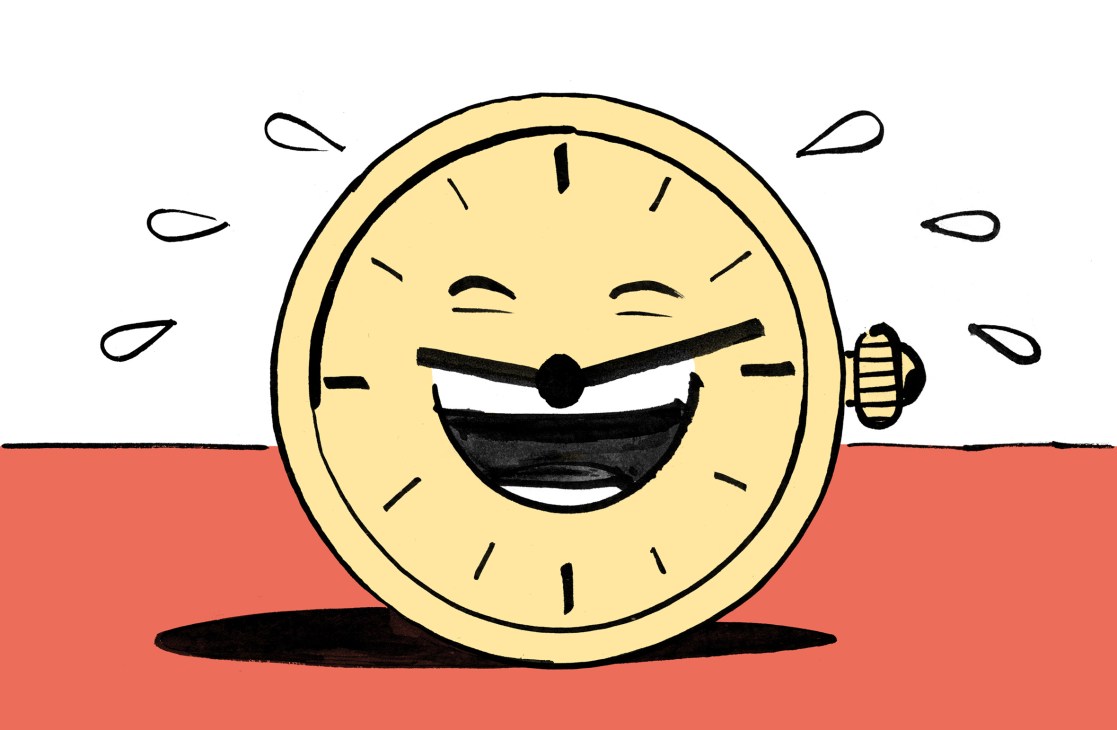
If comedy were physics, timing would be gravity: the invisible force holding everything together and stopping jokes from floating off into deep, awkward, silent space. Deliver a punchline too quickly and a joke finishes prematurely. If it comes too late, your audience has already mentally vacated the space. But if you get it just right, there’s a kind of comedic resonance, like hitting the exact frequency that shatters a window, or in this case a person’s composure.
Take, for example, my wife. No, please, take my wife. Or the classic joke: a lion walks into a bar. He orders a drink… and a packet of crisps. The bartender looks at him and says, “Why the big pause?” Now, the joke itself is, to put it generously, mildly amusing. But any success it might stake a claim to hinges entirely on the big pause. Without it, you’ve got a potential mauling situation, or simply an old drunk lion on the floor.
Or there’s that bawdy wartime ballad (sung to the tune of Eine Kleine Nachtmusik):
A sol… a sol… a soldier I will be,
Two pis… two pis… two pistols on my knee,
For cur… for cur… for curiosity,
Oh, fight for the old count, fight for the old count, fight for the old country.
On the page it loses a smidgen of its humour but say it out loud and note the effect of those pauses. For the first-time listener, the truncated words sound rude. Do you get it now? Let me spell it out phonetically:
AAS-hohl… AAS-hohl… AAS-hohl-juh eye wil bee,
Too pis… Too pis… Too pist-uhlz on my nee,
Fak joor… fak joor… fak-yoor-ee-OSS-ih-tee,
O, fite fuh duh old kuhnt, fite fuh duh old kuhnt, fite fuh duh old kuhnt-ree.
If not mildly amusing, then at least slightly bawdy, I think you’ll agree. Of course, developing comic timing is like studying physics in that it involves trial and error – with the scales tipping ever so slightly towards error, like a big fat drunk lion on a seesaw opposite… Sir Isaac Newton. You tell a joke, no one laughs. You realise you rushed it. You run home, you brush your head, you scratch your teeth. You stare into the abyss, the abyss stares back into you. You go and sit under a tree. An apple falls on your head. Your head falls on an apple. The tree pretends not to notice. The apple crumbles. The lion admits his powerlessness, acknowledges that his addiction has become unmanageable and recognises the need for help. And there you have it, Newton’s law of universal gravitation. Which as I said, isn’t dissimilar from comic timing.
About the writer
Self serves as Monocle’s foreign editor. He is mildly amusing.