Joachim Trier, the director of Oscar-winning ‘Sentimental Value’, on taking art seriously and the wounded child inside every difficult parent
From the influence of his cinematic roots to the current spotlight on Nordic film, director Joachim Trier reflects on the importance of personal narrative.
Joachim Trier’s Norwegian drama Sentimental Value is a poignant exploration of family, fame and the complexities that often come with both. Featuring an ensemble cast including Renate Reinsve, Inga Ibsdotter Lilleaas, Stellan Skarsgård and Elle Fanning, the film follows two sisters who reunite with their estranged father as he attempts to restart an ailing directorial career. On Sunday, the title, which was nominated for nine Academy Awards, picked up the gong for Best International Feature.
The director has become well-known on the international cinema circuit, drawing acclaim for the Scandinavian film scene. His 2021 feature, The Worst Person in the World, was nominated for several major awards including the Palme d’Or at Cannes Film Festival and Best Original Screenplay at the Academy Awards. For Sentimental Value, Trier worked with his longtime writing partner, Eskil Vogt, to create a story that meditates on the intricacies of family and the passing of time.
Trier joined Monocle senior correspondent Fernando Augusto Pacheco to discuss how his personal life informed the film’s narrative, getting the casting right and how cinema can bring people together in trying times.
This conversation has been edited for clarity and length.

As a father of two girls and coming from a film-industry family, is it fair to say that ‘Sentimental Value’ feels personal to you?
I’m the kind of director who sits down and tries to create a story about where I am in life. Every time I make a film, I start from scratch with Eskil Vogt, my co-writer. This time we realised that we were at a moment in our lives in which we both have children – Eskil and I have two children each – our parents are still around [and] we’re sensing how fast time flies. As you mentioned, my grandfather was a filmmaker. My parents worked with films. I grew up on film sets. That’s my life and I’m very grateful for being allowed to make them. But we didn’t start out thinking that we would make a film about film people.
The scene where the sisters [Nora and Agnes] embrace towards the end of the film – it’s so pure and beautiful.
Thank you. Another thing that motivated this [project] was that I had a great collaboration with [the actor] Renate Reinsve in The Worst Person in the World and I really wanted to work with her again. She has an amazing capacity for levity and humor but also deep dramatic work. As I had gotten to know her even better, I felt that there was something to explore in the character of Nora – a workaholic actor who is very successful but somehow finds it hard to create a sense of home or connectedness. Then we had to find a sister to match her and also match [Renate] as a performer. We found a wonderful actor in Inga Ibsdotter Lilleaas.
In the film we see the National Theater where Nora, the older sister, works, which is the place of imagination. It’s like the left part of the brain. [Her sister] Agnes goes to the National Archive [of Norway] where all [our society’s] facts are stored and researches family history. That’s kind of like the right brain. Between these sisters and between these places of societal understanding of who we are in terms of narrative, there’s a space for family in the movie.

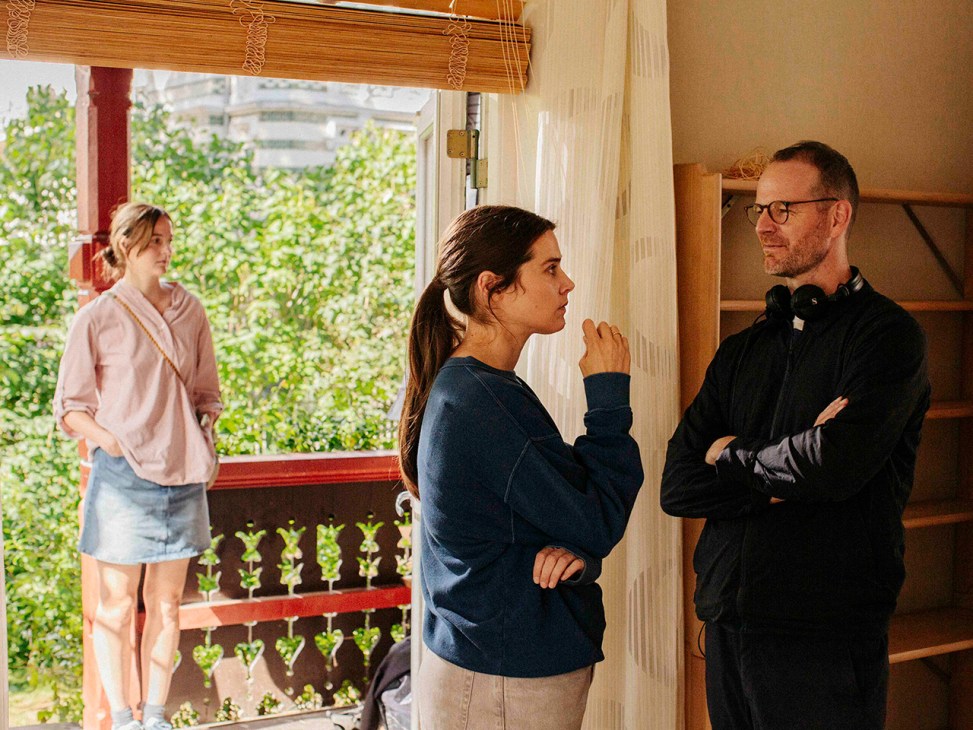

You could have made the father, Gustav, played by Stellan Skarsgård, an unlikable character, but there’s some tenderness for him in the film.
He’s not perfect at all but there is tenderness, right? The father – this director, Gustav Borg – hasn’t made a film in 15 years but still thinks that he’s the king of the world. We cast Stellan Skarsgård because he’s such a warm, sympathetic man. We hopefully created a more three-dimensional character with nuance. It’s a story about reconciliation. It’s about understanding that inside every difficult parent there is also perhaps a wounded child, and to grapple with that. What is reconciliation in the family? I didn’t want to make a film with cheap solutions where, [the characters] talk about it and it’s all fine. That’s not how life works.
Tell us more about the Norwegian film scene. It’s experiencing a boom at the moment.
I care more about the cinema world as a whole, and I work with collaborators from around the world. But I will say this: the wonderful thing about the Nordic-film boom is seeing that personal cinema is being allowed to be made financially. This could encourage other governments to really support the arts.
At this moment, we need to take art seriously. We need, in complicated times in society and in the world, to have reflections of stories on a deeper level. [To] try to communicate, create empathy, meet in cinemas, meet in theaters, meet in books and understand on a deeper level that we are more alike than different. Art can be a place for reconciliation.
It seems as though people are craving more personal stories in the cinema. Maybe they are getting tired of all the remakes and rehashed stories.
We’ve been through a big wave of superhero features and certain formulas, and people want development and forward momentum. They want change. They want to see something new.
Listen to the full conversation on ‘The Monocle Weekly’.