
Smart curation keeps the outlook sunny at this year’s Frieze London and Masters art fairs
The opening of Frieze London is casting the world’s art market in a positive light – and catching the eye of eager buyers.
The bright blue sky of a perfect autumn day hung over the white tents at Frieze this week. On Wednesday, the opening of the UK’s most important art fair was so packed with invite-onlys that it made you wonder where so many very important people had been hiding for the rest of the year. The art market, we are told time and again, is not what it once was – but is there hope for it to be found in Regent’s Park? Or just the opportunity for some excellent people watching?
At one end of Regent’s Park, Frieze Masters – the section of the fair dedicated to works created before 2000 – tells a fascinating story of craft and creation. There are some wonderful things to see: meteorite fragments, dinosaur skulls and historic weaponry among them. “You could say that we’re telling the story of our universe – not just of mankind and of human creativity,” Emanuela Tarizzo, the director of Frieze Masters, tells Monocle. “We see more people collecting art alongside natural history and it reflects a way of collecting that was already in existence at least 500 years ago – the so-called Kunstkammer [cabinet of curiosities]. It’s fun to see it come back today with different generations.”
What makes Frieze Masters such a unique proposal – and what has been masterfully realised this year – is the savvy curatorial approach that underpins it. At the booth of rare books dealer Daniel Crouch is a set of 10,000 satirical prints from the collection of the late British restaurateur Andrew Edmunds. The single lot is esoteric, yes, but extraordinary and shown alongside a 17th-century French printing press. It’s a steal at £45,000 (€53,000). Elsewhere, a 17th-century still life by Jan Brueghel the Elder (which led early sales at about £5m, or €5.9m) hangs alongside an artwork by star British artist Flora Yukhnovich, creating the chance to see both in a new light.
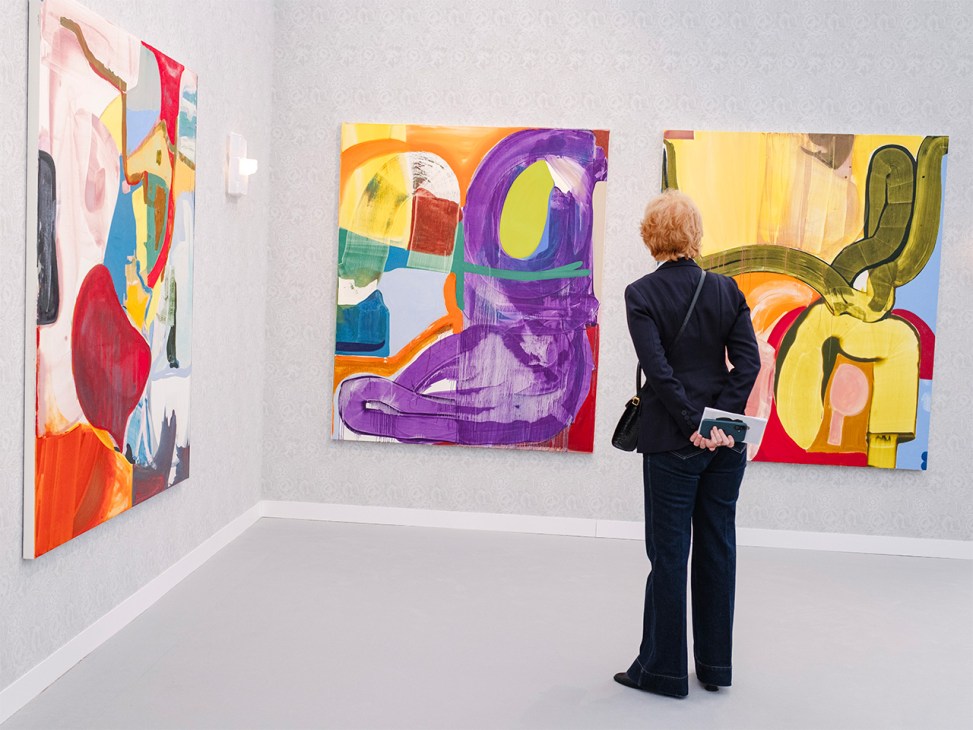
Across the park at Frieze London, which is focused on contemporary work made after 2000, many of the booths belong to familiar names. For those debuting, the fair has been a North Star. “Frieze London has been my favourite fair internationally for as long as I’ve been in this industry,” says Jennifer Carvalho of New York-based Carvalho gallery, which joins the fair for the first time this year. Carvalho is presenting new works by Corinna Gosmaro, Guillaume Linard Osorio and Rachel Mica Weiss, with sculptures, paintings and installations that make use of unusual materials – marble, thread and polycarbonate among them. Carvalho seems content with her sales so far, including of two works by Mica Weiss (who has a waitlist in the US), which sold in the fair’s first hour for £22,000 (€26,000) each. “I wasn’t necessarily expecting that,” says Carvalho. “I have always found the US market to be the most resilient but I see now that the strongest works will find their collectors wherever they are.”
Carvalho’s peppy sentiment is echoed by the energy across Frieze this year – and in the healthy sales sheets. Highlights include the sale of three paintings by Alice Neel for a combined $5m (€4.5m), a new painting by Michaël Borremans for $1.5m (€1.3m) and a second-century mottled red sandstone sculpture going for just over $1m (€890,000).
It seems that great works, as Carvalho contends, will find their buyers and, at both Frieze London and Frieze Masters, galleries have brought their best. In turn, collectors are putting their hands in their pockets – whether for a bronze William Turnbull sculpture or a prehistoric sabre-cat skull. Those blue skies might have been something of a portent and Frieze is painting London in a good light.