

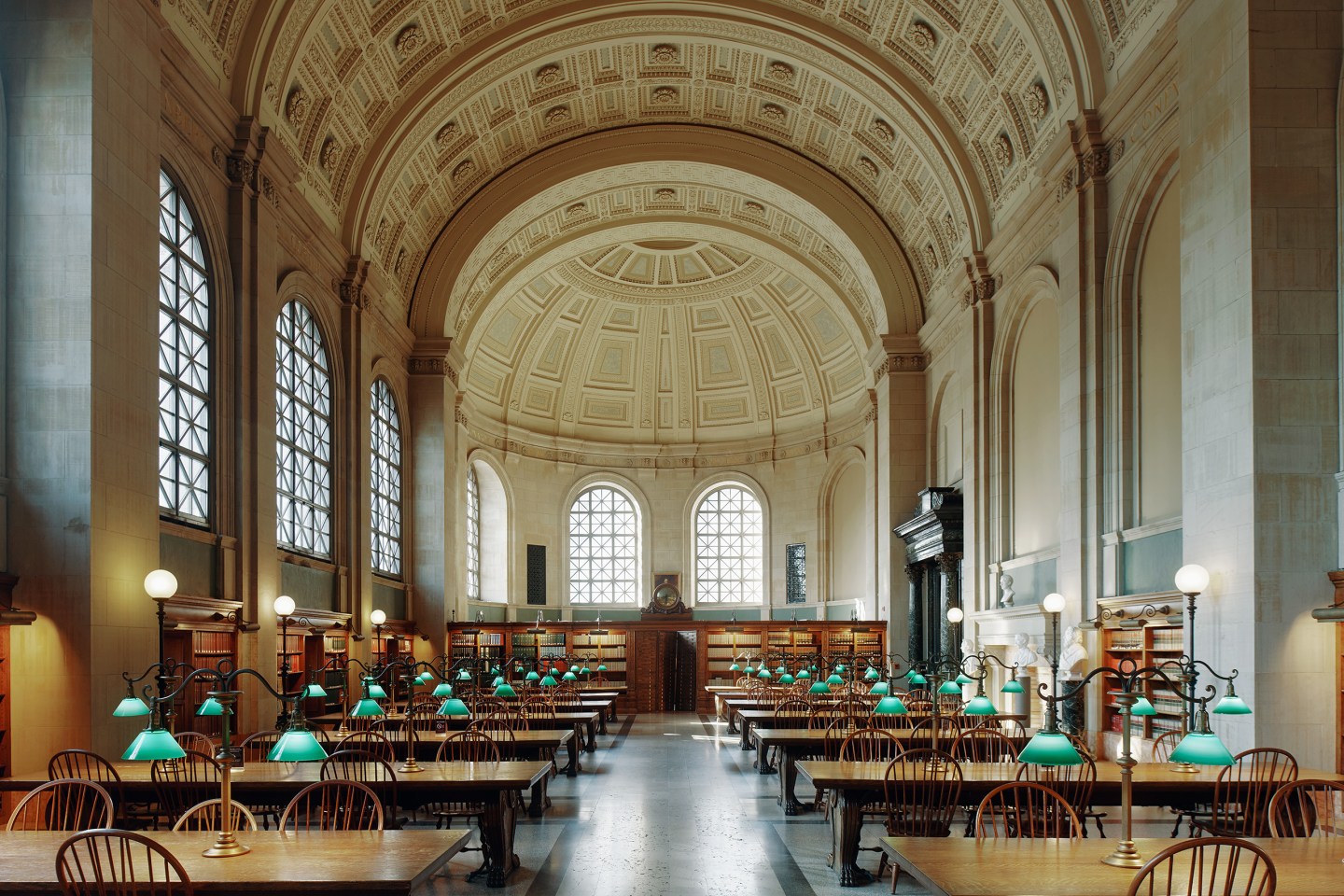
Step inside the Boston Central Library, a beaux arts monument to democracy
Founded in 1848, the Boston Central Library’s McKim Building is a celebration of civic pride and access to knowledge.
There’s a stately, almost courtly grandeur to the Boston Central Library’s McKim Building. It’s magisterial but not imposing; ornate but not baroque. Even on a cool, rainy morning, people filter through its bronze doors and crane their necks to read the names carved into its granite façade: Confucius, Mohammed, Socrates, Pushkin, Edison and Bell, alongside dozens more philosophers, artists, scientists and composers whose works are among the peaks of human achievement. A motto is inscribed above the entrance: “Free to all.”
The building, which opened in 1895, was commissioned at a time of cultural optimism, amid a drive for social reform in the Anglophone world. As disinformation and AI slop pollute the public discourse, the story of this institution and its original ambition to provide free access to accurate information, space for forums and room to learn feel particularly relevant today.
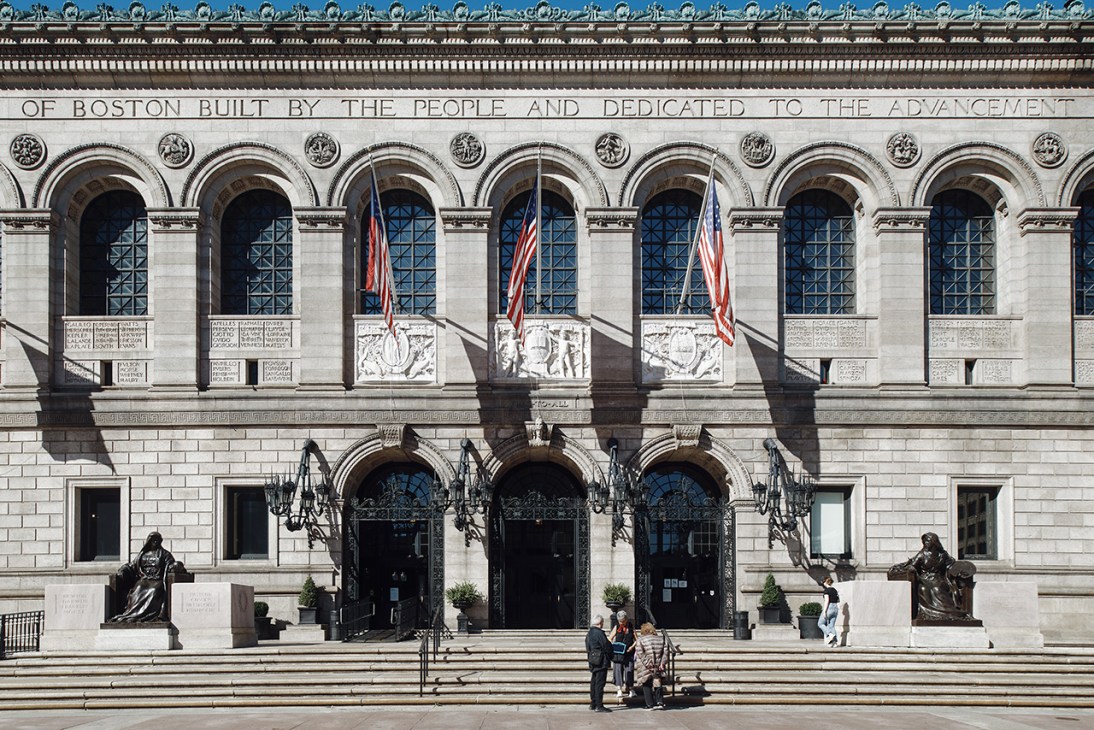
Founded in 1848, the Boston Central Library was the first city-run, free public institution of its kind in the US. It was a hit with the city’s residents; when the library eventually outgrew its first premises, the state legislature allocated funds to erect a new building. After a few false starts, New York architecture firm McKim, Mead & White was handed the commission. Its namesake founders were the leading architects of the American Renaissance movement, which was characterised by lofty ideals and a fondness for classical and Renaissance aesthetics. The building took its name from the project’s primary architect, Charles Follen McKim.
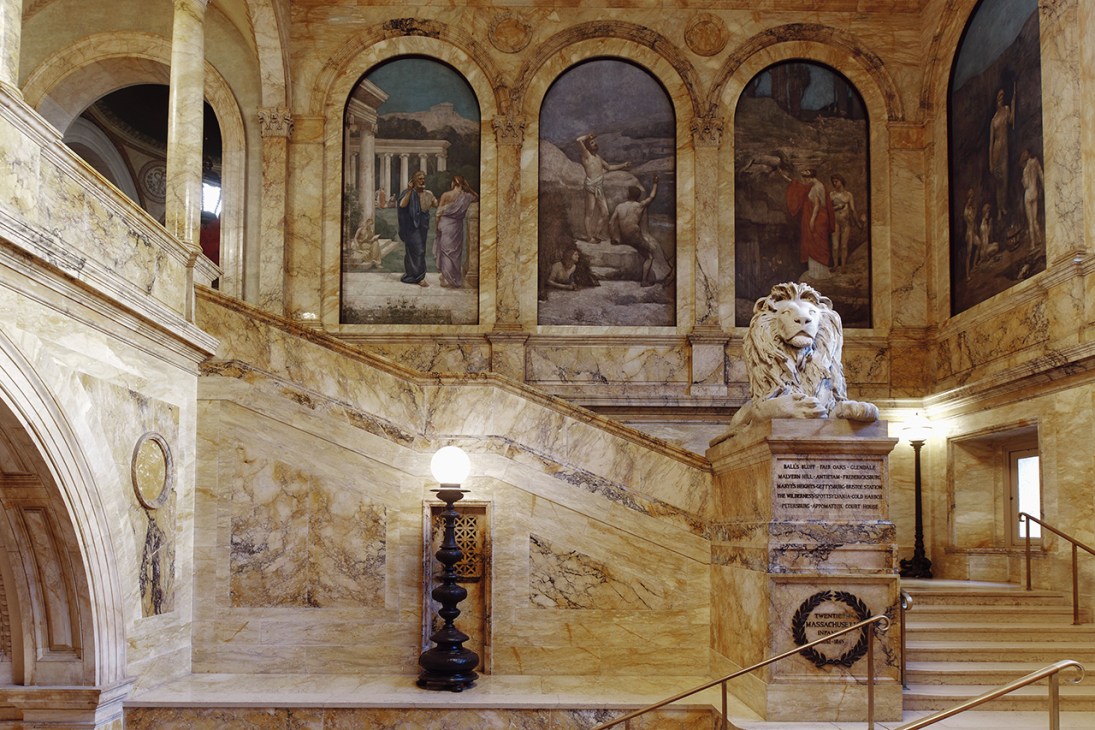
“This is McKim’s brainchild,” says visitor experience co-ordinator Katherine Mitchell. “He worked closely with the library’s trustees but had a real vision.” McKim’s influences were broad. For the building’s façade, he took inspiration from the arched windows and neoclassical restraint of Paris’s Sainte-Geneviève Library, built in 1850. Inside, his beaux arts education rears its head with two marble lions on the grand staircase, whose walls are made from yellow Siena marble.
“Based on his correspondence, he was probably a micromanager,” adds Mitchell. “He handpicked every block of marble.” Such attention to detail was essential to deliver architecture that would inspire. For the staircase, McKim split marble blocks in two and arranged them to form mirror-image panels, placing darker pieces at the bottom and lighter pieces at the top. Ascend the stairs and the room appears to brighten with every step until, at the top, eight murals by Pierre Puvis de Chavannes – depicting personifications of different expressions of human knowledge, such as astronomy, philosophy and epic poetry – burst into view.
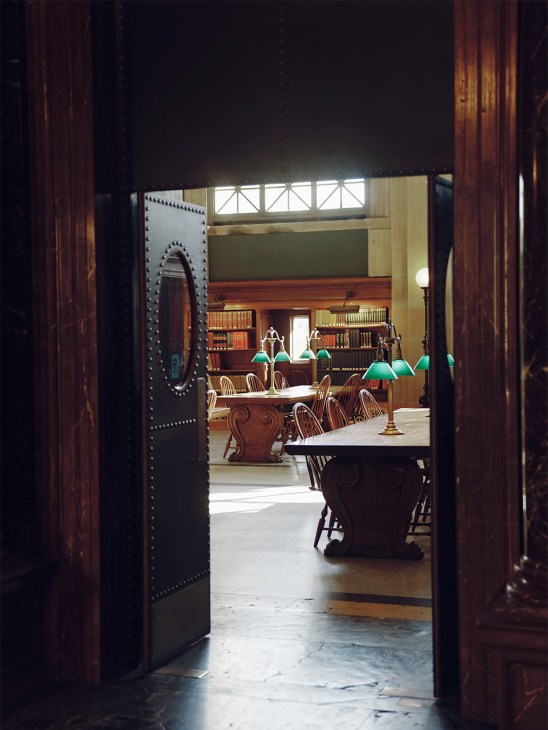
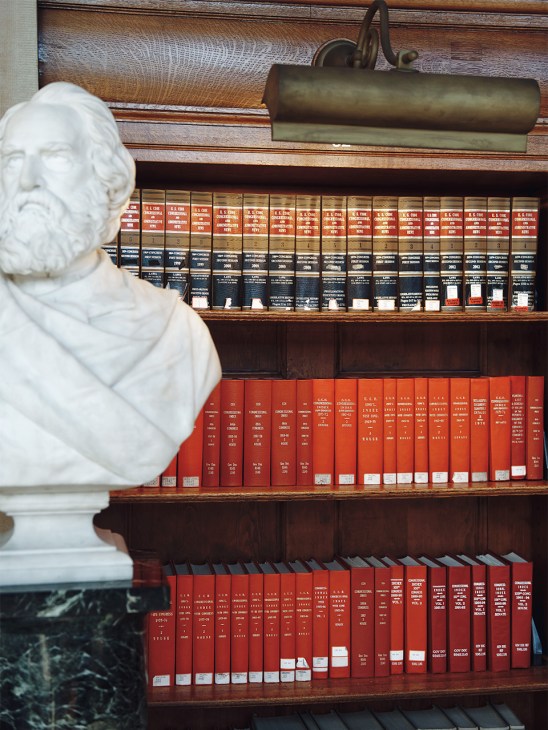
Every section of the library is a world unto itself. There’s the sun-filled reading room, Bates Hall, with its enormous barrel-vault ceiling; the Abbey Room, in which McKim installed a 15-panel mural depicting Galahad’s quest for the Holy Grail, so that visitors would have something to look at while waiting for book deliveries; and the courtyard garden, which was inspired by Italian Renaissance palazzos – a cloistered oasis with neat hedges, a gurgling fountain and arcaded colonnades.
The library’s top floor is home to unfinished murals by John Singer Sargent – the largest-scale works that he ever painted. He spent more than 30 years on the project but was unable to complete it before his death, leaving a blank panel in the centre of the room. The series, Triumph of Religion, depicts scenes from Judaism, Christianity and ancient Egyptian and Assyrian polytheistic traditions. The work is mesmerising, tonally intense and almost frightening – a stark contrast to the murals that adorn the lower rooms and halls, with High Renaissance colouring and mythic themes.
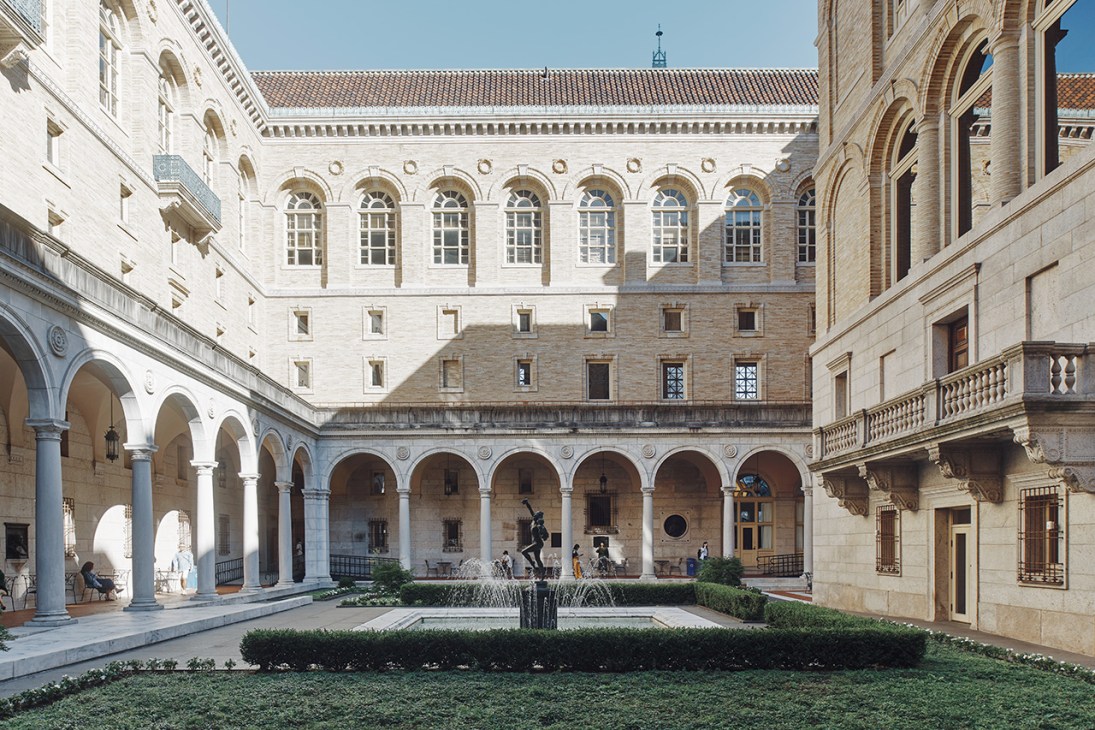
Today the McKim Building is a hybrid institution. It’s a library but also something of a museum. There’s a café inside and chairs and tables in the courtyard where visitors work, read, chat and play – or simply relax beneath shaded porticoes. Most of the library’s day-to-day services and newer, more technologically advanced amenities are next door in a modernist structure on Boylston Street, designed by Philip Johnson in 1972. But the McKim Building offers something different. It’s a long-standing reminder of the essential role that libraries play. Some 130 years after it opened, it remains a monument to the ideals that inspired its construction: civic pride, humanism and democratic access to knowledge and art. And it’s still free to all.
bpl.org
This article is from Monocle’s March issue, The Monocle 100, which features our editors’ favourite 100 figures, destinations, objects and ideas.
Read the rest of the issue here.