Press play: How the indie publisher behind ‘Heartbeat’ is remixing the music magazine
The team behind ‘Broccoli’ and ‘Catnip’ magazines set their focus on music and sound, creating ‘Heartbeat’ as a publication for the world’s overlooked sonic stories.
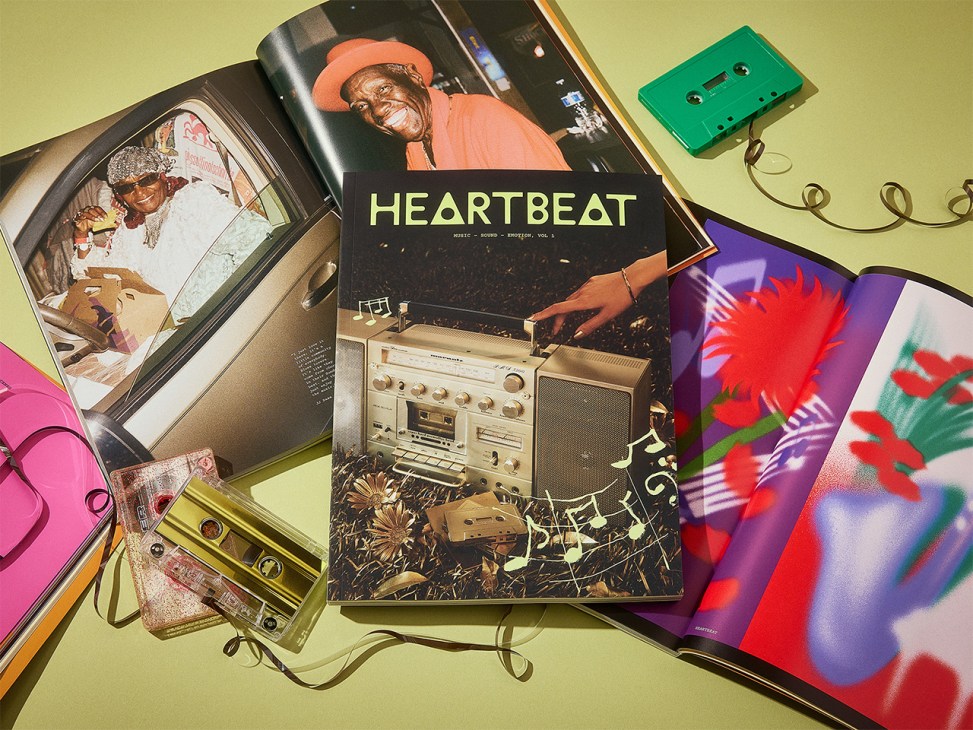
Heartbeat isn’t your typical music magazine. Open its pages and you’ll be invited into the homes of prolific record collectors in São Paulo, taken through the history of hearing aids and guided across Mexico City for a sonic day-in-the-life. The magazine is “time agnostic”, meaning that it focuses on enduring stories overlooked by conventional music magazines rather than chasing the hype of the moment.
The debut issue unearths ephemera from the 2000s punk scene in the US state of Michigan, revisits Suzanne Ciani’s pioneering work with the Buchla synthesiser in the 1970s and goes behind the scenes with Additional Dialogue Recording (ADR) artists. Printed alongside each article are carefully curated playlists that give you something to tap your feet to as you read. The result is a highly intentional exploration of the experience of sound, with something for everyone.
The magazine is the latest venture from indie company Broccoli Publishers, which already has a devoted following for their niche, collectable titles: Catnip for cat lovers; Mildew for devotees of second-hand fashion; and, of course, Broccoli for cannabis enthusiasts. With the release of Heartbeat, they turn their focus to music and sound.
Stephanie Madewell has been an editor at Broccoli for almost a decade. She spoke with Monocle Radio’s Annelise Maynard about the team’s decision to create a magazine specialising on sound, their focus on foregrounding underrepresented histories and voices in music, and why chasing the moment is futile when magazines are made of paper.
This conversation has been edited for length and clarity. Listen to the full interview on The Stack from Monocle Radio.
How did you arrive at the title Heartbeat, and why music and sound as the focus of your latest magazine?
Heartbeat came to be in the way that many of our productions do. As an editorial team – Anya Charbonneau [founder and editor in chief], Ellen Freeman [deputy editor] and myself – we often just start thinking of ideas and stories, and they tend to coalesce around a core. In this case, Pitchfork had announced that it was changing hands. It was quite a force in music writing and people were having all sorts of emotions about it. We were really fascinated because what they all seemed to evoke was that people wanted more stories – and they wanted stories that they weren’t getting. So we started thinking about what it could look like if we were to make a music magazine. Very quickly, the focus broadened from music to sound because it felt so emotionally resonant. The name Heartbeat came about because the one sound that every human shares is a heartbeat. There is this incredible point of connection at the base that pulls everything together, which then allows us to open up this broad lens about the way sounds make us feel.
Was the distinction between sound and music important for you? Or did you like how they combined?
The distinction comes down to intentionality. Music has a degree of intervention and intentionality, even if it’s a field recording that somebody has taken of a [certain] environment and placed it in another context. We quickly realised that this is a magazine about how music and sounds make us feel. By giving that as the brief, we were able to attract all sorts of stories from different corners of the world with different angles that felt exciting, stories that weren’t finding other ways to get out and into the world.
The editorial team has called Heartbeat a ‘curated mixtape of sonic tales’; many of the articles feature accompanying playlists in the margins and interjections from writers reflecting on their motivations for the story. What drew you to these moments of dialogue between the reader and writer?
We’re living in this time of unprecedented richness and people are able to access sounds and music in ways that they never have before. In many traditional music publications, there is a sense that the editors are an arbiter of taste, of boundaries and of what is worth listening to. We wanted to flip that on its head and create a space where many different people could tell us what was worth listening to. Many writers and artists create in another format while listening to music. We were curious to know what songs they were listening to. One of the things we keep telling people is that no matter how much music you listen to, if you flip through Heartbeat, you will find something that you haven’t heard. We’re hoping that it acts as a tool for people – that the intentional experience of going through the magazine encourages listening.


What unifies all of the articles is a focus on unrepresented histories. How important was it to foreground these stories as opposed to the biggest stars of the moment?
One of the things we think about intentionally is the fact that magazines are made of paper. Magazines last and we create them to be worth reading for a long time. They act in two dimensions. They’re a bottle for a particular moment and set of ideas but that bottle then floats out on the tides and we hope that whatever is in it is still evocative to whoever picks it up, whenever they pick it up. If you chase the moment too hard, you end up with something that feels ephemeral. When you look through history, there are so many fascinating folks who have never had their moment in the spotlight, or who have something about their story that is resonant now in a way you wouldn’t expect. All of our publications are time-agnostic. We hope that gives the reader a way to step out of the hectic narrowness of a screen-mediated existence, into something that is richer, stranger and maybe takes them to places that they didn’t know they wanted to go.
There is also such a range in where these stories take place. Was it important that Heartbeat was representative of experiences from across the globe?
It really was. One of the unique things about Broccoli as a team is that none of us grew up in a major media market. We all come from places where our stories aren’t seen as the stories worth telling. I know the place that I’m from is rich and layered, which means there are many other places in the world that fall beyond the major media and news focus. We wanted [the magazine] to feel capacious and for there to be space for stories from all sorts of places that people wouldn’t think of for a major feature.
Listen to the full episode on The Stack, Monocle’s podcast about print media: