‘Le Figaro’ at 200: Legacy and innovation in French journalism
For the editor in chief of ‘Le Figaro’, France’s oldest continuously running newspaper, a fearless commitment to classical liberalism and defending the country’s ‘art of living’ are more important than ever.
In 1826 two free-spirited twenty-somethings, Maurice Alhoy and Étienne Arago, decided to start a weekly newspaper in a dingy building on Paris’s Boulevard Saint-Germain. They named it after the raffish hero of playwright Pierre-Augustin Caron de Beaumarchais’s The Barber of Seville, Figaro – three syllables that roll off the tongue. In a crowded marketplace, however, the publication struggled to break through.
The tide turned in the 1850s when Le Figaro was taken over by Hippolyte de Villemessant, an editor with plenty of business nous and fresh ideas. It has been a mainstay of French life ever since and now has 450,000 subscribers, 320,000 of whom are digital readers. The rest receive the print edition six times a week. In total, five million people visit lefigaro.fr every day, making it France’s biggest news site.
Today the newspaper’s offices are in a Haussmannian building on Rue de Provence. Two golden Fs adorn the entrance; behind the revolving doors is a spacious hall. On the storeys above, 500 full-time journalists cover everything from politics to culture and lifestyle.
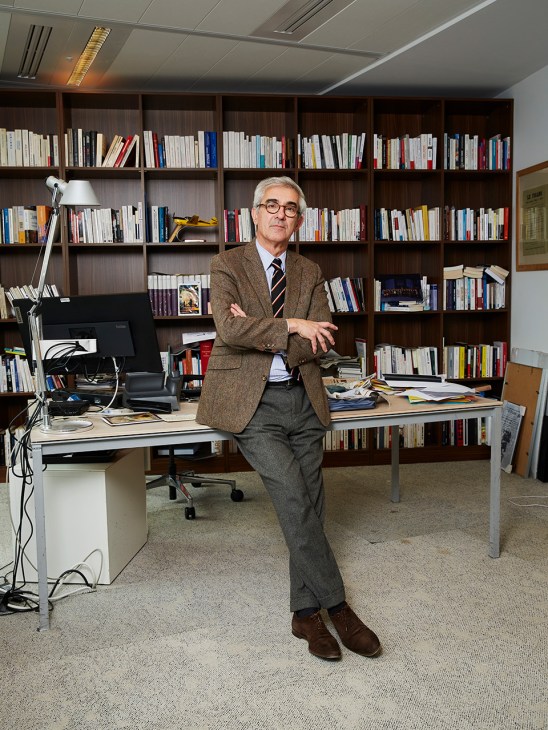
The editor in chief’s office, a modest space strewn with books, is on the third floor. Alexis Brézet, its occupant since 2012, is refreshingly unpretentious and speaks passionately about the publication. It has been a few months since Le Figaro’s three-day bicentennial celebrations at the Grand Palais, which were attended by 60,000 people. “This is an exceptional moment,” says Brézet. “There’s no other national newspaper in France that has 200 years of history.” Rival paper Le Monde, for example, was founded in 1944.
Brézet’s official title is directeur des rédactions (“head of newsrooms”) because he oversees content across multiple formats. Alongside the print edition are the website, the app and both weekly and monthly supplements (including Madame Figaro, Le Figaro Magazine and Le Figaro TV Magazine), as well as podcasts, in-person talks and a TV channel launched in 2023. “Everything’s moving more quickly,” says Brézet, who adds that the paper has changed more in the past 20 years than in any other period of its history. He has been blessed – or cursed, depending on how you look at it – to be here for this transformation.
Brézet joined the paper in 2000 as its deputy editor, then progressed to become the editor in chief of Le Figaro Magazine. For the past 14 years, he has steered the publication’s wider editorial operation. Brézet compares his role to that of a conductor: he relies on “many section leaders, like in an orchestra”. He chairs two meetings a day. At the first, his team schedules the day’s web stories and outlines the next print edition. During the second, the following day’s web coverage is planned and the newspaper’s front page is finalised.
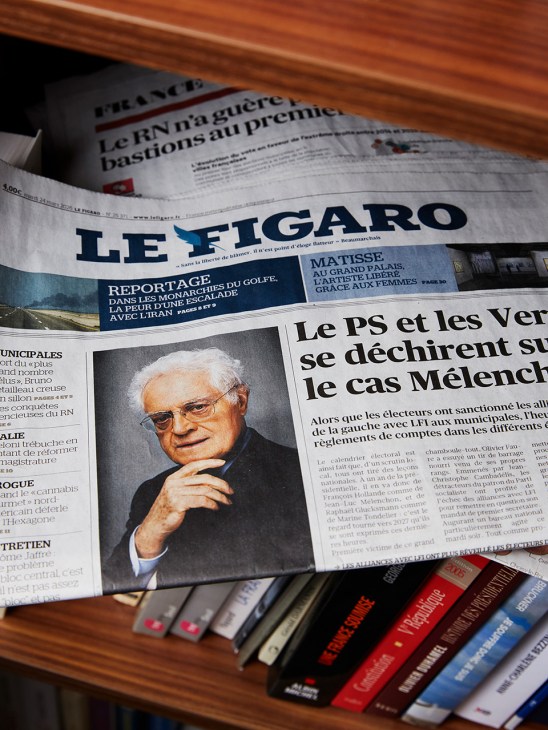
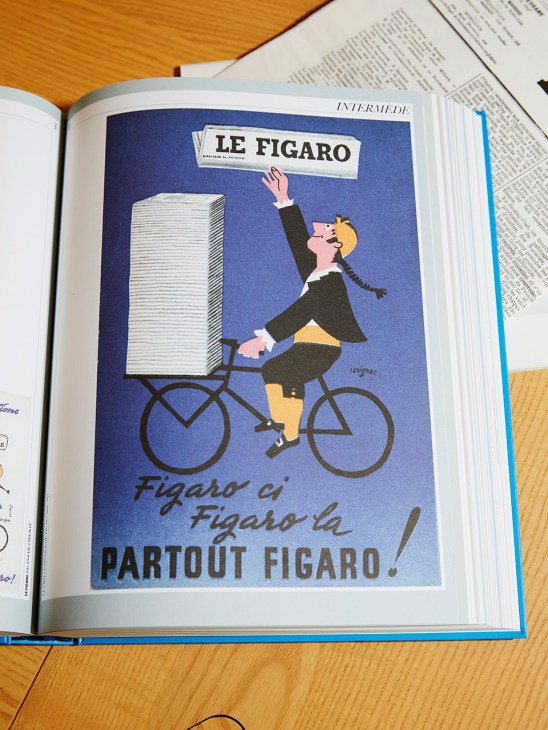
Le Figaro has long had a reputation for being right-wing. Brézet prefers to be more precise: the paper is liberal (in the traditional sense, not the American one) and conservative. Both labels, he admits, are loaded in France. “We must reclaim them,” he says. “We say that being liberal doesn’t mean we’re awful and that being conservative doesn’t mean we’re fossils.” Instead, he explains, Le Figaro is liberal because it “supports business and believes in public debate”, and conservative because there are “a lot of things to protect in our model of society, our culture and our art of living”.
Ideas matter to Brézet. When he became Le Figaro’s editor in chief, he revamped the comment pages and created an online opinion offshoot, Figaro Vox. “We couldn’t just do op-eds from ambassadors or MPs,” he says. “We sought out intellectuals.” With contributions from the likes of Bernard-Henri Lévy, Eugénie Bastié and Thierry Breton, Le Figaro is now a driving force in French intellectual life. When Emmanuel Macron reads the paper, which he does most nights, he starts with the comment pages.
Next year, France will go to the polls to pick Macron’s successor. The establishment right – long the natural readership of Le Figaro – is at a crossroads. Some argue for a union with the far-right Rassemblement National (RN) to form a dominant conservative bloc. Others see this as a betrayal of everything that the centre-right is supposed to stand for. During the 2024 parliamentary elections, Brézet wrote an op-ed arguing that the RN’s policies are “in many respects concerning” but that La France Insoumise was far worse, with its “antisemitism, Islamo-leftism, class hatred, fiscal hysteria”. Some Le Figaro journalists published a letter voicing their opposition to Brézet’s piece and how it had represented “unprecedented support for the RN”. In the end, nothing came of it: Brézet issued no retraction. Instead, he sent a reminder to staff about his editorial philosophy.
As he sees it, there is a crucial distinction between political parties, which have voters, and newspapers, which have readers. “Our role is to bring together readers and enlighten them,” he says. “After that, they are grown men and women. They can do what they want.” Brézet’s conception of journalism is at odds with the increasingly popular idea that publications have a duty to be partisan. “Newspapers are not schoolmasters – we aren’t here to issue voting instructions,” says Brézet. “Our views vary from one writer to another. What matters is that as many readers as possible find themselves in that diversity.”


While most people read Le Figaro online, print still matters. According to Brézet, France’s economic and political leaders like to read Le Figaro in its paper edition. “Print is a bit like haute couture,” he says. “When Bernard Arnault [CEO of LVMH] or Emmanuel Macron have something to say, they won’t say it on Facebook or a website. They want to be in Le Figaro and on the cover.”
Such scoops generate advertising euros. Le Figaro is a rarity among French publications in that it makes money. (The paper is owned by the Dassault family, which also owns Dassault Aviation and Dassault Systèmes.)
Brézet’s goal now is to grow the subscriber base. Le Monde is ahead with about 600,000 subscribers, though it has fewer online visitors. Brézet doesn’t think of it as a competition. “There’s room for everyone,” he says. Ultimately, all newspapers are “fighting for fair remuneration for our content, which is being scraped by social networks, search engines and platforms”. And, of course, there is the threat of AI too. Le Figaro is working with software company Perplexity to create a search engine that draws on the paper’s 200-year archives. But Brézet is adamant that the publication won’t publish AI-generated content – whether text, images or illustrations – which would damage the trust of readers.
When Brézet writes articles, he does so by hand, using a fountain pen. Ink bottles dot his bookshelves. Does writing make him more credible as an editor in chief? “There’s that side of it – showing your teams that you still know how to do the job you’re asking them to do,” he says. “It’s a good thing, from time to time, to say that the boss has written something and it’s not too bad.” But, for Brézet, writing is more than just a leadership strategy. It’s a calling. “At some point, you have to write – you have to pull things out of yourself,” he says. “For me, that’s my life.”