Ok Go’s Damian Kulash on reinventing the music video and resisting algorithms
Two decades after redefining viral creativity, Ok Go’s frontman reflects on DIY spectacle, analogue magic and resisting Tiktok-era metrics.
Few artists have shaped the language of the modern music video as profoundly as the US band Ok Go. Long before Tiktok and Instagram, the group’s DIY treadmill routine for “Here It Goes Again” became a defining moment of early internet culture and a viral phenomenon before the word “viral” meant anything beyond an infection.
Now, following frontman Damian Kulash’s acceptance of UKMVA’s Icon Award for music-video innovation, he is reflecting on two decades of creative risks, homemade spectacle, analogue magic and why the band never chased metrics while the platforms around them were changing everything. With two new Grammy nominations for “Love” (video) and And the Adjacent Possible (artwork) and a decade-long gap between albums finally closing, Kulash spoke to Monocle Radio about the past, present and future of visual music-making.
This conversation has been edited for length and clarity. Listen to the full interview on ‘The Globalist’ from Monocle Radio.
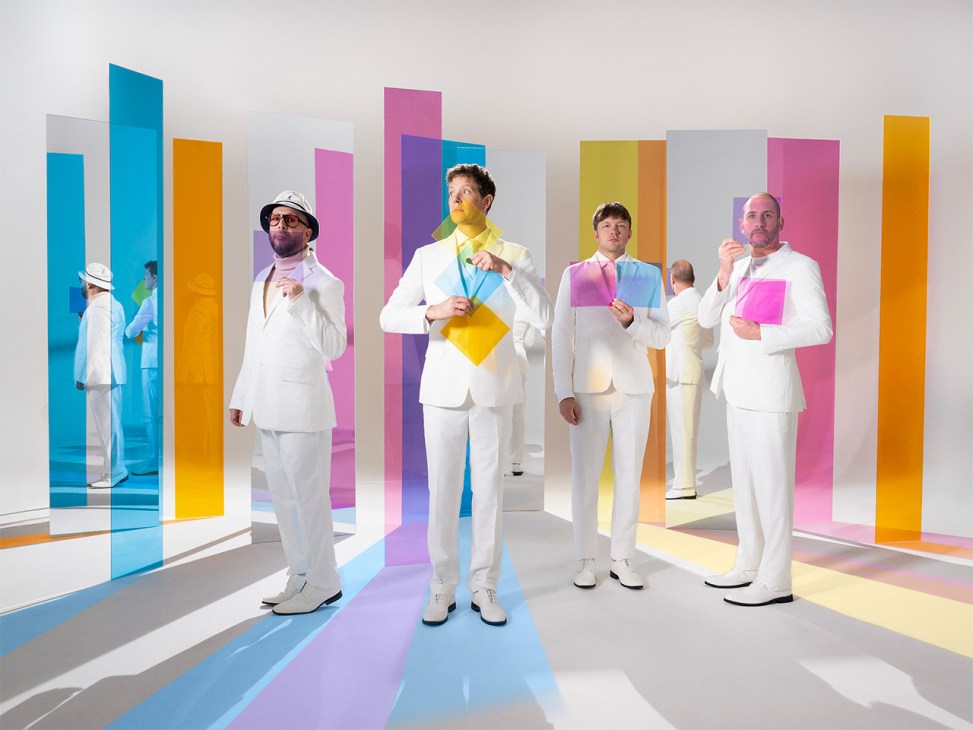
Let’s start at the beginning. What was going through your mind when you created the music video for ‘Here It Goes Again’? What did you want it to be?
When we made the video for ‘Here It Goes Again’ – the treadmill video – we were trying to make something for this nerdy group of fans that we had stumbled upon and connected with. At the end of our concerts, we would do a ridiculous boy-band dance on stage to diffuse the hipster tension that was in indie-rock rooms in the early 2000s, when it was cool to smoke cigarettes and shuffle your feet. We wanted music that felt like Queen or Cheap Trick or Joan Jett. We wanted people to be fist-pumping and have fun. So we came up with a dance for a song called ‘A Million Ways’ and a rehearsal tape of that was uploaded online in the pre-Youtube era. It was then downloaded 300,000 times over a few weeks and we realised that we had accidentally created a music video and made a connection with our fan base. So we thought we should make something else for those people.
We didn’t think of it as a music video but more as just another ridiculous thing. We recorded a routine on treadmills at my sister’s dance instruction studio. We thought it was a weird, modern way of filming a video but we did not think it would ever be seen by anyone outside those few fans.
You were one of the first bands to break through via Youtube. Now artists are adapting to Tiktok and algorithmic discovery. How has that shift affected you?
Oh, boy, that’s a huge question. If you needed a poster child for Youtube, we were the ones. We were right there. We lucked into being the first wave of truly homemade stuff to take on the giant media machine and win, and that was really liberating and fun.
I’m sure that there are people in their twenties who see the canvas provided by Tiktok, Instagram or whatever, and feel genuine art in their souls. I still think in a slightly different framework. I like working for months on end to come up with a nugget of something that could never have existed otherwise. I put all my effort into two, three, four or five minutes of music or film that feels as though I’ve figured out where the edge of impossible is and tipped my finger over to the other side. That’s what art feels like to me.
But that’s not what succeeds on Tiktok. What succeeds is putting something up every day: a low-quality bar, highly repeatable. And that’s only the beginning of the definition of the new form. The fact that it’s now the arbiter of what you see shows how the algorithm isn’t picking content based on how the viewer feels about it but rather how it thinks the broader masses will react to it. It has completely changed the way things move through culture.
I am not changing what I do in reaction to it. I probably should, if I wanted to maximise success or numbers. But you don’t wind up being in a rock band or being a filmmaker because you’re highly strategic about making money. You wind up here because you want to connect with other human beings.
Listen to the full conversation with Damian Kulash and Monocle Radio’s Tom Webb on ‘The Globalist’.