Antiquities collector James Perkins invites guests at Parnham Park to holiday among dinosaur fossils
The UK collector is restoring Dorset’s 16th-century manor house after a fire in 2017 destroyed the property, transforming it into a hospitality destination where ancient creatures take centre stage.
The question of how one sources a megalodon doesn’t really cross James Perkins’ mind. “Someone says, ‘Oh, you need to talk to him – he does all of the museums in England and worked on the Harry Potter films,’ and one thing leads to another. You don’t just nip into the local Jaws shop and come out with a megalodon. It doesn’t happen overnight.”
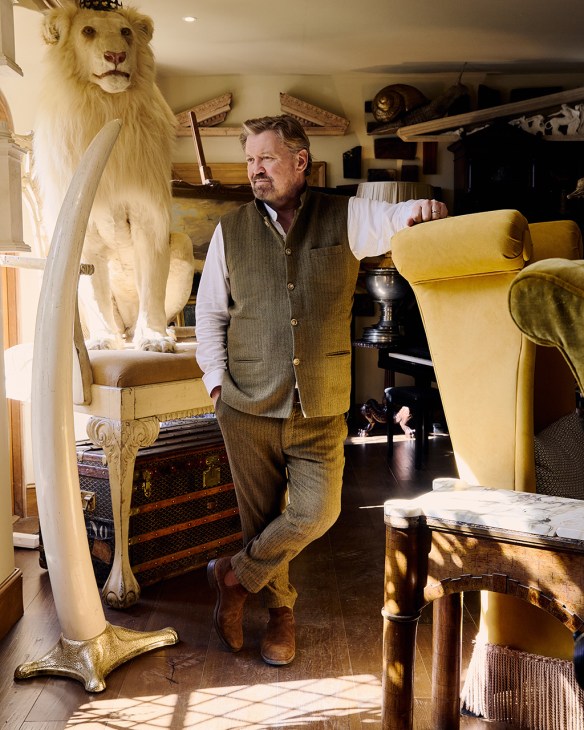
Perkins is a co-founder of Fantazia, a UK-based music-events company and record label. Collecting runs in his family; his mother was an antiques dealer. At the age of 14, he spent his paper-round money on a bust of Apollo. Whether buying a stuffed giraffe or the remains of an 18-metre-long megalodon, he approaches every purchase with the same collecting logic. Now, Perkins is working on his biggest project to date: the restoration of Parnham Park, a Grade I-listed 16th-century manor house on England’s south coast.
In 2017 a fire tore through the building, burning for four days until the roof caved in and the floors buckled. The original stone frontage held, though the wisteria climbing the southern façade looks as though it might be the only thing keeping the wall upright. The place is spooky, otherworldly and magnificent.
Architect Thomas Heatherwick is among those working on Parnham Park’s restoration. The Perkins family already lives in part of the house, firmly installed amid the scaffolding and the dust. The walled garden restaurant, meanwhile, has become a destination for the area’s residents. The long-term plan includes outbuildings, a lake house and event spaces. A multi-conceptual hospitality destination is slowly rising from the rubble.
Perkins calls Parnham Park’s aesthetic – the tasselled chandeliers, feathery masks and four-poster beds of Wolf Hall proportions – “elegant decay”. His collection of plaster sculptures, spanning some 4,000 pieces, is a tribute to houses that no longer exist. “It’s rather like Sir John Soane’s Museum,” he says. It’s an apt comparison: Soane, a neo-classical architect, filled his London townhouse with salvaged items and curiosities, then left it as it was for posterity. Perkins is doing something similar, only louder and with dinosaurs.


Parnham Park is a short distance from Dorset’s Jurassic Coast, 153km of shoreline so rich in terms of geological history and fossils that it has Unesco World Heritage status. Palaeontologist Mary Anning roamed these cliffs in the early 19th century, pulling ichthyosaurs and plesiosaurs from the rock face. The fossilised remains of ammonites the size of dinner plates still emerge from the mud after rain. Perkins often discovers them in his garden. “We probably found 20 last week.”
At Parnham Park, three pterodactyls will soon hang from a ceiling, lit to throw shadows on the walls and set the mood at dinner parties. The resident triceratops is currently on loan for an exhibition. The megalodon is having its jaw reconstructed and its body finished in papier-mâché that has been aged to a formaldehyde yellow; it will be suspended in the great hall like a prehistoric blimp. “The problem with dinosaurs is that they’re quite large,” says Perkins. “Even in a big house, it isn’t easy to fit a T-rex.”
His ambition extends beyond the walls of the property. “I want to inspire people to collect things,” he says. “They don’t have to be valuable. I used to fish plaster casts out of skips.” Perkins sources his objects himself, travelling to fairs and meeting dealers across the globe. His vision for Parnham is something between a country house and a natural-history museum – a place where children come for educational stories during the day and their parents settle in for supper by candlelight at night. “I haven’t seen it done before,” he says.
James Perkins on finding one-of-a-kind objects:
1.
Source them in person
“It’s important to see what you are buying. Buy what you can afford and trust your gut feeling. Value comes later.”
2.
Avoid big-city fairs
“In general, the closer you are to the capital, the higher the pitch fees – and prices will reflect that. If you’re in the UK, the distance from London matters.”
3.
Hunt for what looks out of place
“I have often bought things from the corner of a little sale that nobody else wanted.”