The quiet lens: How an Indian immigrant captured the UAE’s visual history
Ramesh Shukla, the noted photographer who documented the UAE’s rise from obscurity, has died at the age of 87.
On the wall of Ramesh Shukla’s Dubai home hangs a 50-dirham note in a simple frame. Visitors often assume that it is there for the currency’s novelty value. It is not. The note carries his photograph of Sheikh Zayed bin Sultan Al Nahyan signing the Federation agreement in 1971 – an image so embedded in the UAE’s psyche that it circulates daily in wallets and tills. When the design was first issued, his son Neel tells me, Shukla went around handing out crisp notes to friends and strangers alike. “He was giving out free 50-dirham notes to people, proudly showing off his work.”
It is an endearing detail but also a revealing one. For a man who never chased a salary, never invoiced a ruler and never built a property portfolio, that small rectangle of polymer was proof of something more enduring than wealth.
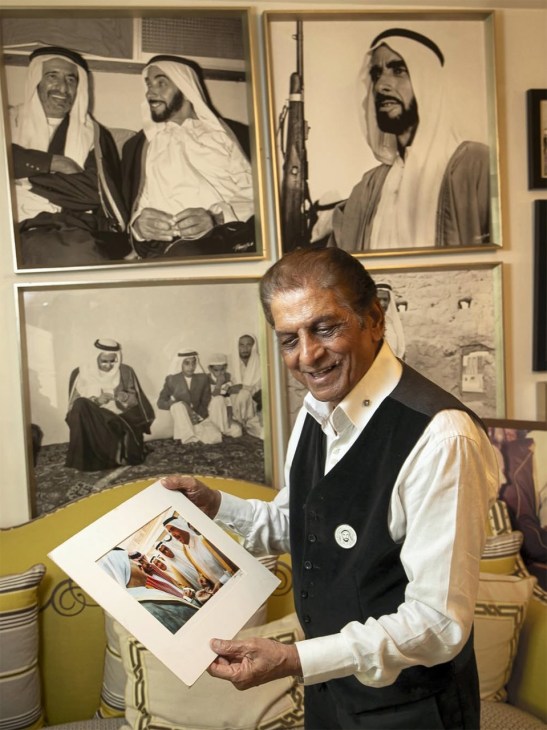
I meet Neel and his mother, Taru, in the family apartment where Shukla lived for the past 20 years. The walls are dense with art – not only the black-and-white photographs that documented the rise of a country but paintings he later made of those same moments. History, then memory, then reinterpretation. There are pictures of Bill Clinton, a youthful King Charles III, Gulf rulers, Bollywood stars. “He’s seen it all,” Neel says. A tour of the house reveals thousands of prints and canvases – enough to fill a museum easily. And yet the most interesting thing about Shukla is not his proximity to royalty. It’s his position behind them.
He arrived from Gujarat by boat in the late 1960s with hardly any cash and a camera. He left India not as a businessman or engineer – the archetypal Gulf migrant – but as an artist. In Bombay, he had supplied photographs to newspapers. “He never got any job, never took a salary”, Taru tells me. “Whatever he photographed, they’d give some money”. It was a precarious existence even then. In the Emirates, it would be more so.
Within days of landing he was photographing a camel race attended by local rulers. When he showed the prints to Sheikh Zayed, something shifted. “Eye-to-eye connection”, Taru says, locking her fingers together to illustrate the point. Zayed recognised the talent and told him to stay.
From that point on, Shukla became a constant, crouched presence at the birth of a nation. But he did not experience it as history. “He just saw human beings with incredible charisma,” Neel insists. The famous Federation photograph was not taken with a sense of destiny but with technical obsession. He focused on the nib of the pen; Taru developed the negative at home in improvised trays. “If you give too much time, it’s overexposed; less time, it’s underdeveloped”, she says. The stakes felt personal: “Our life will be spoiled”.
The image would later become the visual shorthand for unity. At the time, it was simply the best frame he could make.
It’s tempting to romanticise the title “royal photographer” but it risks obscuring a more telling narrative. Shukla was an Indian immigrant who recorded the ascent of Dubai and the UAE from the shadows. His Rolleiflex sat low at waist level; his lens looking up at leaders who were building a state. The symbolism is almost too neat. Millions of expatriates – Indian, Pakistani, Filipino and beyond – have constructed the Emirates physically and economically. Shukla constructed it visually. All in their own way were present but peripheral to the official story.
“‘My bank balance doesn’t dictate who I am’”, Neel recalls his father saying. “‘My work is my bank balance’”. While others bought land, he bought film. While contemporaries moved into commerce, he doubled down on craft. Even as he gained extraordinary access – travelling with Sheikh Mohammed bin Rashid Al Maktoum on hunting trips, photographing leaders at home and abroad – he never leveraged it into business. “He never said, ‘Give me money’”, Neel says. “There was no ‘give me’”.
That choice came at a cost. The life of an artist in a boomtown is rarely straightforward. “It was very hard, very challenging”, Neel says. “As an artist, there’s no progression”. Yet perhaps that was precisely why the rulers trusted him. He was not there to extract but to observe.
There is a story Taru tells about Sheikh Mohammed asking her husband how many girlfriends he had. “Twenty,” Shukla replied, referring to his cameras. It is a line that captures his singularity. He loved equipment, light, composition – not mere accumulation.
In the days since his death, tributes have flowed from across the Emirates, including from Dubai’s Crown Prince. They recognise a man who dedicated six decades to documenting the country’s transformation. But perhaps his deeper legacy lies in what his vantage point represents.
To look at modern Dubai is to see skyline and spectacle. To look at it through Shukla’s archive is to see something quieter – leaders squatting on sand before there were chairs, handwritten documents before ministries, desert hunts before highways. His photographs anchor a narrative that might otherwise drift into myth.
Neel, dressed in a black kandura – a subtle signal that this is home – speaks about stewardship now. The family has resisted commercialising the archive. “We want this to have a meaning,” he says. It is not just a trove of images but a record of immigrant contribution rendered visible.
Shukla died with a camera nearby and his signature Panama hat on his head. Even in his final days he was signing prints as part of a vast project for the UAE’s president. “‘Son, this is what I live for,’” Neel recalls him saying.
In the end the most striking image is not the one on the 50-dirham note. It is the idea of an Indian man, waist-level camera in hand, steadying his frame while history unfolds inches away. He rarely appears in the photographs that define the UAE. But without him and without those like him, the picture would be incomplete.
Inzamam Rashid is Monocle’s Gulf correspondent. For more from Rashid, click here.