Inside 19th-century mummy mania, when Europe dined with Egypt’s dead
After Napoleon’s Egypt campaign, the European bourgeoisie became fascinated by pyramids, hieroglyphs and mummies. The latter were shipped to Europe by the thousands, despite laws prohibiting the trade.
On 15 January 1834, London’s Royal College of Surgeons invited the public to a special event, where renowned surgeon and antiquities expert Thomas Pettigrew gave a lecture on ancient Egypt and unwrapped a real mummy (writes Till Hein). All in the name of science, of course.
Such presentations soon became fashionable in France, Germany and particularly in Victorian Britain. Members of polite society who considered it improper for women to remove their gloves in public watched with delight as the wrappings fell away and the naked body of a millennia-old corpse was revealed to them. Thomas “Mummy” Pettigrew became a star of the unwrapping scene. At first, he performed his shows in university lecture halls and later at dinner parties. The combination of morbid eroticism, education, Egyptian romanticism and shiver-inducing entertainment fascinated aristocrats and wealthy bourgeois alike.

It was the era of European Egyptomania and this obsession extended to mummies. In the 19th century, preserved bodies were not only ceremonially unveiled; owning one became a status symbol. “It would be quite unrespectable to return from Egypt without a mummy in one hand and a crocodile in the other,” wrote the Austrian nobleman Ferdinand von Geramb in 1833. Artists painted with pigments made from ground mummy remains. And the dead were literally consumed: the sick and injured ingested powdered mummy as medicine; health-conscious parents sprinkled this “mumia” into their children’s porridge for strength.
The first embalmed bodies had already been brought to Europe during the Middle Ages, mainly for the production of mumia. The powder was believed to have healing powers for several reasons. One being that since antiquity, scholars had trusted the medicinal qualities of bitumen. This tar-like substance – along with resins and oils – was used in ancient Egypt to preserve bodies.
The excellent state of preservation of mummies also encouraged the belief that the bodies possessed mysterious powers. Thus not only bitumen and remnants of embalming materials were crushed into mumia but also the bodies themselves. In 1574, German doctor Joachim Strupp recommended this “useful gift of God” for more than 20 ailments, including sore throats, dizziness, heart pain, trembling and kidney problems. Other physicians and apothecaries prescribed corpse powder for broken bones, toothaches or even as an aphrodisiac.
Body parts at vegetable stalls
In the 19th century, following Napoleon’s campaign, an increased number of Europeans travelled to the glorified land of the pharaohs. And those who could afford it visited the pyramids to see mummies. The interest in human remains became so great that enterprising locals transported mummified remains from remote areas to more impressive burial sites to satisfy tourists. Traders even offered mummified bodies and limbs at fruit and vegetable stands as souvenirs for wealthy European visitors who already had everything else.
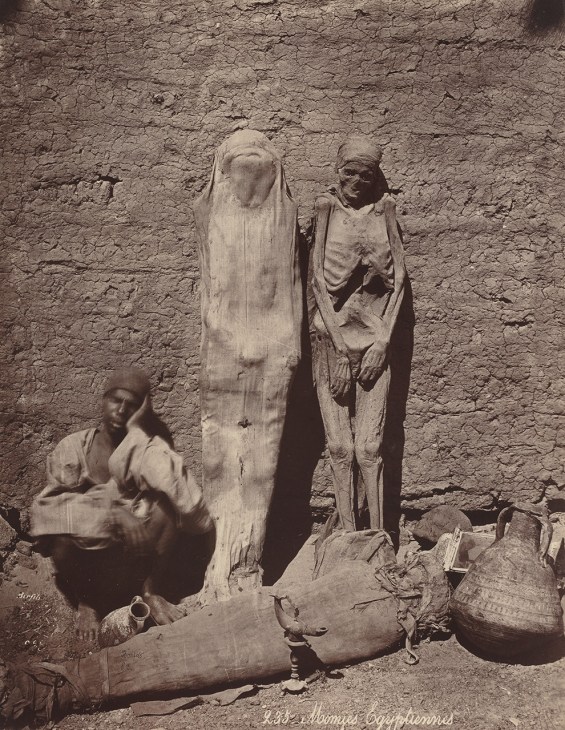
The supply appeared large enough. In ancient Egypt, embalming was widespread; not only among members of the elite but also among ordinary people. It was believed that only a body that resisted decay could be prepared for the afterlife. Embalmers opened the abdomen, removed the internal organs and extracted the brain through the nose. The empty and dried body cavity was often stuffed with sawdust or sand and coated with bitumen, resins and oils. The skin was meant to appear lifelike and embalmers tried to preserve facial features so the soul could recognise the body upon its return to the tomb.
But such religious beliefs mattered little to 19th-century Europeans. They imported mummies in huge quantities and were not deterred even when the government intervened. In 1835, Egypt’s governor, Muhammad Ali Pasha, issued a decree prohibiting the export of antiquities without official permission. The preface noted that the passionate interest of European travellers in ancient Egyptian artefacts had caused “true devastation”.
Despite the ban, plundering continued and smuggling boomed. Some travellers had mummies sawn apart and hid hands or feet in their luggage. And locals were enticed by the lucrative opportunities available in the flourishing black market.
A unique shade of brown
Traditionally, mummification in ancient Egypt took 70 days and more than 100 metres of linen were used to wrap a body. The bandages were repeatedly coated with bitumen and liquid resin, which glued the strips together and hardened when dried.
Connoisseurs in the 19th-century greatly sought after the label mumia vera aegyptiaca – “genuine Egyptian mummy”. Even though experts estimate that more than 70 million people were mummified in ancient Egypt, by around 1850, the vast European demand could hardly be met. Swindlers exploited the shortage, creating “instant mummies” from recently deceased bodies and selling them as ancient originals. Some supposedly ancient body parts were even later revealed to be camel meat wrapped in burial cloths.
Even still, the powder remained a popular medicine and tonic, and mummies continued to provide entertainment at unwrapping parties. Since the 18th century, a popular artist’s colour had also been produced from mummified remains: “mummy brown” – a pigment prized for glazes and soft shading. Eugène Delacroix, creator of the famous 1830 painting “Liberty Leading the People”, loved mummy brown as did the English landscape painter William Turner.
The colour also became popular among the Pre-Raphaelites but not all members of the artists’ group realised what the pigment contained. When a colleague informed painter Edward Burne-Jones, he was horrified. He went to his studio, took a half-used tube and buried it ceremoniously in his garden. However, at London’s Roberson & Co, one of the largest suppliers of paints and pigments, whose clients included celebrated artists and amateurs such as the future prime minister Winston Churchill, “mummy brown” remained on sale until 1933.
Cats turned into fertiliser
In the second half of the 19th century, many Britons of means dreamt of owning an ancient Egyptian mummy – or at least receiving an invitation to an unwrapping party. That was especially if Thomas “Mummy” Pettigrew – the grand master who mingled with learned men such as writer Charles Dickens – was hosting.
Not everything always went smoothly at these events. Sometimes the bandages refused to come off, and on one occasion, the mummy of a supposed Egyptian princess turned out to be that of a man. Pettigrew’s reputation nonetheless remained intact, eventually being elected to the Royal Society. A Scottish duke admired him so much that he asked Pettigrew to mummify him after death. And in 1852, after the death of the nobleman, Pettigrew obliged. The embalmed duke was laid to rest in Hamilton in the sarcophagus of an ancient Egyptian princess.
The long wrappings of genuine mummies often concealed jewellery, artefacts or valuable documents – offerings intended to ease the deceased’s journey into the realm of the dead. For guests at European unwrapping parties, however, the relics mostly arouse greed. “The brown, well-preserved body of a maiden who had died in the bloom of her life was revealed to the eyes of those present,” wrote German author Theodor Fontane in 1883 of an unwrapping at Dreilinden Castle in Brandenburg. But “No amulet, no piece of jewellery, no papyrus scroll was found with the body of the holy temple servant. The disappointment was universal.”
Commercial motives also kept interest in mummies alive. In 1850 in the US, paper shortages hampered newspaper production and some considered using mummies as raw material. According to one geologist’s calculation, the linen wrappings of embalmed Egyptians could supply the US with paper for roughly 15 years.
Whether such “mummy paper” was ever actually produced in the US is disputed. It is clear, however, that in Britain large quantities of animal mummies were processed industrially – especially mummified cats, which were used as fertiliser.
£200 for a pharaoh
It must also be acknowledged that descendants of ancient Egyptians were not always respectful of their ancestors’ remains. In the 1800s, mummies in North Africa were often used as firewood: soaked in resin, they burned extremely well. Mark Twain noted in his 1869 travelogue, The Innocents Abroad, that embalmed bodies were used as fuel for steam locomotives in Egypt.
Some travellers found the pushy sales tactics of street vendors offensive. “I was very annoyed by an Arab who offered for sale the hand of a mummy,” wrote an American visitor in 1894. “He followed me, held this horrible object before my face again and again and urged me to buy it cheaply.”
For many travellers, however, acquiring looted antiquities or mummies remained a perfectly normal part of an educational trip to Egypt well into the early 20th century. The Australian Daily News reported in 1907 that a high-quality pharaoh could be purchased for £200 (about CHF30,000 [€31,943] today). The mummy of a priest sold for £12 to £15 (about CHF2,000 [€2,129]) and that of a commoner for just £1 and 10 shillings (CHF200 [€212]). And as late as 1924, German pharmaceutical company Merck was selling mumia vera aegyptiaca at 12 gold marks per kilo (approximately CHF600 [€638]).
Mummy parties fell out of fashion around 1900, as it then seemed tasteless to use human remains as entertainment. Later the legend of the vengeful mummy would find its way into horror films, perhaps rooted in feelings of guilt over the mummy mania that had gripped Egypt enthusiasts in the early 20th century.
A booming black market once again
None of this prevented the next great wave of looting and trafficking roughly a century later. After the Arab Spring of 2011, criminals exploited political instability and armed gangs raided archaeological sites and museums across Egypt. Though unlicensed export of antiquities had been banned repeatedly since the 1830s, and a 1983 law imposed prison sentences and fines of up to EGP1m (CHF16,000 [€123,503]), the black market was flooded with artefacts. Unauthorised trade continued even after president Abdel Fattah al-Sisi tightened laws in 2013: smuggling antiquities now carried a 25-year prison sentence.
Smaller items often left the country in suitcases accompanied by a receipt from a bazaar vendor attesting that an alleged “imitation” had been sold to a tourist. Larger objects were wrapped in bubble wrap and shipped by container to Genoa, Marseille or EU customs warehouses, stored among similar-looking cheap goods. Customs officers could hardly tell the difference at first glance. Experts say that the bonded warehouses of Basel, Geneva, Bern and other Swiss trading hubs are also centres of smuggling, as illegal objects can be stored there securely and tax-free under customs supervision.
Dispute over Schepenese
Meanwhile, critics have been calling upon curators and private collectors in Europe to return ancient Egyptian objects, mummies and sarcophagi that were imported long ago. It is unacceptable, they argue, to continue displaying cultural heritage and human remains that were most likely obtained under dubious circumstances. In Switzerland, the debate is best known in connection with the mummy of Schepenese – a priest’s daughter born around 650 BCE in Luxor – whose embalmed body has been on display for more than a century in a glass coffin in the Abbey Library of St Gallen.
Theatre director and political activist Milo Rau sparked controversy in 2022 with an open letter. Schepenese had been brought to Switzerland illegally, he wrote; her rest had been disturbed; her “display” was disrespectful. The mummy should therefore be returned to Egypt, her “spiritual home”. Roughly 100 people signed the manifesto, which included prominent figures such as Adolf Muschg, Sibylle Berg, Jean Ziegler and French art historian Bénédicte Savoy, a renowned expert on art theft.
But the demand has also met resistance, including from experts. Salima Ikram, archaeologist, mummy specialist and professor of Egyptology at the American University in Cairo, expressed surprise. She stressed that the Egyptian state has not requested the mummy’s return and Schepenese appears on no repatriation list. And for good reason: she is interesting but not particularly spectacular. Finding a suitable place for her in Egypt – still rich in antiquities – would be difficult. Ikram argues that the mummy should remain in Switzerland as a kind of cultural ambassador.
The decision lies with the administration of the Catholic church of St Gallen, which owns the mummy. And they have decided that Schepenese will stay, reasoning that, as far as current knowledge suggests, she left Egypt in 1820 before the first export ban in 1835.
But the question of how to handle Egyptian artefacts in European collections will not go away. Experts call for far greater transparency about the provenance of exhibits and propose partnerships with the communities or nations from which cultural treasures originate, including those of other ancient civilisations, to seek joint solutions. What is clear is that every artefact and mummy has its own history and what should happen to them today is rarely easy to decide, even with the best intentions.
Can we still say ‘mummy’?
One debate linked to these issues seems somewhat eccentric: some curators, especially in the UK, now consider the term “mummy” ethically problematic. They advocate “mummified person” instead to emphasise that these preserved bodies once belonged to human beings – people with feelings, personalities, lives and clear ideas about what should happen to them after death.
They argue that if known, the name of the mummified person should always be stated along with everything else learned about them. But the legacy of 19th-century mummy mania often leaves little room for this. In many cases, not even the burial place of a mummy is recorded, let alone the deceased’s family or profession. Such information might have been gleaned from tomb inscriptions had they not been lost. “It is almost impossible to say anything meaningful about a dead person when all you have, for example, is their left foot,” says Enrico Paust, curator of prehistoric archaeology at the University of Jena.
Whether mummies in Europe will continue to be referred to as mummies remains to be seen. One term that certainly would not be socially acceptable today is a slang expression from the 1990s: dance evenings for older people, where participants moved stiffly across the floor, called “mummy shuffles”.
Till Hein (27.11.2025). Tote Ägypter als Gag beim Dinner: Im Europa des 19. Jahrhunderts waren Mumien der letzte Schrei. Neue Zürcher Zeitung. Translated into English by Monocle.