Desert bloom: How the AlUla Arts Festival blends history with the here and now
Amid shifting sands punctuated by palm-fringed oases, the AlUla Arts Festival brings the long history of Saudi Arabia’s desert landscape to the kingdom’s bid for contemporary relevance in art and design.
The AlUla Arts Festival wrapped up this week. It’s an event that’s transforming perceptions and setting the ambitious tone for art and design in its namesake town in northwest Saudi Arabia. After touching down in its desert landscape earlier this month I was whisked from the airport through dramatic stone escarpments that emerged from seemingly endless expanses of sand, occasional oases of palm trees and horizons defined by low-slung mountains.
The region is clearly undergoing rapid development; diggers and excavators are a constant against the stunning natural backdrop. But those driving the project, the Royal Commission for AlUla (RCU), are establishing frameworks to ensure that change is as sensitive as it is swift. Case in point is a petrol station constructed from rammed earth by Jeddah-based SAL Architects, which rises from the desert on the town’s southern outskirts. It blends into the landscape and speaks to AlUla’s history as a cultural crossroad on the route to Medina. Even today, it remains a place for travellers to refuel.
It’s scene-setting architecture that responds to place. This ambition is also being harnessed by the AlUla Arts Festival whose programme included artist residencies, design prizes and exhibitions. Its aim is to help lay the groundwork for the region’s development in a way that’s appreciative of its past but striving toward the future. Here are five takeaways from the event, with applications that stretch far beyond the seemingly infinite Saudi desert.
Don’t be a copycat
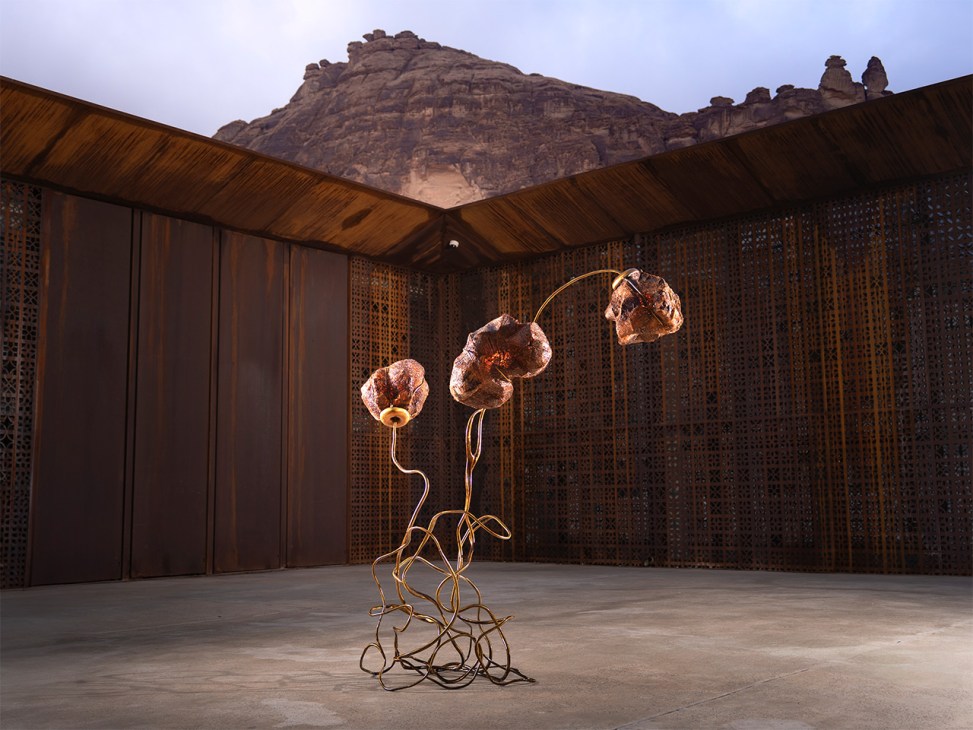
“It’s not about mimicking the past,” says Sara Ghani, an urban planning and design manager at RCU, while explaining that it can be tempting to simply mirror the forms of AlUla’s ancient buildings, some 900 years old. Her team encourages architects of new projects to find ways of referencing place without replicating it. Take the Alula Design Centre. “The skin of the building is corten steel, not mud, but it references the city’s ancient breeze blocks – a contemporary building that reflects older character.”
Put on rose-tinted glasses
“There’s more than 7,000 years worth of continuous civilisation that have lived on this land and so we see AlUla as a place to learn from the past,” says Hamad Alhomiedan, arts and creative industries director at the Royal Commission for AlUla. Hegra, he says, is a case in point. A major archaeological site near AlUla, it features water wells and cisterns that never relied on mechanical pumps or electricity, as well as decorated tombs and inscriptions. It’s a 2,000-year-old benchmark for building better with less. “In AlUla, we see art and design excellence cascade from ancient civilisations to today.”
Build for the best
A good artist and design residency should have a legacy that extends beyond its duration. “They’re a living reference for designers working in a region,” says Arnaud Morand, the head of art and creative industries at the French Agency for AlUla Development, while moderating a panel on the AlUla Artist Residency. He articulates the importance of bringing in an international cohort of designers. “Through research, we can root future work in the land, the people and its history, so that design doesn’t land on top.”
Reframe regulation
A participant in the artist residency is Amsterdam and London-based Studio ThusThat. As part of the programme, they developed a new concrete-like material from slag (a waste-product of Saudi Arabia’s aluminium and copper refineries). And while it has the potential to play a part in a circular economy, a widespread introduction won’t be without difficulty. “Economies of scale and regulation framework are the big challenges,” says co-founder Paco Böckelmann. “But it’s about looking for opportunity: we found a factory where it was easier to mill the waste slag for us than store it.”
Look to art
Wadi AlFann, or “Valley of the Arts”, is a 65 sq m open-air, contemporary land-art destination. Set to open in coming years, it will feature works by the likes of New York-based Agnes Denys, whose ethos will be imbued in the development of buildings on the site. “We’ll be drawing inspiration from the artists that we’re going to commission,” says Iwona Blazwick, the lead curator for Wadi AlFann. “Land art is of and for the land, so we want an architecture that is made of and for the land, too.”
Nic Monisse is Monocle’s design editor. For more on AlUla and the movers and shakers that made waves at its arts festival, click here.