A shore cure for urban fatigue: How Sydney, New York and Kobe are rethinking their waterfronts
A fish market revelling in theatrics, an amphitheatre-inspired hill uniting the sea and mountains, and a park acting as a flood defence. Smartly designed spaces are bringing people back to the water.

Waterfronts often serve as connection points in urban environments. When designed well, such spaces function as ecological buffers, economic engines and public spaces where communities can gather. But arriving at such a point requires vision, investment and ambition to reimagine precisely what a shoreline can be. Here, we examine three cities that have done exactly this: Sydney, reinvented through industrial infrastructure; New York, restored through environmental intervention; and Kobe, reshaped through civic and landscape design.
1.
Sydney Fish Market
Sydney, Australia
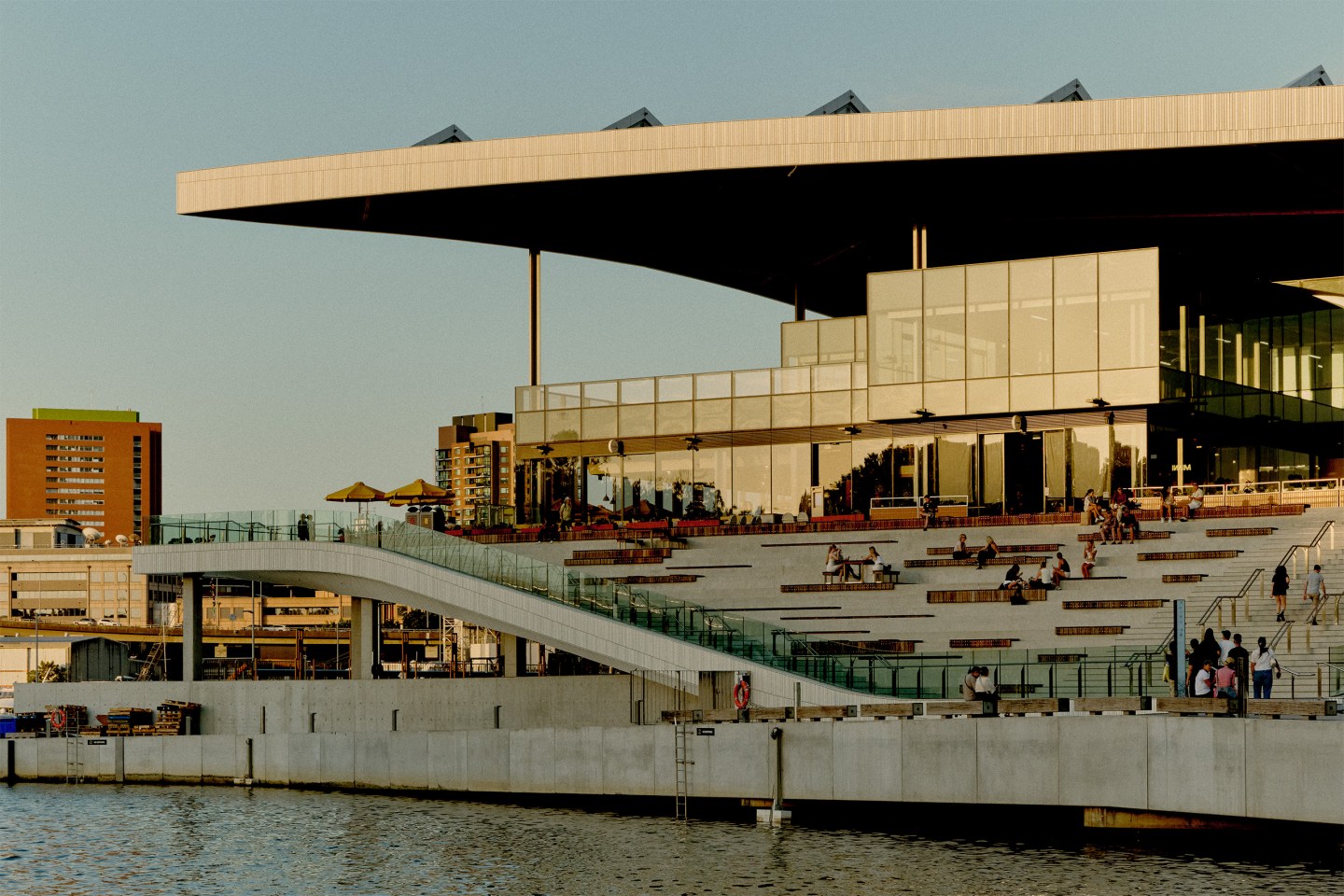
It’s 06.30 and the operations centre at the new Sydney Fish Market is in full swing. At one terminal, a worker is washing mud crabs in a deep sink; at another, fish are being checked for freshness. An aquatic bounty sits on slabs of ice: tuna, snapper, barramundi, tiger prawns. Workers push the market’s signature blue crates through the wide lanes, deftly avoiding some tourists – even at this early hour, there is a tour group coming through, learning about how the market functions. It’s all part of a grand architectural plan. Unveiled in January, this is the largest fish market in the southern hemisphere.
“We have turned an introverted industry inside out,” says Fred Holt, partner and Australian director at architecture firm 3XN. The international outfit, headquartered in Denmark, designed the building in partnership with Australia’s BVN Architecture and landscape firm Aspect Studios. The trio has produced a design that serves the public and industry, with a blurred activity programme headlined by a market hall that accommodates fishmongers, speciality shops, cafés and restaurants.
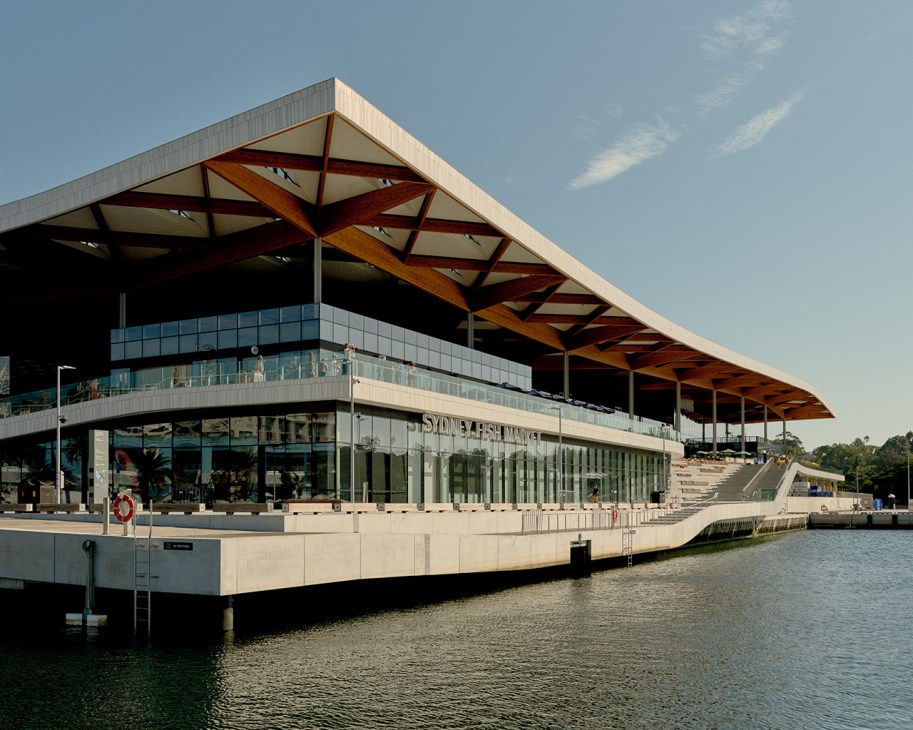
In a similar vein, the behind-the-scenes operations of the market have been foregrounded: the cold storage rooms are set on ground level and visible to anyone driving or walking past. Visitors can also see the auction hall, though circulation flows have been smartly designed to separate the daily operations of the working fish market from the public. “We’re putting the back-of-house operations on display,” says Holt. “We’re making the theatrics and intense choreography of seafood trading part of the public experience.”
As if to prove the point, Holt welcomes Monocle to the auction hall early on a summer day, whose cloudless blue sky promises scorching heat. It’s surprisingly quiet: about 40 bidders sit at desks in the hall, which is lined with glass windows and cascading rows of seating that make it reminiscent of a university lecture theatre. Coffees in hand, they stare intently at computer screens at their terminals. The auction uses a Dutch system, involving a clock that ticks down until a winning bid is made. Occasionally the contenders groan loudly when they’re outbid, otherwise the only sounds are gentle murmurs.
Far from simply being innovative in terms of inviting the public into an industrial market, work has also been done to link the site to the city. The building is set on Blackwattle Bay in the inner-city suburb of Glebe, along a 15km foreshore walk that starts near the Sydney Opera House. Part of the brief was to connect the building with this walk through a waterfront promenade. “The building is shaped to respond to this request,” says Holt. “The ground level has sweeping stairs to draw people up but also provide a place for Sydneysiders to just enjoy the view.”


It’s a view that the city’s inhabitants are well acquainted with: the building is a replacement for the former fish market, which, since opening on an adjacent site in 1966, had been a fixture of Sydney’s economic, cultural and tourist map. The new structure builds on this storied legacy but while adding a layer of architectural significance – it has already been described as the city’s most outstanding harbourside structure since the Opera House. Appropriately, the fish market’s roof, which looks like a wave coated in fish scales, is well on its way to icon status too. The design was informed by practical requirements: it needed to be low-lying to avoid obstructing the nearby Moreton Bay fig trees.
An undulating form proved the best solution, allowing natural light and ventilation to flow through the space, while collecting rainwater for later reuse. It’s a savvy design that means the building gives back to its tenants. “The Sydney Fish Market is actually owned by the industry for people who actually support it,” says Gus Dannoun, the operations manager at the market, who has worked here for more than 40 years. “One half of the business is owned by the licensed commercial fishermen through a trust, and the other half is owned by the tenants and merchants who operate from this site. It’s a truly industry-owned operation.”
It’s a situation that Holt is perfectly happy to acknowledge, adding that his work has built on it. “The fish market is two things,” he tells Monocle, as he wraps up his tour of the building. “It’s an operating fish market but it’s also a Sydney institution.” By 09.00 the public spaces have filled up – there are people walking dogs, buying flowers and coffees, gathering around an oyster shucker to watch him work, and, of course, buying plenty of fish. “It’s Sydney’s living room,” adds Holt.
View Monocle’s complete city guide to Sydney.
2.
East Side Coastal Resiliency
New York, USA
When the $1.45bn (€1.25bn) East Side Coastal Resiliency project is completed in 2027, the waterfront along lower Manhattan’s East River will look significantly different to the one that was destroyed by Hurricane Sandy in 2012. The ambitious 15-year project, named the Big U, is being built to a master plan by Bjarke Ingels Group and One Architecture and Urbanism. It is defined by a 16km stretch of park and public realm, featuring flood protections (such as a tidal gate chamber, floodwalls and elevated parkland) designed to safeguard New Yorkers from future storms and tidal floods, while also providing abundant public amenities.
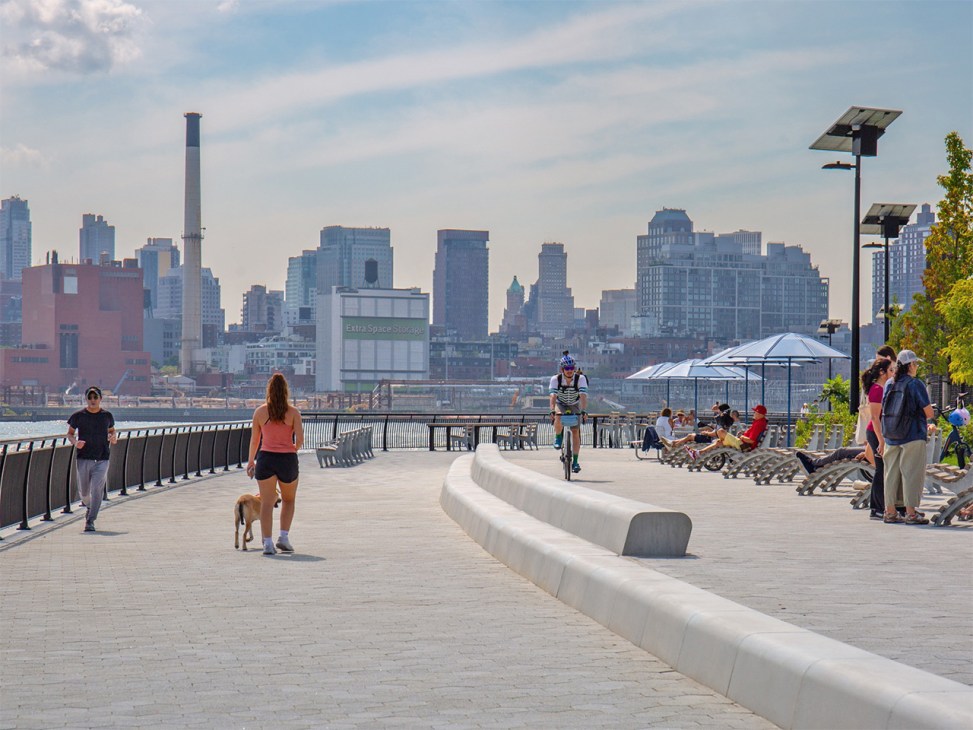
“It’s an archipelago of parks forming an elevated, undulating new landscape – a ‘parkipelago’ if you will,” says Ingels. “Each island of green is devoted to a use and character decided by the community. Rather than separating the city from the waterfront, we’ve designed a public realm that invites people in.”
Its crown jewel is the 4km-long East River Park, which is being transformed into the Lower East Side’s most vibrant civic space. Those who visit the site this summer will hear the hum of construction at the park’s northern end. But they will also be able to visit the most recently opened section (pictured) south of the Williamsburg Bridge.
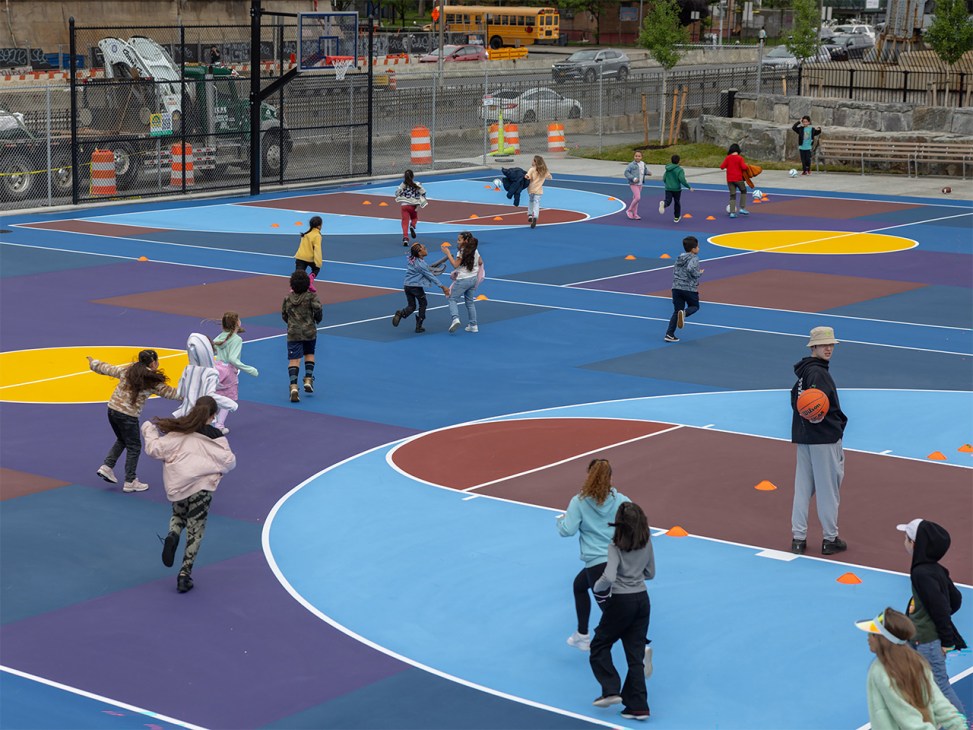
Elevated above the floodplain, it features lush planting, sports courts and spots for the community to gather in, fields, lawns, nature and water play areas, an amphitheatre and an extended esplanade for walking, running and cycling. “It protects, connects and inspires,” says Ingels. “Proof that the future of our cities can be both safe from floods and full of life.”
View Monocle’s complete city guide to New York.
3.
Tottei Green Hill
Kobe, Japan
Fifty years ago, the Japanese port of Kobe had multiple inner-city piers lined with cargo ships. Times have changed: an earthquake in 1995 caused extensive damage to the waterfront and today’s larger container vessels now dock offshore. Architect Tomohiro Hata was tasked with transforming the tip of the centrally located No 2 Pier into a space for Kobe’s citizens. “Our first thought was an outdoor theatre where people could gather,” says Hata. Inspired by the Teatro Antico di Taormina, a third-century BC amphitheatre in Sicily, Hata set about creating a venue that made sense in a modern Japanese metropolis.
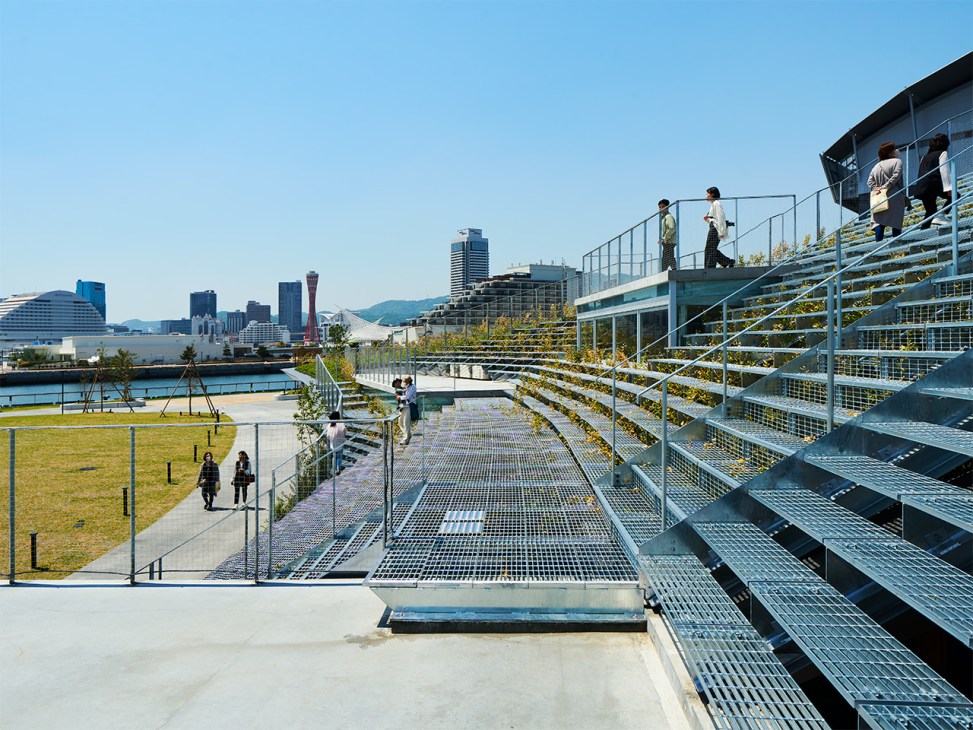
The city of 1.5 million is sandwiched between the Seto Inland Sea and Rokko mountains. “When you walk through Kobe, the dense concentration of high-rise buildings makes it difficult to understand the connection between the sea and the mountains,” says Hata. Once you reach the waterfront, however, the region’s dramatic topography reveals itself. The brief called for a large public space so Hata designed a grassy plaza before raising one corner by 11 metres, creating a hill that opens up to those panoramic views.
Hata’s idea to combine an outdoor theatre and a manmade hill demanded complex engineering. “To realise the hill, we used moisture-retaining lightweight soil and planted two varieties of bamboo grass of differing heights, capable of withstanding harsh seaside conditions.” The design allowed for rapid drainage of seawater even when exposed to large waves. For the theatre part, stepped platforms made from metal grates float above the planted slopes, allowing sunlight to reach the vegetation below while providing spaces for people to sit. The empty space within the hollow hill can be used for events in all weathers.


It’s an impressive reinvention of a piece of unwanted urban infrastructure – and Kobe has embraced it. Hata thinks that the idea could work elsewhere too. “People are drawn to waterfronts,” he says, “It suggests a universal quality that extends beyond the context of Kobe.”