South Tyrol: Cultivating the future

A combination of southern European sunshine and Alpine air has guaranteed that South Tyrol is a grower’s paradise. While grapes and apples are the traditional crops in this region of northern Italy, its real strength lies in the depth of expertise surrounding them. Across South Tyrol, agricultural know-how, combined with an innovative spirit, has inspired distinctive new ways to bring food to market, from advanced farming techniques to developing new products and business models.

Food industry
VOG – Home of apples
Drive through South Tyrol and it won’t be long before you spot a row of neatly planted apple trees. Often covered with netting to protect them from summer hailstorms, such crops have found the perfect home in South Tyrol. The region produces a crisp five billion hand-harvested apples every year. This accounts for eight per cent of Europe’s apple production and the industry is worth about €1bn per year to South Tyrol.
One of the major players in the region’s industry is VOG. The “home of apples” is Europe’s largest apple organisation, built on co-operative roots and fuelled by an entrepreneurial mindset. The consortium unites 10 co-operatives and more than 4,000 family-farms, helping them thrive together. Many of the region’s producers come from generations of farmers, including Bernhard Lösch, who inherited organic orchards near Merano from his father, just as his father had before him.


VOG drives innovation across products, production models and routes to market. It also focuses on the promotion of apples, whether that is telling the stories behind the products – Marlene, one of its several brands, is presented as the “Daughter of the Alps” – or helping consumers understand different varieties and learn about new pairings. “We are always trying to discover new ways to experience the apple,” says Hannes Tauber, VOG’s chief marketing officer. By uniting growers, brand expertise and an entreprenerual mindset, the consortium shows how South Tyrol brings fresh ideas to a long-standing, traditional crop.
Dr. Schär
The expansive, architecturally striking headquarters of Dr. Schär in South Tyrol is a fitting base for a company with global reach. Set alongside apple orchards with the region’s mountains as a backdrop, the Burgstall building houses a modern food business that recorded turnover of €632m in 2025. Dr. Schär now has 18 sites in 11 countries, from Sweden to Argentina.

It is a remarkable success story for a company with modest origins. Dr. Schär’s roots date back to 1922, when a doctor from Merano practising in Austria pioneered the use of semolina and other food products for children. The company took a giant leap in 1979 when it was bought by Ulrich Ladurner. “He saw an opportunity to enter a white space,” says CEO Hannes Berger. “Nobody was tapping into it.”
The space that Ladurner identified was providing gluten-free foods for coeliacs who had long struggled for options. In the 1980s, Dr. Schär began with gluten-free bread and bakery products, but today it produces everything from chocolate-chip cookies to pizza bases. The brand’s recognisable yellow packaging is a staple of health food shops and supermarkets around the globe.


The context may have changed, given that food-related illnesses and intolerances are now widely recognised, but the family-run business has remained true to its core values: helping people who require special nutrition. “We have a pioneer approach,” says Berger, a sentiment easily witnessed through Dr. Schär’s growth into new categories and markets globally.
Profarms
In the countryside south of Bolzano/Bozen, there is a neoclassical villa that hides a futuristic business. Once the residence of an Austrian count, today it is one of the homes of Profarms, a start-up radically rethinking agriculture in South Tyrol.
The company produces indoor-grown microgreens, a fresh addition to South Tyrol’s well-established apple, wine and honey industries. Founded by duo Ulrich Kager and Patrick Sanin, the idea was first conceived on Kager’s parents’ farm. “We didn’t want to do the same as everyone else,” says Kager, who is also the company’s CEO. “We can grow from 1 January to 31 December with a regional product.”
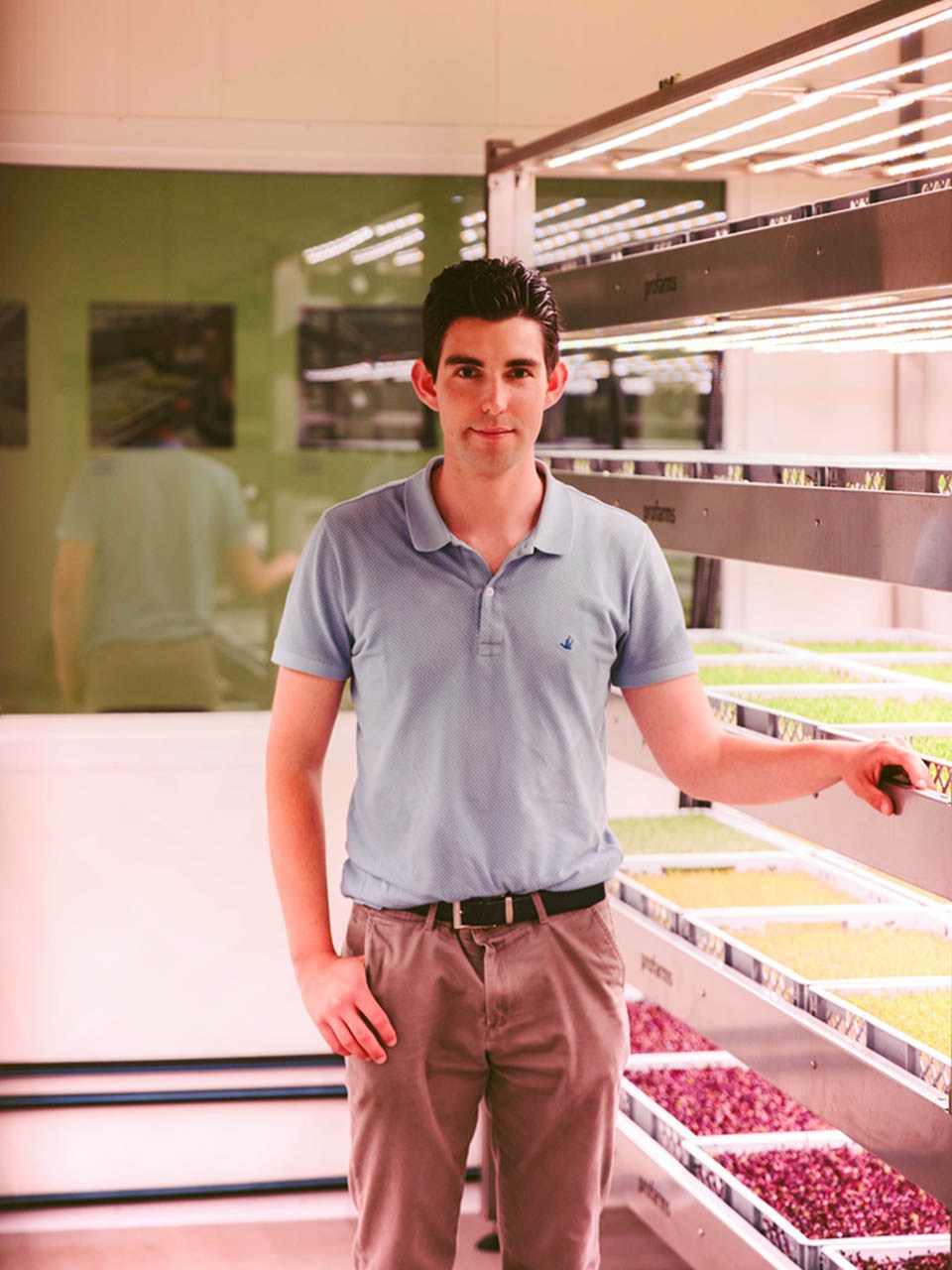

Vertically farming a chef-favourite ingredient proved both lucrative and efficient, with crops consuming low amounts of water and taking only about 10 days to grow. “We are one of the few places doing vertical farming in a sustainable way,” he says. Profarms sells its produce to food markets and works with restaurants and hotels, supplying 11,000 chefs every week with greens such as nasturtium and pea shoots. The entrepreneurial company has also developed a franchise model to expand Profarms to other areas, with Kager and Sanin providing everything from seeds to their own bespoke software which automates much of the growing process.
By combining South Tyrol’s agricultural tradition with new production methods, Profarms is showing how a small Alpine region can shape the future of food.
Find out more at suedtirol.biz