The Entrepreneurs
Little by little
09 /100
Fourth city putting business first
Aalborg, Denmark
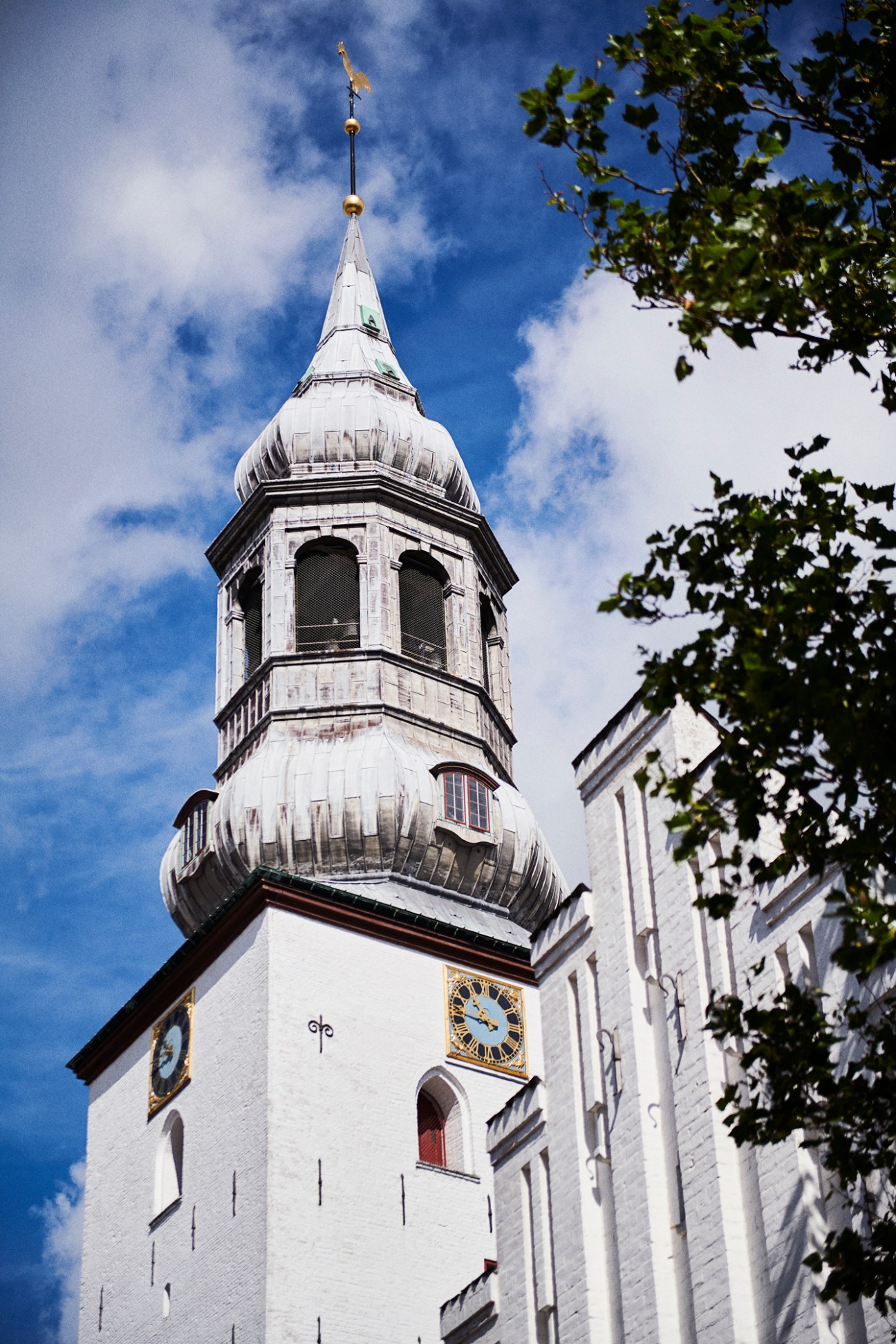
Copenhageners can sometimes be sniffy about Denmark’s fourth city. The capital is where much of the country’s design industry is based and where the New Nordic food movement started. But for many of Aalborg’s entrepreneurs, the north Jutland city’s small scale is one of its big attractions.
Home to almost 217,000 people, this was once a major centre for the country’s shipbuilding and heavy industry. That might have disappeared towards the end of the 1990s but, over the past decade, the harbour front has seen major redevelopment, including a Jørn Utzon-designed exhibition centre and concert hall Musikkens Hus. And entrepreneurs have found room to grow too.
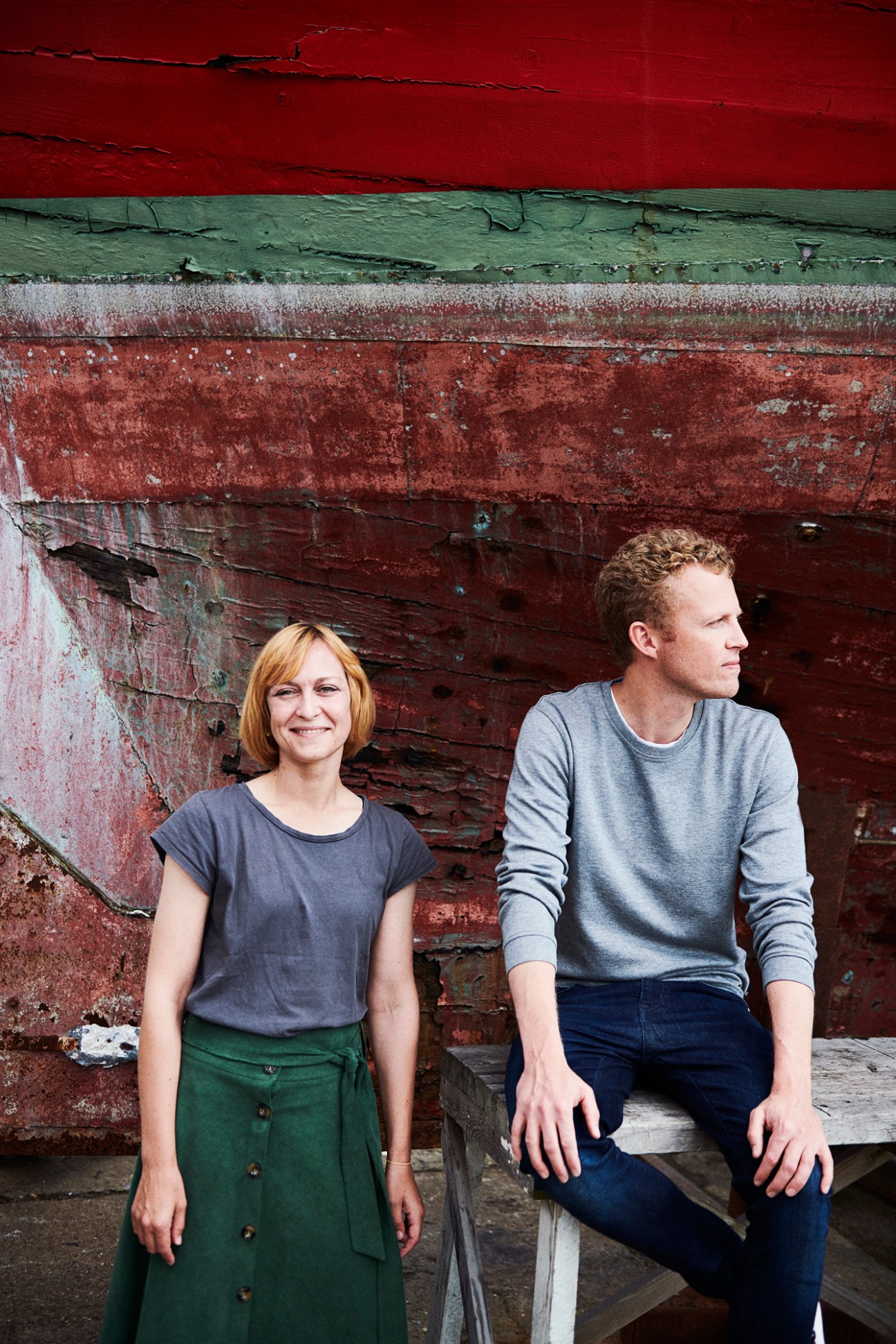
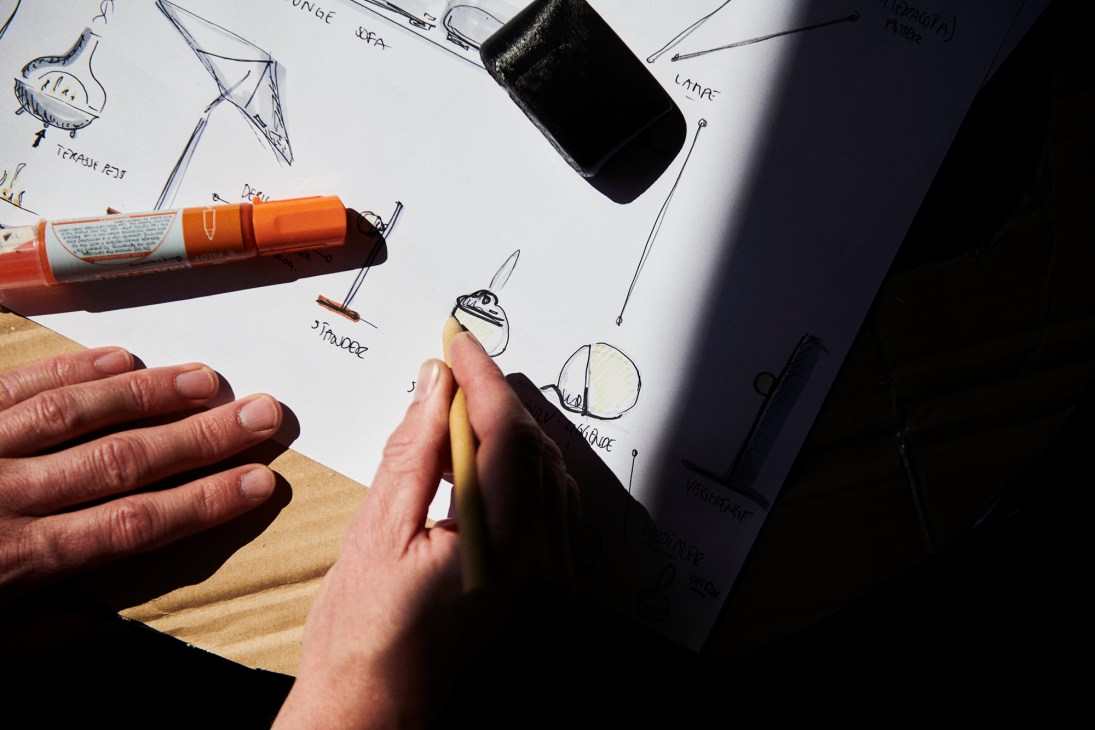
Aalborg’s old industrial buildings have provided cheap premises for start-ups: designers Pia Würtz and Thomas Steffensen were among the first to make the most of it when they opened their practice in a former shipbuilder’s canteen in 2016. Today their clients range from Swiss bathroom company Fraefel to Danish kitchenware manufacturers Rosti.
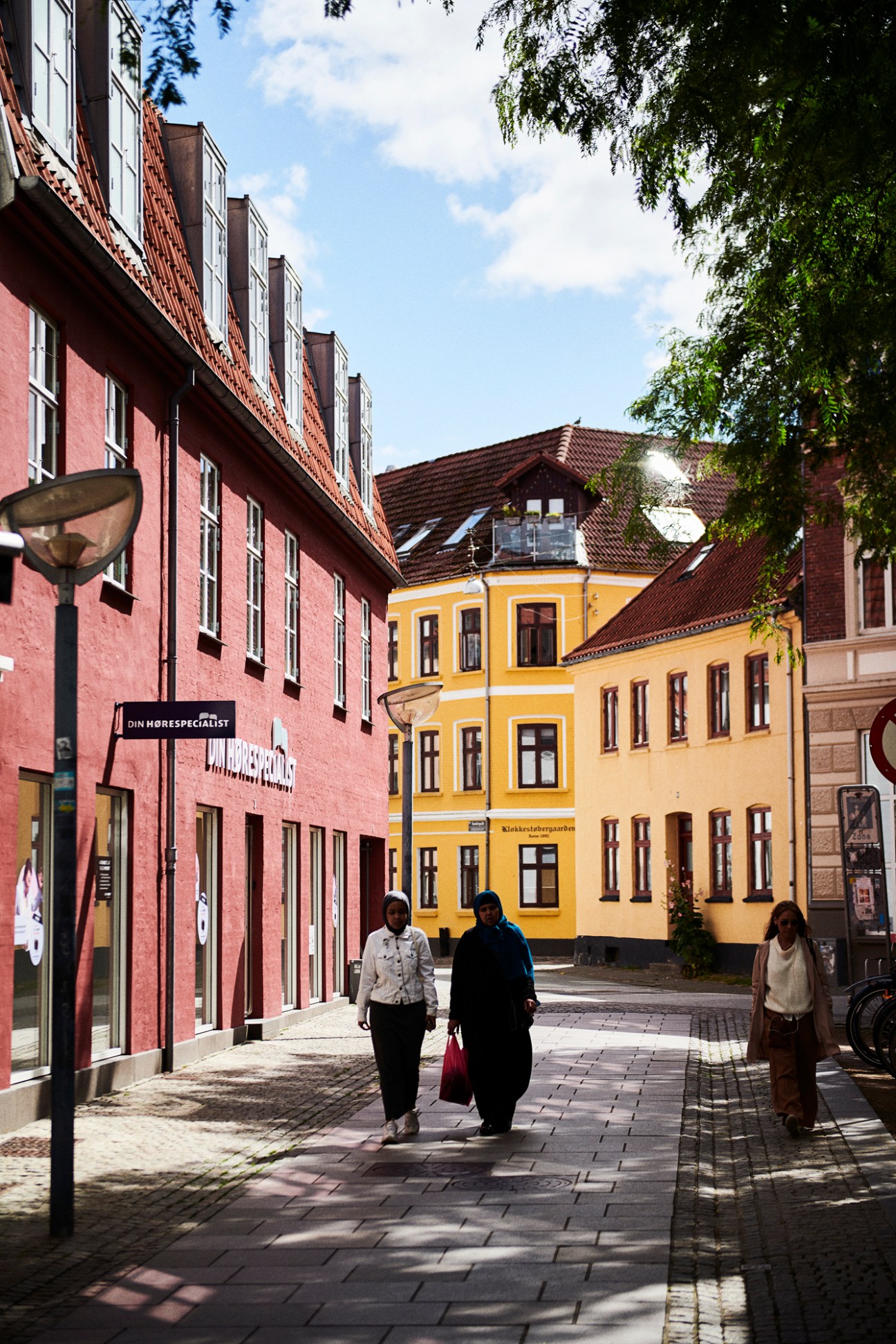

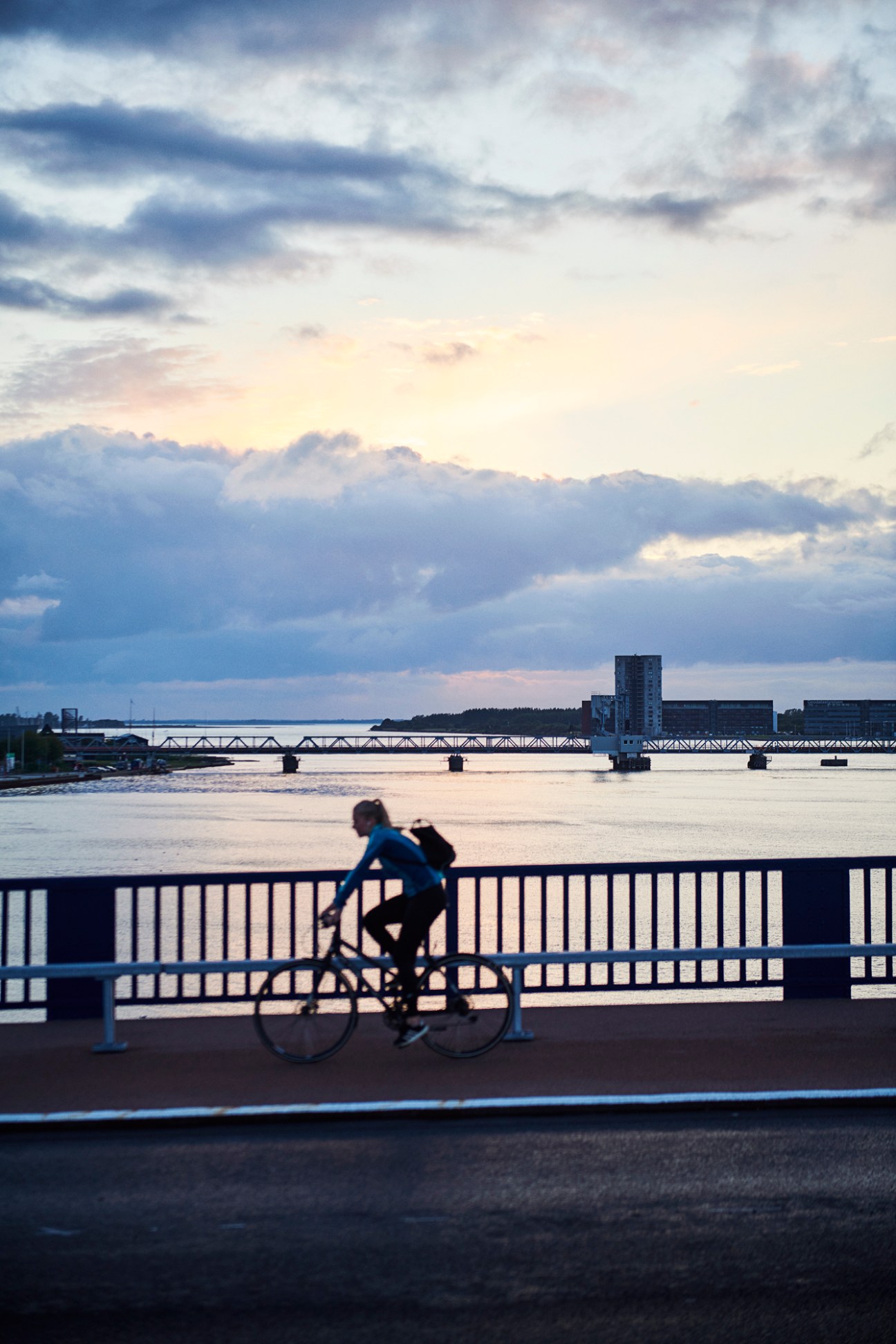
As the city continues to expand its brownfield-site developments, some of the cheaper options for offices have been threatened – but Aalborg retains its relaxed air. Being within cycling distance of forests and the coast helps. “You never even hear people ring their bells,” says Würtz. “We like the slower tempo; people here are down to earth.”
Aalborggenser (as the locals are known) might be a no-nonsense crowd but they still get to enjoy the world-class produce purveyed by the city’s businesses, including new restaurant Alimentum, founded by chef Soren Birch and manager Simon Kvist Bjerre. “No bank would back us but we found an amazing business angel who owns this building,” says Bjerre. With dkk350,000 (€47,000) in backing to add to dkk150,000 (€20,000) of their own, they opened their venture in a former Chinese restaurant in 2019, serving a seafood-heavy menu and natural wines. Despite a tough year so far, Alimentum has flourished thanks to a devoted clientele and even expanded – opening a wine shop across the road and leasing a farm 20 minutes outside the city. “We were lucky because Aalborg was ready for something new,” says Birch, who adds that, despite everything, they expect to turn a profit this year.
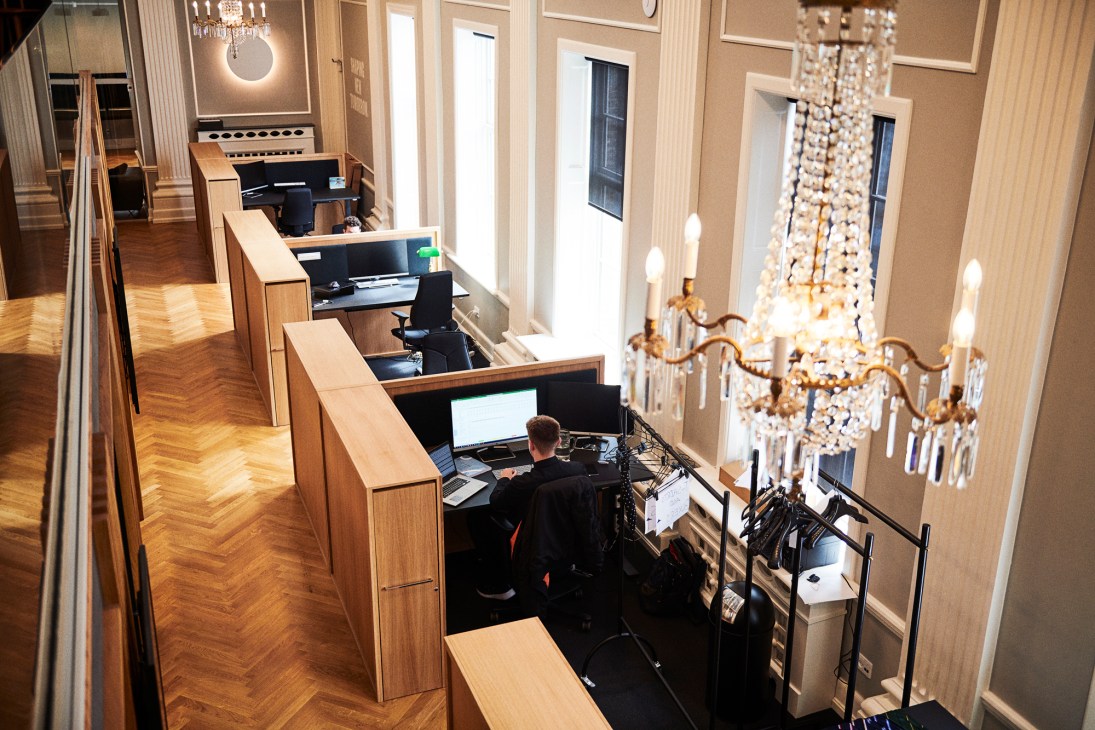
Some entrepreneurs who set up shop in Aalborg are now looking to expand further afield. Friends Christoffer Bak, Kasper Ulrich and Christian Aachmann were born here and founded their line of smart-casual menswear in 2015. An appearance on a TV show helped rocket Shaping New Tomorrow to national awareness. “Afterwards, we were selling for dkk1m [€135,000] a day and it was chaos for a month or two,” says Bak. “As word spread, the sales continued.” Last year, turnover was dkk100m (€13.5m), via online sales and two shops in Denmark. The company is now venturing into the Netherlands, Germany, Austria and Sweden, and has its long-term sights set on the US, with a goal of dkk1bn (€135m) in sales a year.
The ambitions of entrepreneurs such as Daniel Christensen and Mette Jakobsen might be less grand but their decision to start up in Aalborg still made a difference. They relocated from Aarhus in 2019, having started game-developing company Galdra Studios in 2017, because of the cheaper rents and help from the council. “I mentioned our idea at a meeting and within 24 hours they set us up at a workshop and put us in touch with their business consultants,” says Jakobsen. The advice and funding that they received from Vaeksthuset (The Growth House, part-funded the Danish unemployment service) has also been crucial.
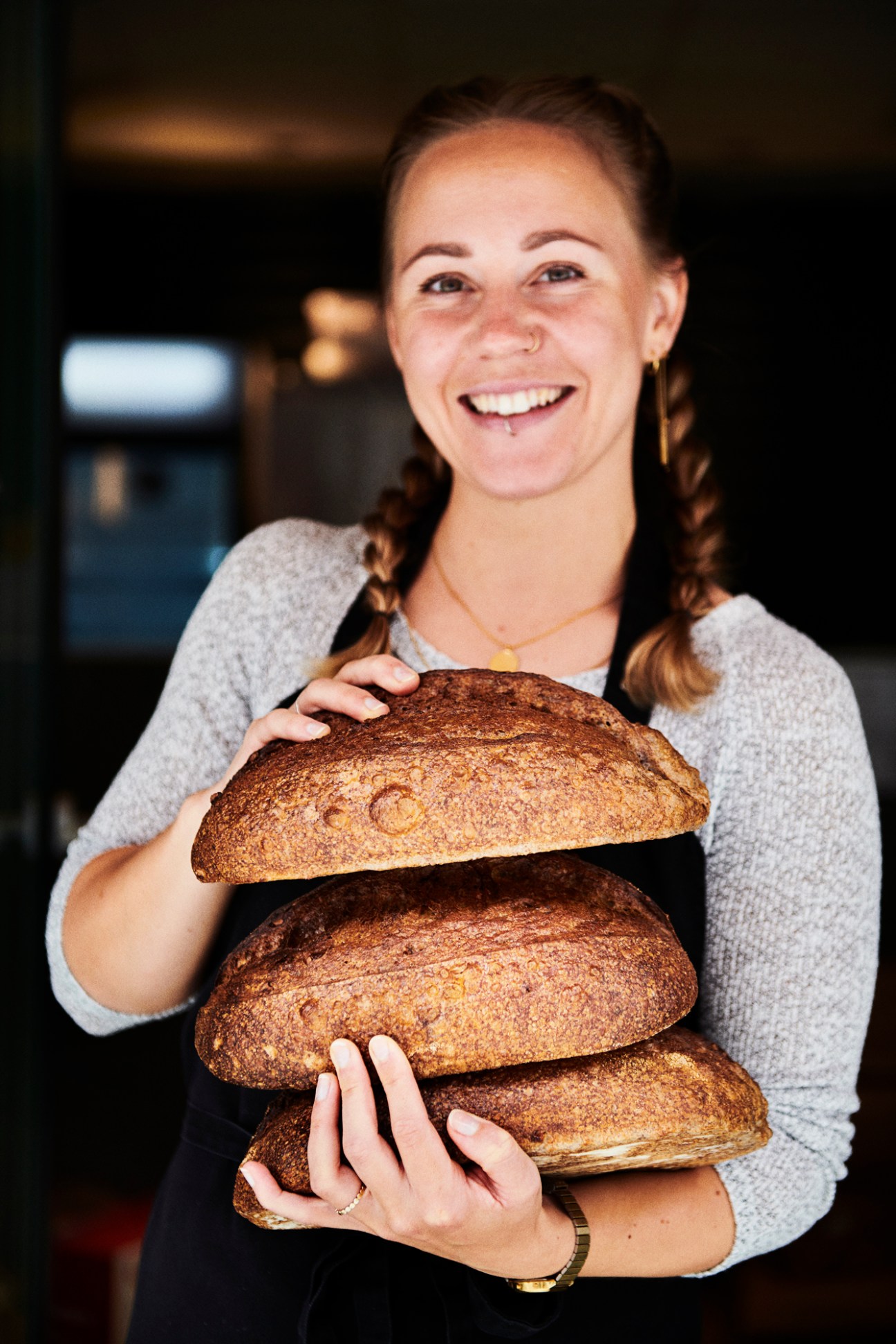
A supportive environment extends to awards and grants: Henrik Bruse Skougaard opened his bakery, Surdejsbageren, in 2019 and a few months later bagged the dkk10,000 (€1,300) prize that came with the title of 2020 young entrepreneur of the year – a mark of his success in weathering the pandemic thanks to a nifty service hatch and baking kits. “After lockdown was announced we had one quiet day but then it took off again and kept going,” he says.
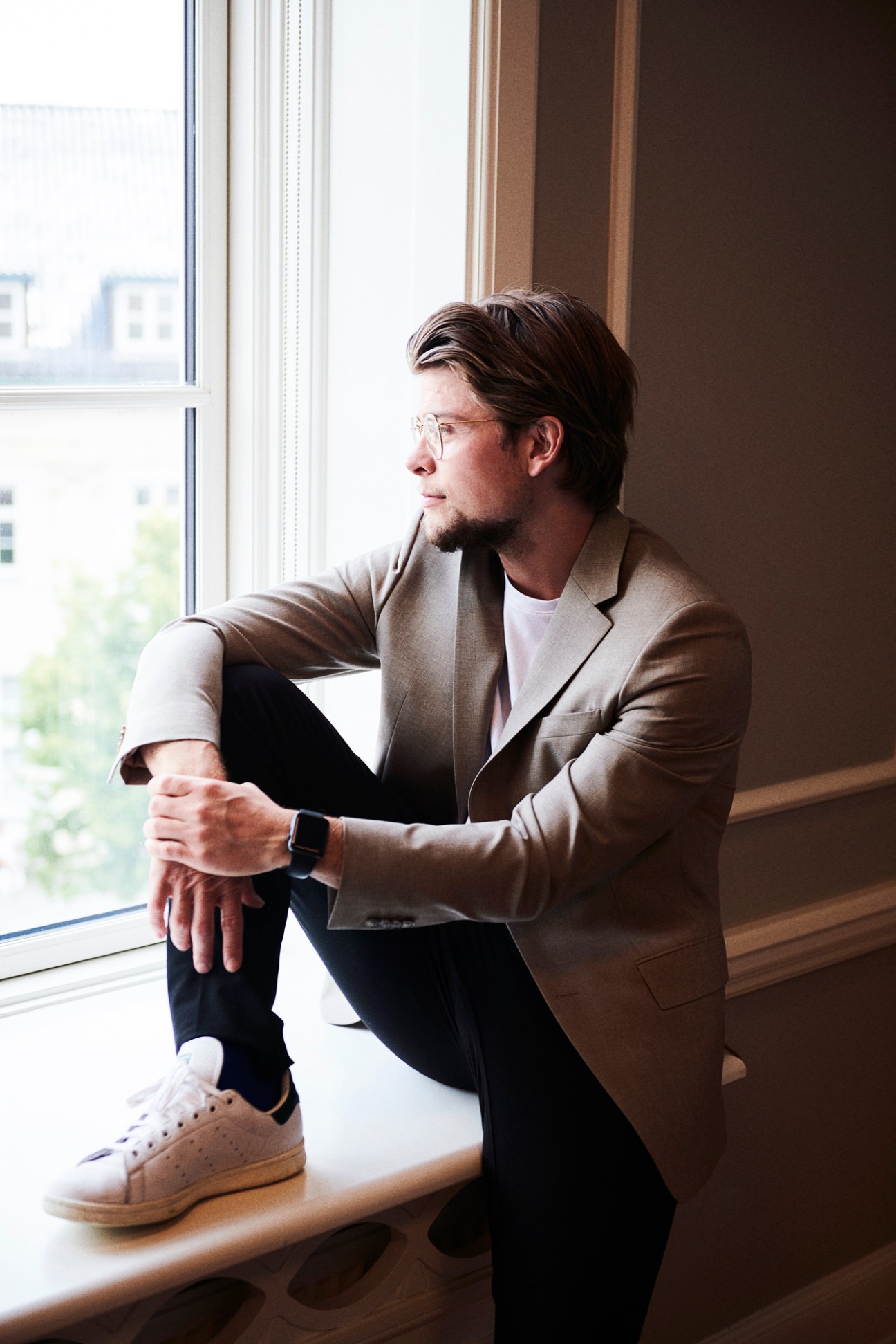
The former chef started his bakery with just dkk30,000 (€4,000) after being offered a space beneath a café. His organic wholemeal and rye loaves were turning a profit within five months; he now has eight employees and, thanks to investors, he’s moving to larger premises in October. “I’ve always been fascinated by good bread and just wanted to show people what it was like,” he says. “I’m so happy with all the support the neighbourhood has shown me.”
Getting bigger and better
Aalborg has a young and global population: 40 per cent of its residents are under 30. The city is growing: population is expected to rise to 227,000 (from 217,000) by 2031; 9,000 companies are based there; and 1,000 new ones are set up every year. It has Denmark’s third largest airport too. Some of the world’s top energy researchers also make Aalborg a driving force behind technological and industrial developments.
10 /100
Shore starter
Busan, South Korea
Busan is a mix of old and new, cityscape and seaside, container shipping and surfing. Global commerce and conventions are big business in this southeastern port city of 3.5 million but there are also pockets of creativity and charm, as well as cheap rents.
The once abandoned area of Haeridan-gil has seen a revival in recent years, with the opening of a flurry of shops. Start-ups have also been capitalising on national initiatives to reduce economic reliance on Seoul and mega-conglomerates. While these chaebols are too big to flail, they have been co-opted into supporting small and medium-sized businesses. Last year, conglomerate Lotte hosted its first accelerator programme in Busan and provided funding and office space to entrepreneurs from Hong Kong and Vietnam.
Busan also benefits from being home to Korea’s film industry and it pulls in a global audience every year for its international film festival. Getting here is a doddle: there are connecting flights to most major cities in the region and the high-speed train to Seoul takes less than three hours, making this seafront city an excellent port of call.
11 /100
Different cloth
St Gallen, Switzerland
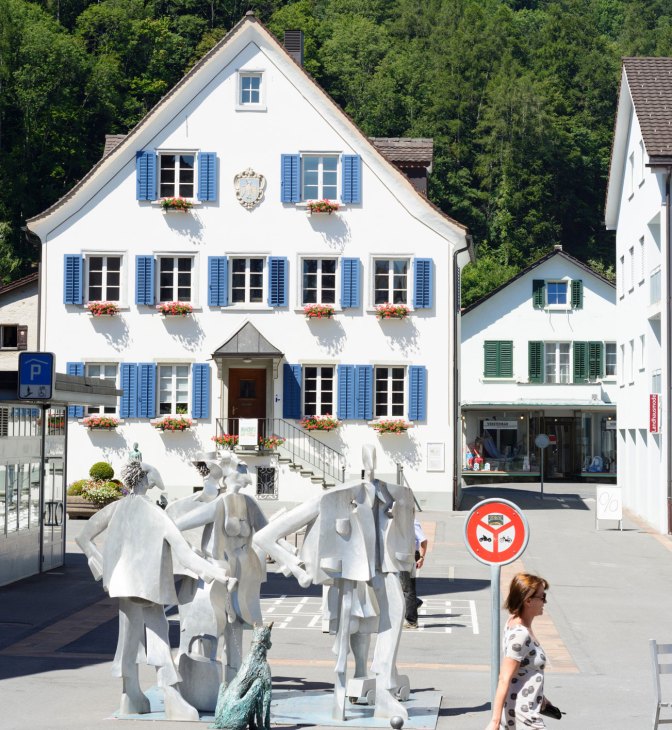
St Gallen was once the hub of the Swiss textile industry, with a direct train line to Paris delivering fine laces and couture fabrics. The glory days led to the establishment of one of the leading business universities in the German-speaking part of the world. Some textile expertise remains but today the region’s industry also includes hi-tech companies and brands dealing in fine mechanics.
Through its proximity to Zürich Airport, St Gallen is well-connected and being close to Lake Constance makes it the ideal location for those who prefer a gentler pace of life. But despite its quaint appearance, it’s home to a thriving art scene, good restaurants (this is the home of St Gallen bratwurst) and affordable rents. Its manageable size makes it an ideal base for anyone starting a business that will benefit from skilled labour, excellent technological infrastructure and educated minds.
12 /100
Support network
Dunedin, New Zealand
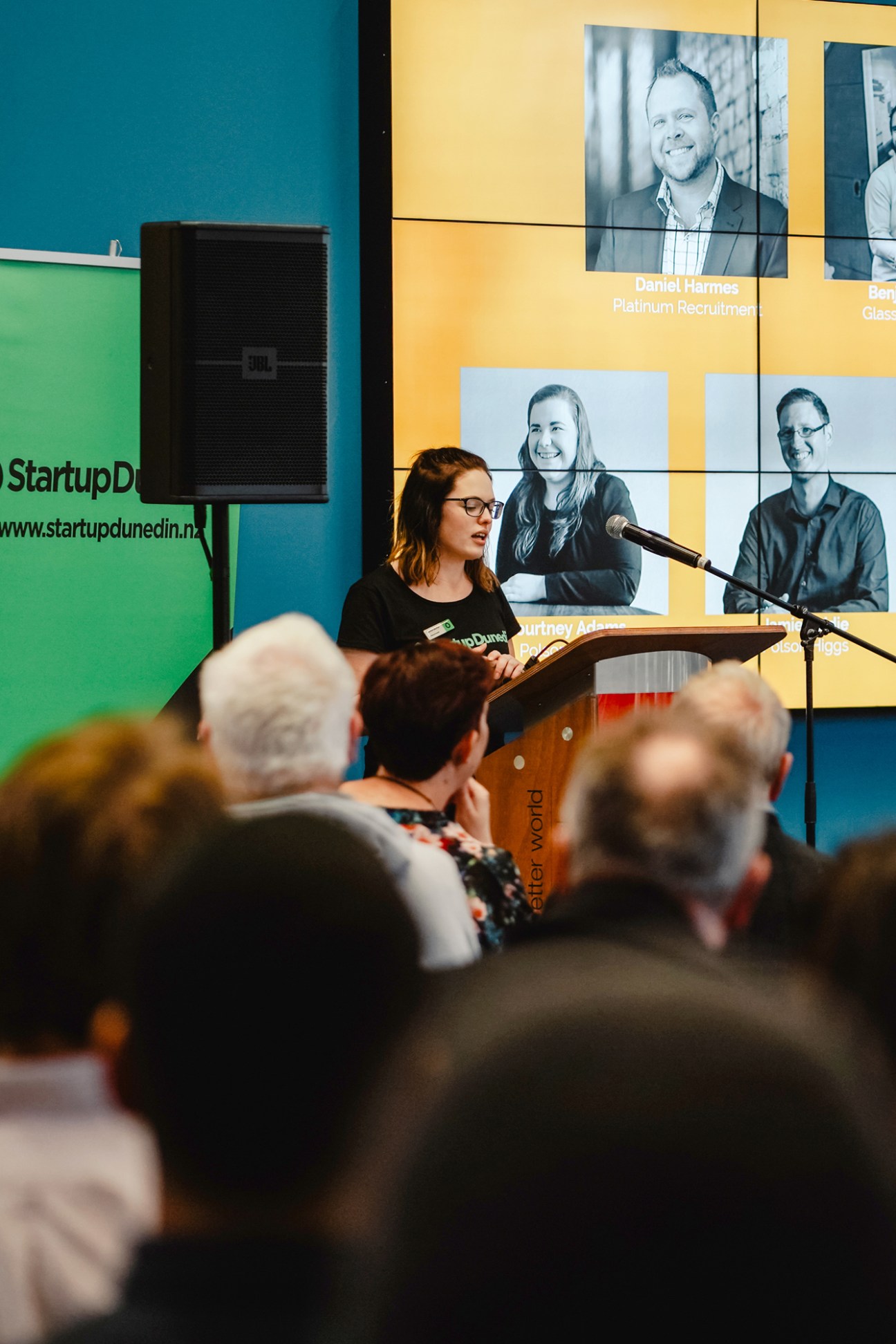
Dunedin is perched low on New Zealand’s South Island but its remote location hasn’t deterred the creative technology companies that dominate its start-up sector. They often choose the city for its lower leases; many have popped up in the Warehouse Precinct. Despite being abandoned in the 1950s, the area has been revitalised in a way that honours its history.
Some entrepreneurs have moved from as far as the US, enticed by the city’s support for new business. “Dunedin hits a good balance: it’s small enough for people to support each other yet it has the diverse, educated population required to build a scalable business,” says Alex Dong, who relocated from San Francisco. Not-for-profit organisation Startup Dunedin offers services including programmes that help newbies. “In Dunedin, I’ve had more support than I can leverage,” says founder of software company CodeLingo, Jesse Meek.
13.
Upward trajectory
Salt Lake City, USA
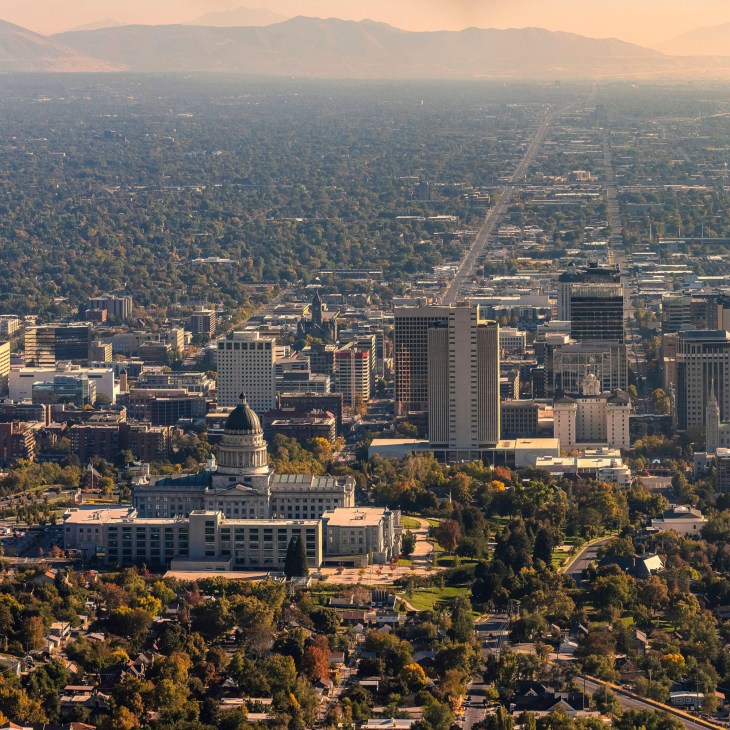
“Salt Lake City has a business- friendly climate that’s bringing a lot of growth and economic development,” says Elle Griffin, editor in chief of Utah’s Business Magazine. With a recent airport expansion and the revival of its downtown centre, the city has become increasingly welcoming for new businesses. When technology entrepreneurs realised they could start their companies at a cheaper rate in Utah than in California, the so-called Silicon of the Slopes was born. Because of the lower cost of living, affordable housing and a plethora of mountainous outdoor activities on their doorstep, more are now making the transition.
The city has always invested in its arts, which makes it a good bet for start-ups in the culture sector, and the food scene is flourishing too. “Salt Lake City now offers businesses tax breaks to set up shop,” says Griffin. “Entrepreneurs are seeing the benefits of being a part of this growing economy.”
Photographers: ULF Svane, Alamy
Banking on it
6.
Goldbell Group
Singapore
Craig McMillan and his wife Juliana Mattar run a small communications agency in Singapore called Motion. They organise internal events for large multinational corporations, such as regional management conferences for Hilton’s Asia-Pacific operation. “We are essentially a projects-based business, so we are at the mercy of our clients’ plans,” says McMillan. In 2020 a strong pipeline of events was put on hold and they watched almost s$1m (€617,000) in expected revenue evaporate, followed by an agonising wait that will be familiar to entrepreneurs around the world. While Singapore’s government declared its intention to help small businesses, banks held back on lending until they could read the small print of any state support. It was during this time that the couple heard about the “Hope Fund” and quickly put in an application.
The s$5m (€3.1m) Hope Fund was created by six Singaporean friends in March to advance emergency loans, each worth s$50,000 (€31,000), to viable small businesses. Alex Chua, a former JP Morgan banker, is one of the key people behind the Hope Fund. “When the pandemic began we thought, ‘We don’t need a foolproof plan; we need a plaster for companies that are bleeding and just need to stem the blood while they find real help from banks and the government,’” says Chua, who heads up the financing arm of his father’s commercial vehicle-leasing business, Goldbell Group. Eight moonlighting Goldbell staff provided the expertise to administer the emergency loans, assessing and approving applications based on willingness over ability to pay them back.
Motion received money within two weeks, helping it to avoid redundancies until a full bank loan arrived two-and-a- half months later. “There was so much uncertainty but the Hope Fund gave us confidence and clarity in our decision-making,” says McMillan. Motion repaid its loan early.
The original idea was for borrowers to move on to a larger, longer-term loan from an established bank but that was shelved after only one out of their 25 referrals met the partner bank’s rigid lending criteria. So Chua decided to do it himself: acting under Goldbell’s banner, he was granted admission to a panel of banks approved by the government to make state-backed loans to small and medium-sized enterprises. It now sits alongside banks including dbs, hsbc and Standard Chartered, issuing unsecured loans of up to sg$300,000 (€185,000) at 5 per cent interest to applicants who have mostly been rejected by more established players. “They added us because they saw what we did with the Hope Fund,” says Chua, who approved loans worth sg$5m (€3.1m) in the first two months, with another sg$10m (€6.2m) to go.
Goldbell is now partnering with a food-delivery platform to offer tailored products to the hard-hit f&b industry. Chua says that the reluctance of major banks to make smaller loans isn’t just about risk, it’s because of the work put into each loan. “The entire credit process and due diligence are the same, so why bother?” he says. Best let McMillan and Mattar answer that one.
7.
Citizens Bank
USA
Bruce van Saun took the helm of Citizens Bank in Providence, Rhode Island, during its 2014 spin-off from the Royal Bank of Scotland. In doing so, the New Jersey native left behind his world of spreadsheets and boardrooms to visit homeless shelters and food banks to improve the regional bank’s community image.Now Van Saun is reaping the benefits: the bank, which operates nationwide with branches in 13 states, has regained its vitality, reporting $180bn (€152bn) in assets at the end of June, compared with its $122bn (€104bn) nadir in 2013 before the spin-off. Global Finance magazine named Citizens this year’s best regional bank, for both New England and the Mid Atlantic region. And industry bible American Banker selected Van Saun as its 2019 banker of the year.
Customer experience is a key focus: the bank conducted a national survey and found that while the pandemic was accelerating customer reliance on online services, large majorities still want face-to-face interaction at least some of the time. “It’s clear that personal interaction remains important to customers, so financial institutions must find ways to serve them seamlessly in their channel of choice,” says chief experience officer Beth Johnson; her job title is itself an innovation. Citizens also works with 20 financial-technology firms to support consumer, small business and commercial banking. That should help ensure that it can keep up with the big banks on technology while preserving the personal touch of a regional bank.
8.
GLS Bank
Germany
With a long tradition in recycling, organic agriculture and renewable energy, it shouldn’t be surprising that Germany is a leader in sustainable banking. “Ethical banks have shown the most resilience in these times of crisis, because we mostly finance bare necessities such as energy, housing and nutrition,” says Thomas Jorberg, CEO of Germany’s gls Bank. It’s this focus on the essentials that he says limits loan defaults in ethical banking, while traditional banks take riskier bets on more volatile industries.
While there are now dozens of socially responsible German banks, gls was the first of its kind when it was founded in 1974. Besides investing in areas such as organic farming, wind farms, free schools and affordable housing – and openly communicating the projects it funds – gls Bank extends its ethical credentials to creating a fair deal for the customer. The aim is not to get the maximum amount of money from the customer but to be as respectful of their needs as possible.
In response to the pandemic, gls Bank has been quick to help companies and individuals in precarious situations, for example by offering an emergency fund for artists who were struggling when cultural events were suddenly cancelled. “gls Bank does not only consider money as a means of payment but as a medium for shaping a future that we all desire,” says Jorberg. “Funding ethical practices is the future-proof solution.”
Images: Getty Images
Forward thinkers
1.
Jeremy King
Restaurateur
About the interviewee: King is a celebrated restaurateur and co-founder of hospitality group Corbin & King, the company behind grand cafés such as London’s The Wolseley and Fischer’s. An outspoken critic of the British government and its support for the hospitality industry during the pandemic, he talked to Monocle 24’s The Chiefs about the need for calm in all situations.
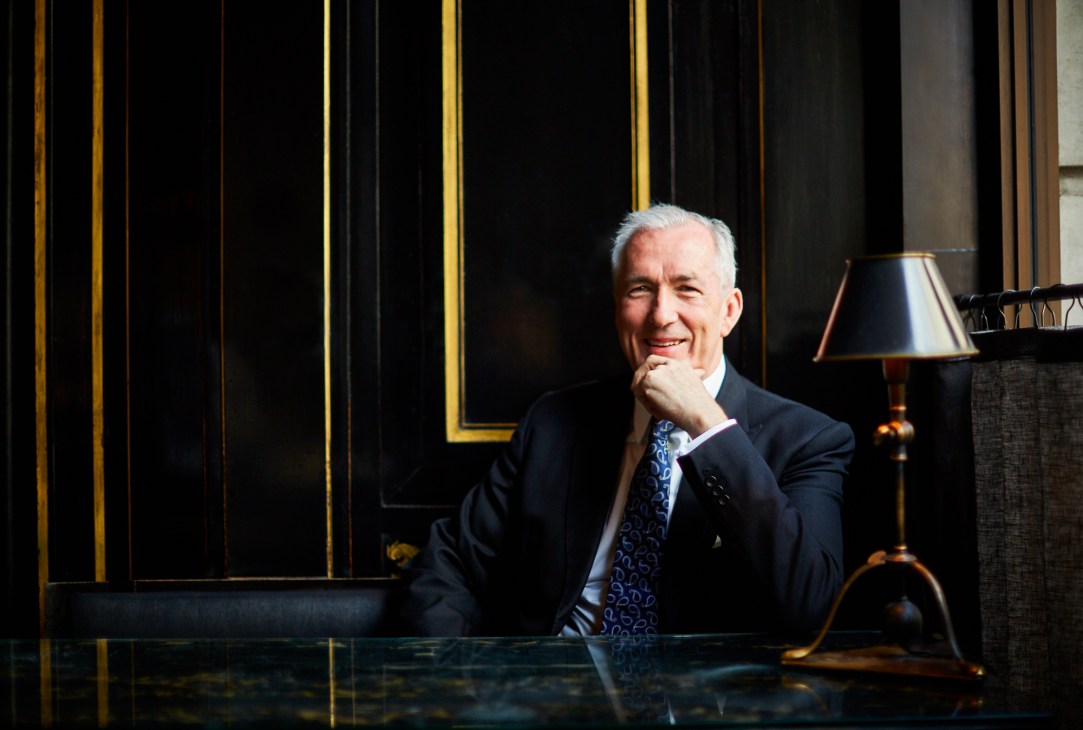
“I’m old enough that I’ve been through quite a few really serious downturns, where it’s worked out in the long run. As an industry, we’re better served now because there’s a body called UK Hospitality fighting on so many different fronts. Remember, hospitality employs close to three million people in the UK and contributes fantastic revenues but we have a home secretary who describes us all as unskilled workers and treats us with contempt. Top that up with the pandemic and problems with the furlough scheme – even though I am full of admiration for the government action – and a lot of people are disappearing.
I was delivering a talk just before the lockdown, addressing about 120 people, where I was being more positive than anybody else was about Brexit; even though I decried and hated it, I said ‘we’ll be fine’, because where the British are really interesting is this notion of not knowing where we stand. If we don’t have anything to fight, we start moaning. Some people just collapse in a puddle on the floor and say, ‘woe is me’. But most people work on the basis that we’ll make good of this. So I think the human capacity to take short-term pain, readjust and become positive, is there. I don’t think that everything is going to be so different. But what it will do is shake out a lot of restaurants – we were overserved – and people might even appreciate them that much more.
“My advice is to always remain in control, even if it means starting really small”
We’ve seen these polls where people are asked, ‘What did you miss most through lockdown?’ Number one tends to be family but normally number two is going to restaurants or the pub. We go to restaurants is for any number of reasons because the restaurants act as a catalyst; you can make of it whatever you want – dates, business meetings, reunions, seduction, divorce – all of these different things. But the other aspect, and what I’ve gleaned from people over the past few weeks, is that they miss what I like to call the conviviality of community. And I think that we all need that community.
For anybody coming into the restaurant business, my recommendation is to first treat your customers as though it’s your opening week, however busy you are. There is this danger for restaurateurs and restaurant staff where there’s a propensity to arrogance and complacency once they get busy. The second problem is that often restaurateurs don’t own their businesses; my advice is to always remain in control, even if it means starting really small. For me, the best restaurateurs are the ones who have control over their business – because otherwise they’re at the mercy of financially motivated people. I always say that too many restaurants are run from boardrooms and that’s an impossible way of doing it. The only way you can really run restaurants properly is from the floor, where you understand who the people are.”

2.
Hao Tran
C0-founder, Vietcetera
About the interviewee: Tran is one of many Viet Kieu (overseas Vietnamese) returning to the country that their parents left because of the Vietnam War and founding companies that draw on their experiences of East and West. In four years, Tran has built one of the only sustainable private media businesses in the country. Headquartered in Ho Chi Minh City, Vietcetera employs 40 people and its lifestyle-focused news site – in Vietnamese and English – is read by millions in a country where much of the media is state-controlled. Tran told Monocle 24’s The Entrepreneurs why media will grow – and how expat entrepreneurs can best contribute to their native countries.
“The first time I returned to Vietnam was when I was 15 years old, with my parents. I was afraid to leave the hotel. At the time, my identity as a Vietnamese-American was more American than Vietnamese. It was quite foreign; it was my first time in Asia.
I visited again when I was 23. As a newly minted college graduate, Vietnam was fascinating. When I went back to San Francisco, I couldn’t stop thinking about the potential. But I left Vietnam thinking, how can I possibly work here? That’s still the overriding perception that people have of a third-world country like Vietnam: how can you have a career here, let alone start a company?
I found a Wall Street Journal article about a venture-capital firm opening an office in Vietnam. I decided to drop a note to the partner, a Vietnamese-American. We met six hours later, since we were both in San Francisco, and he offered me a job.
And that’s how it happened: I moved out here and, about a year later, I decided to go full time on Vietcetera. My motivation for starting it was to better understand Vietnam. At the time Vietcetera was a blog and a mechanism to meet people; my interest in media grew from discovery and learning more about the industry. Media is a double-edged sword: it’s a lot of fun and the personal career development is phenomenal but, at the same time, the industry has its challenges. I don’t see it as a back-against-the-wall challenge; it’s been incredibly enjoyable and we’re lucky to have investors backing us.
“We have a lot of brands looking to navigate or enter the Vietnamese market”
Before we even raised capital from investors, we were profitable. Last year we booked just under $500,000 [€425,000]in revenue as a three-year-old media company. This year we’re on track to hit about $1m [€850,000] in revenue. The market is ripe for new opportunities. You can run the gamut to see what can be improved in Vietnam. And we are doing our small part.
Advertising is 10 to 15 per cent of our revenue. The bulk comes from sponsored content, from Vietnamese and international companies. They’re all trying to reach this audience of millennials aged 22 to 35 that we’ve created. There are a lot of brands that happen to be attracted to this audience because it’s the fastest-growing demographic in Vietnam – and the second largest in Southeast Asia, just behind Indonesia.
Our Vietnamese audience represents 98 per cent of readers. You might ask why we invest in English, at only 2 per cent. Our monthly active user count is on track to hit one million this month; 2 per cent is 20,000. Those 20,000 people are international businesspeople, powerful thought leaders and advocates for the Vietnamese brand. We also have a lot of brands looking to navigate or enter the Vietnamese market, using our site to understand it.
We’re all trying to drive a better Vietnam and be advocates for the country. We are one of few private media companies here and we happen to operate in a space where we need to be sensitive. But, given the kind of content we’re creating, we’re promoting Vietnam. I think there’s enough negativity in the world today; we’ve always been very deliberate about promoting positive content.
I’m more comfortable speaking in English speaking than Vietnamese. We are definitely outsiders but we want to contribute. At our company we’re about 40 full-time staff; I’m the only one who doesn’t speak Vietnamese natively. That’s a sign of how, as a community and as a society, the Vietnamese are holding their own. As foreigners we add to that but we’re definitely not the foundation.”
3.
Roxanne Varza
Director, Station F
About the interviewee: Varza is the Iranian-American director of Station F, a start-up incubator in a 1920s former railway depot in Paris. She told Monocle 24’s The Entrepreneurs why working from home doesn’t work for budding enterprises.

How have the past few months been for Station F?
This was the first time we ever had to close Station F in its history. We reopened in May, obviously adjusting to the kind of new normal that everybody’s talking about, seeing a lot of companies continuing to work in a hybrid model; seeing spaces used differently, people taking new measures in organising how they meet and work together, adapting to a lot of these changes. But what’s also been fascinating to see is: I feel like we started the crisis saying that we’re all going to go fully remote. I feel like now the discourse has changed to say, “We’re sick of remote, we can’t stand our screens, we want to see each other.” At Station F we’ve come back to the numbers that we had prior to confinement.
What has the energy been like with people returning?
I think that now people just kind of want to get back to work. We’re seeing a lot of teams reorganise, a lot of teams are doing more remotely than before but they’re not fully remote. We conducted a study – not just with Station F but covering different kinds of start-ups in the US, the UK, France, Germany and Israel. We had more than 1,000 companies from different stages respond to us and discovered that less than 10 per cent of companies actually plan to go fully remote, which means getting rid of your office, putting your team on remote-working solutions and things like that. I think there is also this mentality that life will probably go back to normal more quickly than we had imagined.
Some companies are considering whether an office is worth the cost. What did respondents say about people being together?
There is definitely still this awareness that we need to see each other physically; that some connections and serendipity happen when we’re together that you just cannot replicate online.
For a start-up looking for the next idea or fundraising or for a mentor, how important is it to have a space like Station F for in-person meetings?
Even before the pandemic we saw all kinds of models; some people are comfortable meeting candidates in a coffee shop or not having an office. Young start-ups competing for talent and customers – particularly if they’re working in the b2b space – need the credibility of an office. There are also people out there who don’t have the right working conditions where they live. So the office will still serve a purpose in the long term. I’d encourage companies to consider some form of space. I don’t think everything can be done in someone’s living room.
4.
Bracken Darrell
CEO, Logitech
About the interviewee: Darrell became CEO at Logitech in 2013. The multinational technology firm’s HQ is nestled beside Lake Geneva in the city of Lausanne. Founded by Swiss and Italian Stanford alumni in 1981, today it is a maker of everything from webcams to headsets, keyboards to surround sound, gaming gear and video-conferencing systems. Worldwide lockdowns have played to the company’s strengths, reflected in an impressive revenue growth of 23 per cent in the first quarter of this year. Darrell talked to Monocle 24’s The Chiefs about what Logitech has in store for ensuring its growth beyond the current crisis.

We’ve seen the evolution of so many players in your sector. Describe where you were a year ago and where you expected to be.
A year ago today we were in our fifth year of near or double-digit growth. We were following four big trends: video; people working from anywhere; the rise of eSports-PC gaming and democratisation of content creation – the move to individuals creating all the content. Those four markets were 90 per cent of our business. We’re now in this spot where those trends are moving into what, without the pandemic, it probably would have looked like in 20 years.
When you look at those four focus areas, how much of that was external and how much was homespun?
It’s 100 per cent homegrown by virtue of the fact that we have a model that’s really fun and interesting. We’re extremely design-driven. We didn’t have a single designer when I joined. I hired the former head of design from Nokia, Alastair Curtis, who’s been my partner ever since. We have a process called “trees, plants and seeds.” The seeds are things that nobody knows about: very small teams trying to create new categories or enter categories as something different. That experimentation and entrepreneurship has been what’s driven us into these four areas. We want to be the big fish in small ponds, not the other way around.
What is the design process like?
We have a super-dynamic organisational structure. When Curtis started, we created a classic centralised design organisation; most of it either in Silicon Valley or Switzerland. After three or four years we felt that was getting stale. Alastair pushed the designers out into the businesses; now they’re all over the world. Now we’re changing it again: we’re pulling some of those people back in again to work on completely new and upstream things, while leaving others in dedicated teams.
Do you think there’s a power that you have as a brand with a base in Lausanne, as well as a base on the West Coast of the US?
We love being Swiss. We are a Swiss company at heart. Two of the three founders were Swiss. Our headquarters are in Lausanne and you can feel the “Swissness” running through us. We’ve had a big advantage where those same founders actually went to Stanford, earned a graduate degree in software engineering and started Logitech simultaneously in Palo Alto and Lausanne – or actually in Apples, Switzerland; you can’t make this up. That simultaneous start led to a company where we feel as though we are a combination of Swiss, American and Chinese. We have the high-quality orientation of Switzerland, the entrepreneurial spirit of the US and the speed of China.
Is there also a Swiss card to be played when it comes to premium?
It’s really remarkable how premium and competitive Switzerland can be as this small mountainous country. We definitely benefit from that mindset, whether it’s quality or premium innovation. From a branding standpoint, should we ensure that people understand we are a Swiss company? Probably. In China we have the Swiss flag on our packaging and we try to ensure that people understand we’re Swiss. We are also, proudly, partly Chinese, partly Taiwanese – but we’re Swiss by birth.
5.
Sarah McNally
Founder, McNally Jackson Books
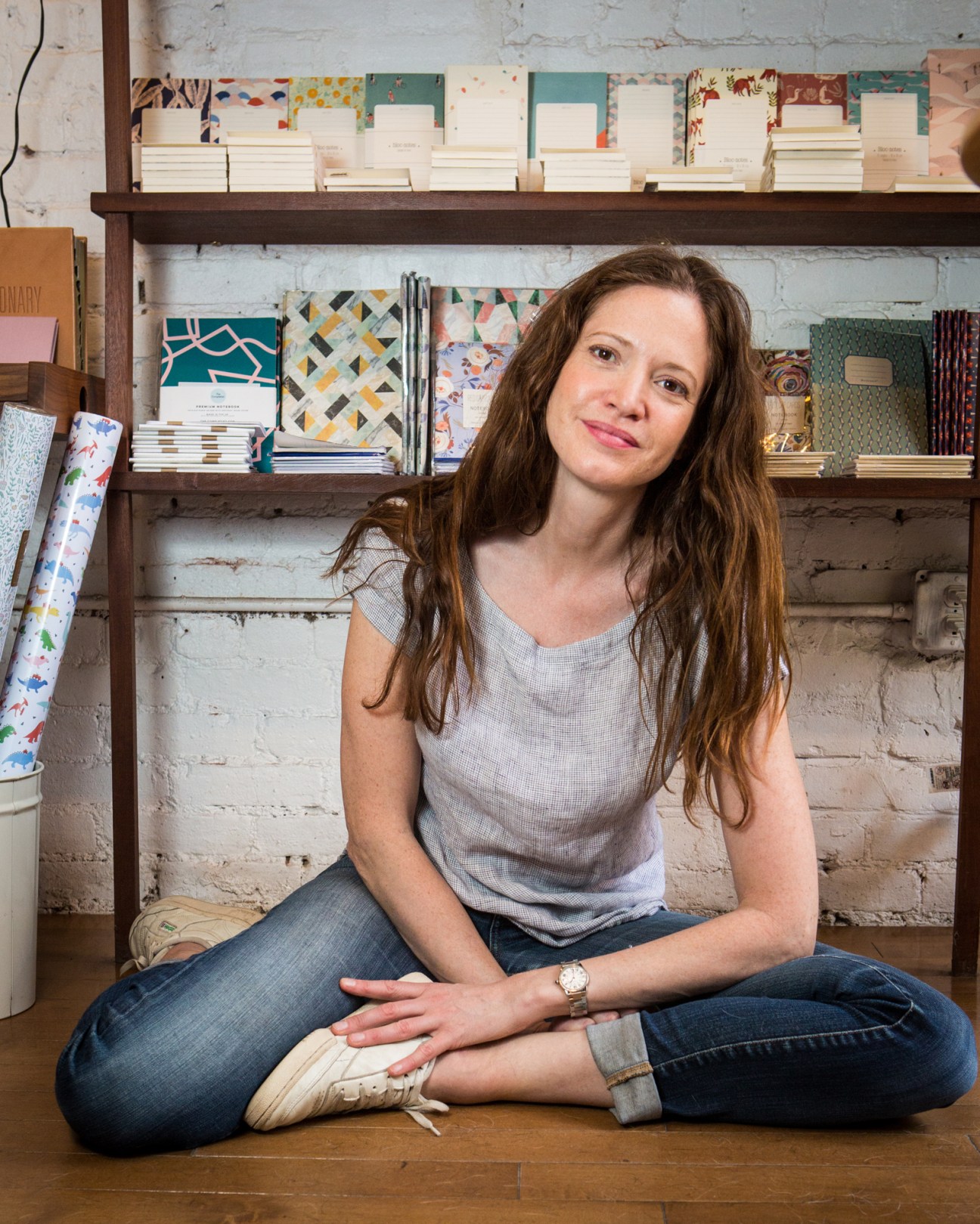
About the interviewee: As the founder of one of New York’s leading independent bookshop businesses, Sarah McNally is responsible for inspiring a new generation of booksellers and consumers alike. Launched in the city’s Nolita neighbourhood in 2004, McNally Jackson now gives its name to four bookshops and a series of stationery outlets across the city. She told Monocle 24’s The Chiefs us why bookshops have a bright future.
“When I first opened the bookshop in 2004, the ecosystem of bookstores, as we knew it then, was dying. I opened as a lot of the old-guard bookstores were closing and then a lot of the Barnes & Nobles in New York closed too.
However, in the past five years or so there has been a real growth of independent shops across New York. In that time my company became large enough that we could look at expanding into neighbourhoods in New York that didn’t have bookshops in a serious way. And equally, the reputation of my business had grown to a point where, after years of me having to grovel to landlords, begging them to lend to me, I had proven myself as a viable tenant. So it has been possible to make real estate deals that were much more workable.
Two of my shops are on percentage rent deals with their landlords because they are with larger developers, so we’re partners and we are in this together; we take risks together and we do well together.
I’ve always looked at my shops as something laid out so that anybody who walks in could take thousands of different journeys through it. I do very deep backlists – I cram, I fit every book I can possibly fit in without making a mess. Nobody gets into bookselling unless they love people. You have to love people and you have to love books, and the intersection of those two things is where your job happens. When you remove people, as happened during the pandemic, it’s a very, very different job than living at the intersection of a conversation about books and reading books.
I’ve always believed that every person contains multitudes, so in my shops, I do all the buying – with the exception of children’s books and some university press books. I never buy cynically. Everything I bring in – even if it’s something I wouldn’t buy or if it’s a book I wouldn’t necessarily read – it has to appeal to me on some level. I think you should go into retail with that sort of honesty and that openness, and never buy cynically. Every time that I’m trying to train somebody to work with me and they say, ‘Well, I don’t like it but people will,’ I say, ‘That’s simply not good enough.’ You cannot think that way. I try to curate my stores, which have tens of thousands of items, in the same way that you would curate a magazine. You wouldn’t put something in a magazine that you thought was stupid or dumb, or for people who you don’t respect. So everything in there is something I respect and is for people who I respect. I think that if retail is done that way, it always adds intelligence and depth to the city and the neighbourhood in which it lives.”
Sunny outlook
Retail
Country pursuits
UK
If you’re a young buck in Italy looking for a sunny pair of socks, a turn-heads jacket or some flattering strides, all you need to do is nip into town on your scooter. Every Italian town seems to have a good menswear shop – and one for women too. This year is set to leave a few more UK towns equally well equipped as brand owners survey the national retail scene and decide that, for now, they will opt out of shops in big-city centres.
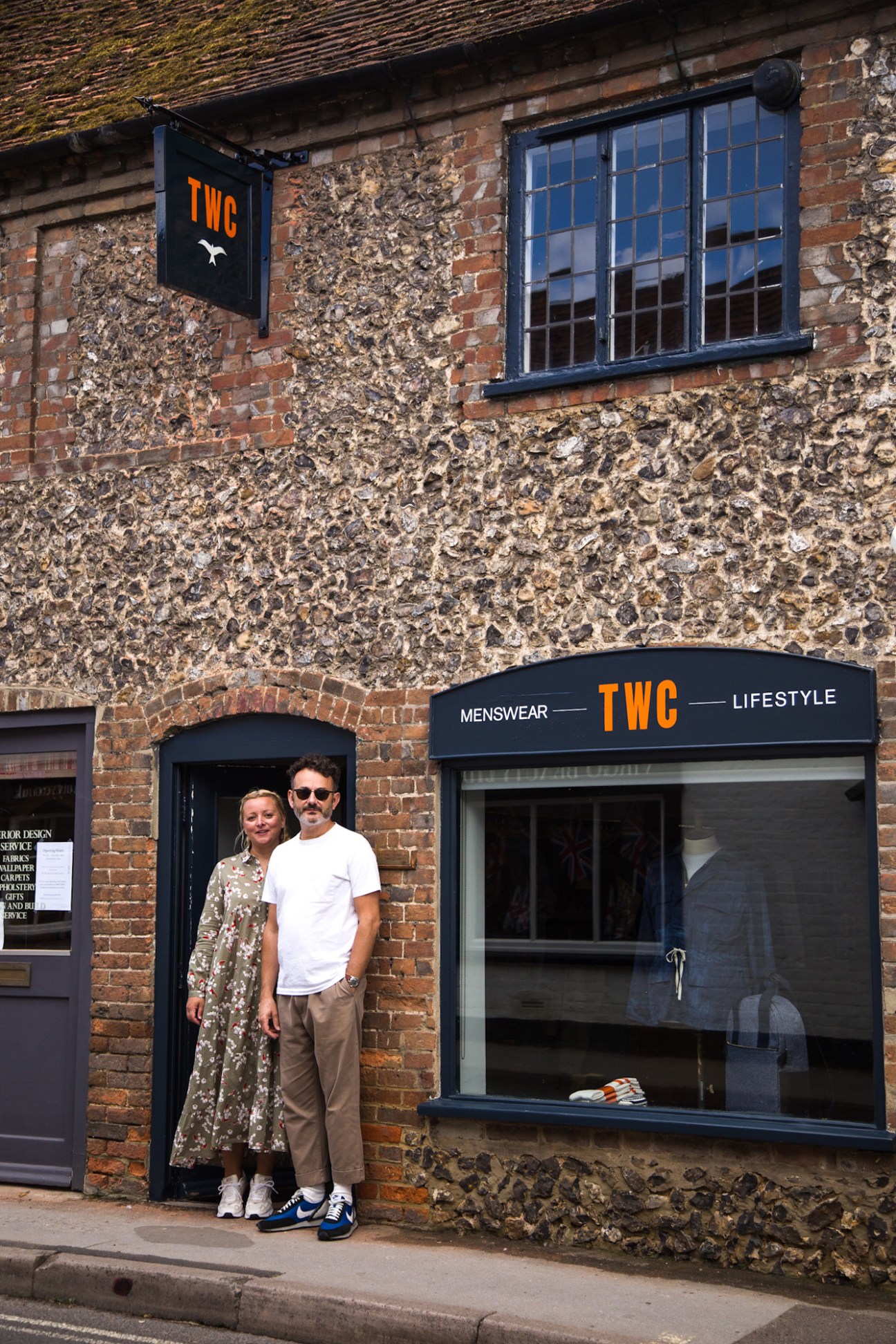
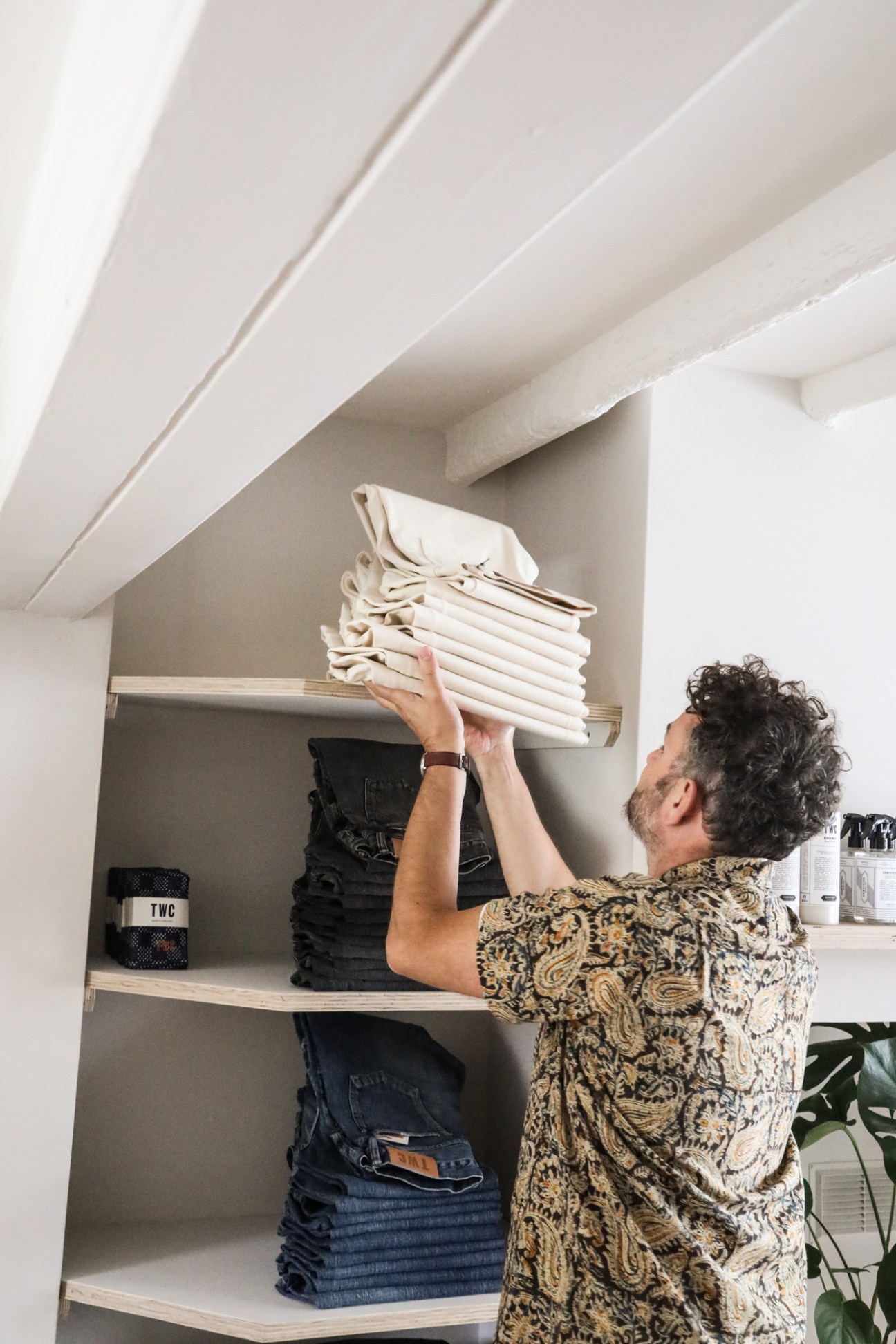
Take The Workers Club, known as TWC, which makes the sort of functional, detailed items that quickly become wardrobe favourites. Founded in 2015 by Adam and Charlotte Cameron, the business has been run from rural Oxfordshire for some years, even as it grew and the owners took on interesting consulting work. And now? “We’ve been working remotely for years and people couldn’t understand how we did it but recently there’s been a real cultural shift,” says Adam.
“We’ve been working remotely for years… recently there’s been a real cultural shift”
During lockdown they decided to deepen their country roots and take on a high-street shop in Goring, a village that sits on the River Thames in an affluent area full of people who like fashion. “It’s really interesting seeing people shop the collection,” says Adam, adding that they can also fulfil orders from here and that the rent is half what they would pay in London. He also says that Goring is busy, even pulling in tourists and shoppers from London.
This is a move that other labels will want to look at because it brings together quality of life and direct access to wealthy shoppers, many of whom have barely been out of shorts since March and could do with a fresh look.
theworkersclub.co.uk
Zürich
What the maître d’ saw
It’s a tricky act balancing business and the buoyancy of a humming restaurant but Catharina Joss does it more gracefully than most. As maître d’ and general manager of Bürgli, a classic Swiss spot with a view of Lake Zürich, she has kept an eye on the trade for 25 years.
“The restaurant was founded in 1945. We’ve had the same head chef for 10 years, the same waiting staff for 20. So we have a lot of regulars. We keep three of 30 tables back for regular guests, always. When they phone, we might reserve them a table with a view of the lake or a cosy spot beside the piano. Our dinner service has changed completely. We have two shifts: one from 17.00 to 20.00 and the next from 20.30 until midnight, as we have to keep guests apart by 1.5 metres. The work is harder but business is still good.”
restaurantbuergli.ch
Manufacturing
Street smarts
Norway
“From shirt-sleeves to shirt-sleeves in three generations,” is an American phrase that encapsulates a commonly held view that business empires, and wealth, rarely survive being passed on. Jan Christian Vestre (pictured), the third generation to run his clan’s street-furniture brand, clearly hasn’t been listening.
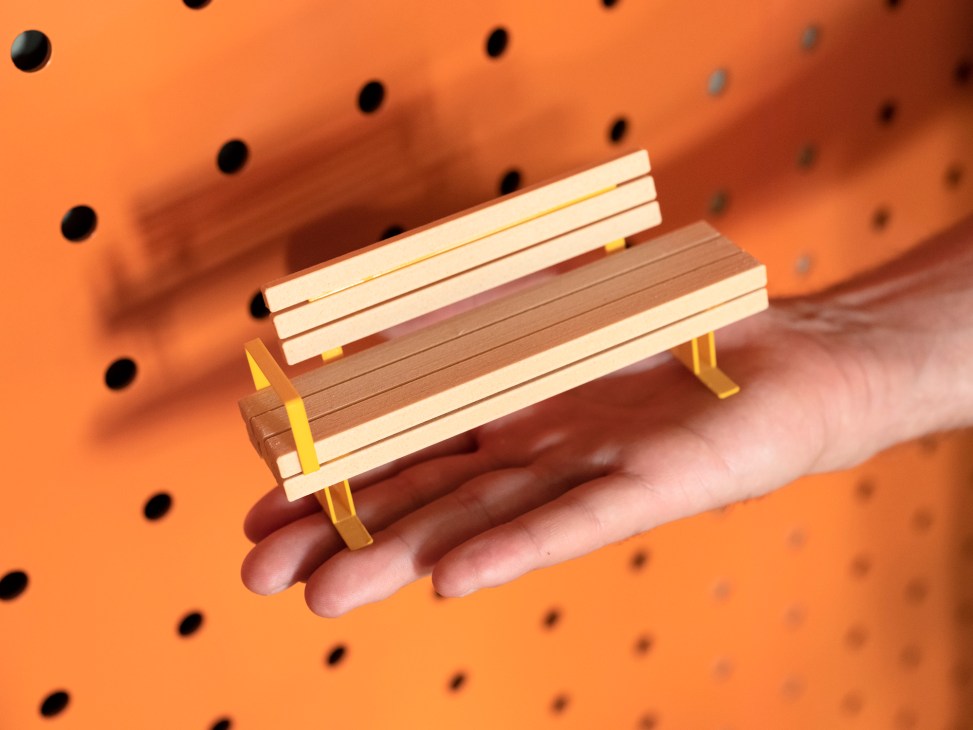
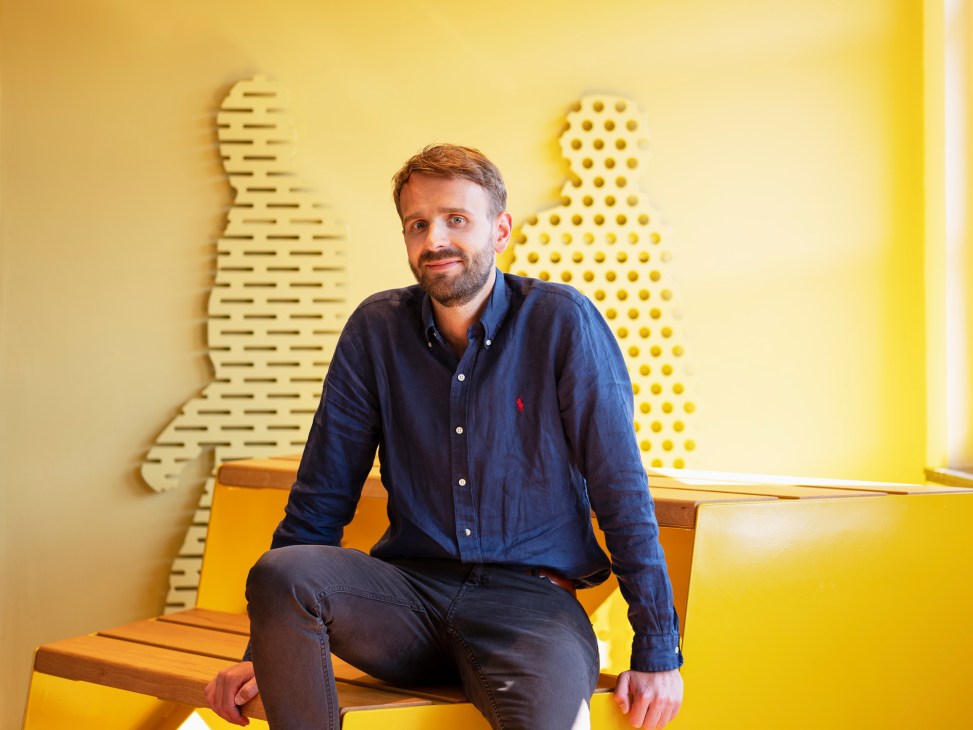
In 2012, aged 25, Jan Christian became CEO of Norwegian family-firm Vestre and has since tripled turnover to a healthy NOK202.5m (€21.2m) with an average sales growth of 20 per cent every year since taking over. And he now employs 60 people. Founded in 1947 by former sailor Johannes Vestre as a mechanical workshop in Haugesund, a coastal town in Norway’s west, today the company’s benches, bins, planters and bicycle racks dot public spaces in the US, Germany, Italy and beyond.
Only two of Norway’s export categories – salmon and furniture – experienced growth last year and Vestre is poised to ride this wave of international demand, with sales outside of Norway and Sweden estimated to hit NOK60m (€5.7m) in 2020. Vestre’s success defies the common perception that it is too costly to manufacture in Norway. And Jan Christian even argues that there is no better place to move towards a greener approach than in a country where sustainable raw materials and clean production practices abound. Vestre’s factories operate on renewable energy and the firm is on track to produce all of its own energy by 2025. Vestre also offers a lifetime guarantee against rust.
“It’s much easier than people believe to do things differently”
In July, Jan Christian made headlines by announcing that he would spend NOK300m (€28.4m) building a factory designed by Bjarke Ingels, set to open in 2021. Called The Plus, the ambition is for it to be the world’s most sustainable furniture factory, while also accommodating Vestre’s growing team and production capacity. It’s also a call to arms. “It’s possible to save the environment and make a profit,” says Jan Christian, challenging other Scandinavian firms to follow suit. “It’s much easier than people believe to do things differently.”
His daring attitude also includes saying no, such as the time when he declined a lucrative project in London to create benches with spikes to deter rough sleepers. This approach is informed by Vestre’s tight-knit family-run model. “We lose in the short term but, in the long run, we’re on the winning team,” he says, explaining that being family-owned means that they can make long-term decisions without feeling the wrath of investors, who often have short-term profits on their minds.
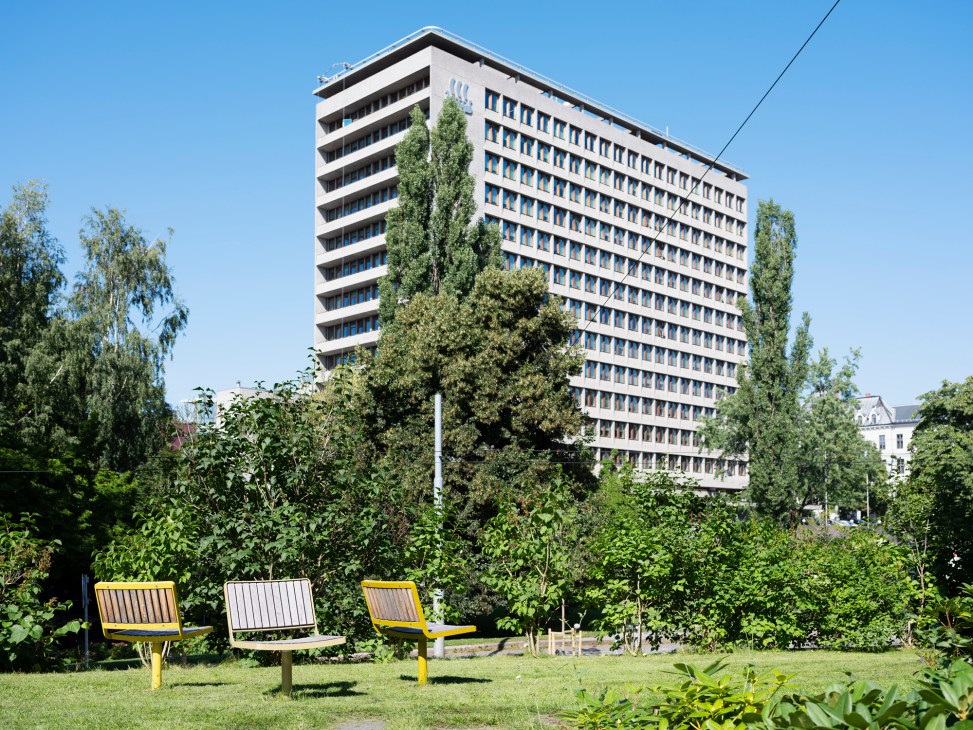
Inside Vestre’s Snøhetta-designed headquarters in Oslo’s affluent Frogner neighbourhood, Jan Christian sits across from his mother Elisabeth. Visiting from New York are also his cousin, Kristoffer Vestre, and his wife, Allegra Garretti, who heads up Vestre’s team in the US, a flourishing market. Kristoffer says that business often spills over to the dinner table and family gatherings, which he appreciates for the synergy of ideas.
Talk predictably turns to the pandemic and Vestre’s Stoop: an innovative nine-seat, multi-level bench that, while sitting as pretty in Vestre’s showroom as it does in New York’s Times Square, wasn’t designed with physical distancing in mind. Might benches need another redesign to accommodate our new world? Perhaps. But whatever the issue at hand, Jan Christian says that he is not afraid to tackle it head on. “Outdoor spaces will become even more important now.”
Best of Vestre
- Stoop bench
Sure, it may not be made for physical distancing. But its clever three-tiered design means that we’ll be eagerly awaiting the day we can all pack back on. - Parklets 2.0
Designed to fit inside one parking space, Vestre’s clever seating and dining areas are especially relevant now that alfresco dining has taken over city streets. - Folk litter bin
Standing on a single post, the sleek silhouette of the Folk litter bin adds a touch of grace to one of the more unsightly pieces of urban infrastructure.
Advertising
Age of the manifesto ad
Global
There was a time in British advertising when television ads were so good that they drew as many viewers as the shows themselves. The 1980s saw creative freedom mixed with huge budgets. Ads went from selling soap and cornflakes to airlines and computers, and the result was cinema-scale entertainment. Things have changed a bit since then and the quality has taken a hit. Earnest moralising has replaced entertainment and what we are left with is the manifesto ad.
It usually begins with a defiant voice giving a toast to a group of people (“Here’s to the have-a-go heroes”). Cue uplifting piano keys, sweeping strings, clunky poetry and a complete lack of self-awareness. The scripts are written like political speeches, all dramatic repetition and fragmented sentences. Visually, they’re mood boards on a screen and they run on for longer than any normal human attention span, stretching the limits of how much you might care about frozen oven chips.

Where’s the wit, where’s the irreverence? Where’s the entertainment? And why does it have to be so long? Surely, this much earnest wholesomeness can’t be good for you. It’s easy to see how we got here, as brands desperately grasp around for a purpose or a cause to align to. In branding, manifestos are usually used as an internal tool to rally the troops or explain the business’s story but they always stayed behind the curtain. Now the curtain’s up and manifestos are centre-stage.
The thing that many brands haven’t grasped is that, by and large, people don’t want to be instructed on morality by corporations that sell consumer goods. While the gist of what they’re saying is often admirable, the appearance of the logo at the end simply serves to undermine the whole thing. It’s unarguable that there’s plenty of good intention behind the messaging – increasing inclusivity and helping others in need are clearly good things – but they would be better served to say less and do more. Put the budget into action that makes a difference or make an entertaining ad that stays relevant to your brand.
This isn’t strictly a new phenomenon. Apple’s “Here’s to the crazy ones” ad in 1997 was a stake in the ground for a company positioning itself as a bastion of creativity against the vanilla Microsoft behemoth. It hit all the right notes and set Apple on the path to domination. But that was Apple and 1997 was a simpler time. Surviving our hyper-politicised news cycle can be tough and advertising should be a refuge from the language of politics. After all, it’s convoluted, opaque and dull. Is that really what a business should be aspiring to?
Design
Why it’s bye-bye ping-pong
Global
There’s a lot of debate about the future of office design, with many predicting the demise of open-plan layouts. Maybe. Let’s see how real the shifts are in the months and years to come. But it is worth questioning all of these design elements. For example, removing walls was done to improve communication but according to one Harvard study, open-plan offices actually reduce face-to-face conversations by 70 per cent, while also leading to 50 per cent more emails (who wants to be overheard asking about finances or performance targets?).
But what is clear is that, for now, the office is going to be a place where work gets done. All those silly office designs that were spawned by Silicon Valley – a world of beanbags and inter-floor slides – suddenly seem out of step with the times. We need handsome offices fit for purpose; places that are smart and comfortable. Here are five office-design elements that are headed for the history bin. Why, after all, design an office to look like an apartment, when lots of workers are, well, still at home? Indeed, these design clichés are hopefully being ripped out as we speak.
1.
Ping-pong tables
The most visible sign that you work in a technology office. Are you “disrupting” or just knocking a tiny ball over a net? Along with overly familiar copywriting and an aversion to collared clothing, the ping-pong table became a staple of a sector desperate to appear easy-going. There’s nothing wrong with being casual (nor ping-pong) but too many businesses came to rely on “forced fun” as a stand-in for what defines a good office.
2.
Bean bags
Is a bean bag really a chair? Or is it just an oversized pillow with the always looming threat of a major mess attached to it? Either way, bean bags certainly never project an air of authority. And, even when their slumped occupants managed to win a client’s business, they were always hard-pressed to stand up and shake hands on the deal.
3.
Themed rooms
It was always a little perverse to have your employees pore over a brief in what appeared to be a surf shack or a ski chalet when, in fact, they’re stuck in an office in a suburban business park. Themed rooms never fooled anyone, nor did they stoke creativity. Keep the office tasteful and allow your employees to hop on a surfboard or skis on their well-deserved holiday.
4.
Slides
Yes, we mean the playground type. Why were they in offices? Good question. Slides are the ping-pong table’s more deranged sibling in the “forced fun” family of office design. While your office’s slide was probably used about three times, ripping it out is no easy task. We recommend filling it with concrete and letting it stand as a monument to bad decisions vowed never to be repeated.
5.
Bars
A drinks trolley is nice and an office fridge for beer and wine is always appreciated but there’s no need to make your office resemble a pub. Plus, an office is supposed to support its neighbours, not act as a fortress where employees never venture beyond its walls.
Urban farming
Growth spurt
Japan
Launched this spring, Tokyo Midori Labo is a visionary green platform tasked with creating a self-sustaining urban neighbourhood. Situated in Nihonbashi Hama-cho in east Tokyo, its four-storey botanical garden-like office catches the attention of every passerby. “It was important to visualise our mission in the form of a building,” says the project leader, Taichi Saito (pictured).
Saito was already the founder of Daishizen Inc, a Tokyo company that provides gardening and landscape-design services, but his entrepreneurial drive saw him embark on this new venture. “I’ve travelled across Japan and have also been asked by municipalities to revitalise their regions,” says Saito. “One day I realised that these places are full of rich nature; they have fishing and farming. But urban areas produce almost nothing when it comes to food.”

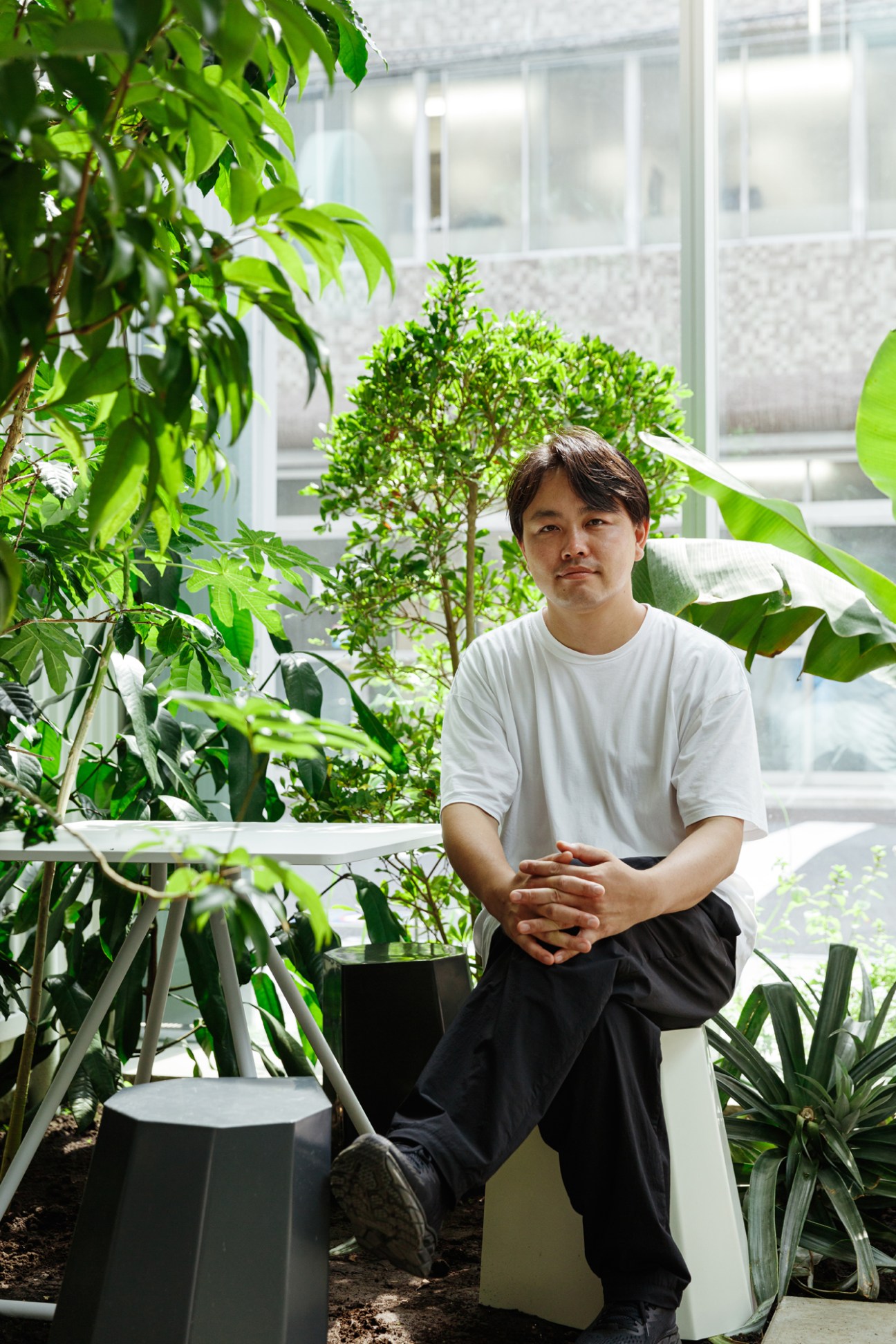
So he decided to change that. When he spotted that the Hama-cho area was dotted with empty properties, tucked behind large commercial developments, he smelled an opportunity. “It’s a traditional area, home to manufacturing and culture. It was the centre of Tokyo where people created a lot of things. So I thought of starting local production for local consumption.” He assembled a team that included three other businesses: indoor-farming-market leader Farmship, technology-meets-agriculture company Plantio and Green Snap, one of Japan’s largest online green-application services.
The team’s vision immediately won support from property giant Yasuda Real Estate. “They were already working to make Hama-cho a green, creative area,” says Saito. After two years of building, the result is Tokyo Midori Labo, home to 70 employees and 300 varieties of plants. The farm produces crops such as grapes, melons, kinkan fruit and tomatoes.
“I thought of starting local production for local consumption”
The four executives meet every two weeks. “You can get admin done remotely but it’s important to share a physical space because you need energy to make something new.” There are already new projects in the pipeline, aided by neighbouring businesses and the Chiyoda Ward. The ground-floor café will house a seed bank where people can pick up seeds and compost and sign up with renewable energy companies.
The vision might sound idealistic but Saito knows his onions about running a business. “We’re different from a traditional start-up,” he says. “We are four [leading] companies producing extra resources to pour into this.”
tokyomidorilabo.jp
Work culture
Clout of office
Dinner with a former colleague – one of the initial intake of writers who helped to get Monocle started. We talk about all the people who he worked with and I’m struck by how they have stayed so tight with each other. He’s been to their weddings, is godfather to one of their children, speaks to them regularly. They are his network. There are some who are getting a little overexcited about the demise of the office. They suggest that no longer having to go to one will deliver unimagined freedoms – even if the main ones seem to be the right to wear athleisure at all times. But offices are about so much more. And a good one can set you up for life. One of the most important things that they can deliver is a fledgling network that kicks into play when times are tricky. A good office, filled with good people, can see you through anything. For a young generation it is a sin to make them believe that a lack of personal networks will be a long-term benefit. We need to feel that we are part of something bigger. We need someone to ask, “How was your weekend?”
This comment first appeared in The Monocle Minute, our free daily newsletter. To read more business views, sign up at Monocle.com/minute
Hard sell
The perils of public relations
Global
How did an industry aimed at making things clearer end up making things so complicated? Part of the problem: there are six public-relations professionals for one journalist these days. It’s a sad state of affairs and it means that every journalist out there is sitting under a deluge of press releases. Cutting through the clutter requires a deft touch. And while we’re certainly no PR pros, we are the recipients of thousands of pitches: some good, some bad and most painfully mediocre. Here’s a subjective guide to improving pitches and press releases.
Ask, ‘Is this worthy of a press release?’
Does a list of the best-selling hamster wheels really warrant a press release? Too many emails about non-newsworthy items and you’ll be relegated to the junk folder.
Choose your opener wisely
The cat-and-mouse game that is PR hinges on pretending you know who you’re pitching to. Opening with “Hi there” reveals you don’t have any idea and indicates that what follows will likely hold no appeal.
Bye-bye buzz words
Synergy. Granular. Cutting edge. Purge them from your pitches and press releases. Use simple language but don’t take that to mean being overly familiar is the sign of a good pitch either. We’re looking at you, endless exclamation marks and winky faces.
Trim, trim and trim some more
Legend has it that Ernest Hemingway once wrote a six-word story: “For sale: baby shoes, never worn.” The point? Words are powerful but easily diluted. Four pages of text isn’t necessary for a new sofa, no matter how plush it may be.
Quit telling us how you feel
“Pleased to announce.” “Thrilled to announce.” “Excited to announce.” Frankly, you’d have a better chance of grabbing our attention by saying, “I’m lukewarm about this new product but here goes…” Just tell us what you’re selling and we’ll go from there.
Attach your story to something larger
The best pitches for anything, from a new product to a new building, help contextualise why it matters. What does it say about how we live? Yes, we understand that’s our job but we do appreciate the help.
Transport
Up in the air
Global
The era of the modern airship is about to arrive. It’s a claim that’s been made again and again in recent decades – and then nothing happens. But several manufacturers and operators claim that this time it’s for real and that they will revolutionise air transport.
The reason: airships are fantastically efficient compared to other aircraft, with up to 90 per cent energy savings on comparable trips. What’s more, they don’t need infrastructure such as runways to operate. Of particular interest are airships’ ability to transport large cargo. Paris-based manufacturer Flying Whales, for example, began with ambitions of changing logistics for the French logging industry: an airship could carry timber from remote forests without the need for roads and trucks. That would save money and be better for the environment.
Airships are fantastically efficient compared to other aircraft, with up to 90 per cent energy savings on comparable trips
The airship is nothing new so what has hindered its comeback in recent decades? For one, they’re expensive to develop. Without proven production lines or a guaranteed market, risk is high. But Igor Pasternak, CEO of US-based manufacturer Aeros, says that the coronavirus is going to accelerate things as we rethink our global logistics system. “You talk to the end user about cargo airships and they know they need them. The benefits are clear,” he says.
If that’s true, Flying Whales might be the best positioned of all. With an initial assembly line planned in France and further facilities planned for China and Canada, the company says that we’ll see its first airship operating by 2023. Flying Whales foresees dozens of industry-altering uses, from carrying wind turbines from factory to installation sites to placing prefabricated houses in remote areas (currently being looked at by Canada for its far north) to unloading shipping containers on small islands and in areas without deep-sea ports. With a lifting capacity of 60 metric tonnes, the airship could accomplish in one trip what it takes helicopters many to do, with a fraction of the fuel burn.
The business case for passenger airships is less developed but also being pursued. Swedish start-up OceanSky Cruises is already selling tickets for its first voyages to the North Pole, starting at SEK900,000 (€87,000) for a two-person cabin. CEO Carl-Oscar Lawaczeck says that the company, which will function like an airline, is positioning itself for the ultra high-end market first with hopes of lowering the price and broadening its customer base later. They’ve also promised customers a refund on their deposit if they don’t operate by 2024.
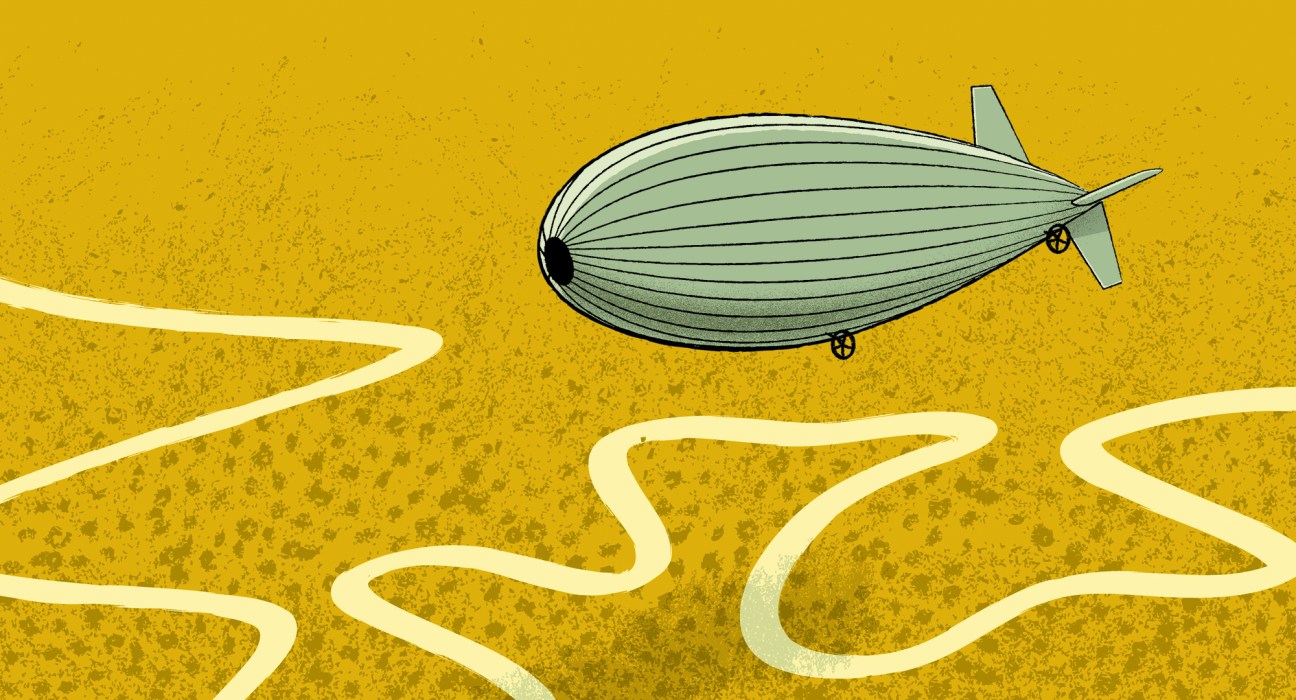
Unfortunately for the industry, airships still call to mind the Hindenburg disaster, which happened in 1937 (and saw 36 deaths, including 13 passengers). But prospective clients will be happy to know that helium (unlike hydrogen, which turned the Hindenburg into a flying bomb) is an inert gas that can’t catch fire. Airships are also slow, with most cruising at about 100km/HR. That’s a hindrance if you need to get somewhere fast for a meeting but if there were to be an accident on landing at, say, 40km/HR, consequences would likely be minor. “You’ll get a bruise if you’re unlucky,” says Lawaczeck.
The striking thing is that airships, which are potentially big business, are based on 150-year-old ideas. It has just taken this long for technology to catch up, and a renewed focus on environmental concerns, to make the airship a viable vehicle once again. Lawaczeck says that if we want to cut our transport emissions, the notion of intercontinental flights or heavy-lift cargo operations on all-electric planes is a pipe dream because batteries simply won’t have the necessary energy density for years to come. “The only solution to the problem is airships.”
Nice try
It’s not just airships that get talked up. In the drinks trade, marketeers also try to endlessly promote various tipples as the next big thing – forgetting that the same trick, with the same refreshment, was tried five years ago, and 10 years ago and… you get our drift. Take sherry. It’s lovely but it just cannot shake off its reputation as an old folks’ drink. But that doesn’t stop people trying. “This,” they say, “will be the summer that everyone goes sherry crazy.” But nothing changes. So the airship folks are buoyant but we’ll only believe it when we see a blimp in the sky.
Doing business
New horizons
Africa
Headlines about African business talk up the foreign investment pouring in from China and while infrastructure is improving, so too is social mobility. A new crop of small businesses is tapping into a young and growing population and offering founders new niches. Here we survey three places on the up with alluring prospects.
1.
Mauritius
By Andrew Mueller
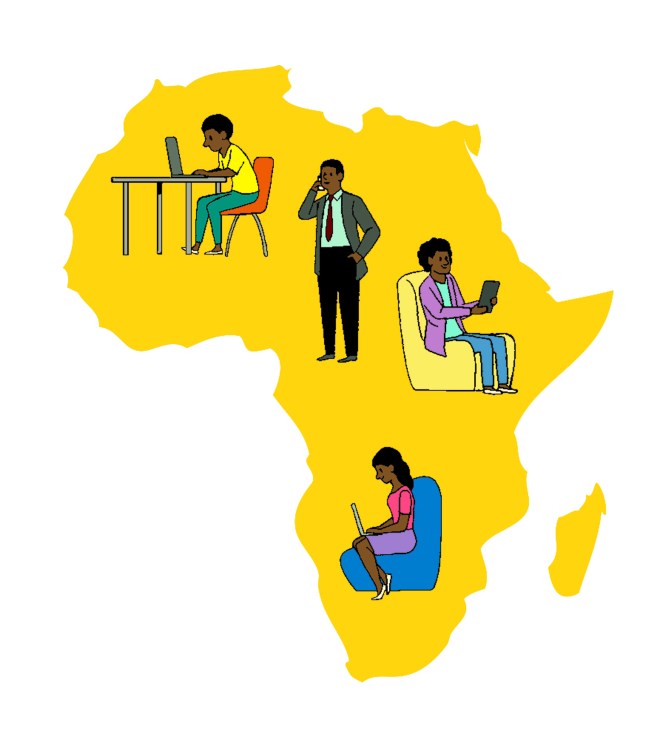
In many respects, Mauritius is an easy sell. In the World Bank’s Ease of Doing Business rankings for 2020, Mauritius placed 13th – ahead of Australia, Taiwan and the UAE, and by far the highest in Africa. “We wanted a stable environment,” says Forbes Mavros of jeweller Patrick Mavros, which moved here from Zimbabwe. “But we still wanted to be in Africa – we’re an African brand. We also wanted an environment that inspired us.”
Businesspeople speak highly of the country’s political and economic stability; Mauritius has polled consistently at the top of the Ibrahim Index of African Governance. Also frequently cited are its plentiful air links to Africa, Europe, Asia and Australia, and a time zone handily in between Europe and Asia.
2.
Tunisia
By Mary Fitzgerald
Next year Tunisians mark 10 years since the revolution that ended decades of autocratic rule. Tunisia’s path since has been smoother than its neighbours’ but high youth unemployment remains. One upshot is that younger Tunisians see entrepreneurship as a way forward – universities now offer modules in it – and are challenging the old way of doing things. Tourism and hospitality are the backbone of the economy but there’s also a spate of designers and artists who draw on craftsmanship and Tunisian materials.
Entrepreneurial efforts were boosted by the Startup Act, passed in 2018, which aims to make it easier for businesses to launch, run and wind up. Walid Sultan Midani, founder of video-game company DigitalMania, was key to the process. His company launched in 2011 when only a handful of start-ups existed in Tunisia. Today, he says, that there are more than 600.
Using Tunisia as a base to sell from was profitable in the case of Fouta Harissa. The two Tunisian-Americans behind it rethought the traditional hammam towel and ship the hand-loomed handicrafts worldwide. “Entrepreneurship is not a silver bullet,” says co-founder Alia Mahmoud. That said, start-ups are a start.
3.
Durban, South Africa
By Samora Chapman
Durban’s population of 3.8 million is diverse – a mosaic of African, Indian and European descendants who call this beautiful but not always straightforward city home. One potential lure for enterprising individuals is that it is home to the largest Indian diaspora outside of India. Trade between the nations has grown steeply – India’s exports to South Africa have increased threefold in the past 10 years.
Some businesses are looking to make a difference closer to home too. Homii is making security solutions including facial-recognition software to create safer inner-city spaces and residences in order to tempt people back to the CBD. It’s a smart idea in a city with a grim past: people were moved from the business district during apartheid and the majority of the population still lives outside the city. If the city centre continues to improve, then Durban might have more than the beach to recommend it to entrepreneurs from across the continent.
Expert view
Office politics
Katrina Kostic Samen is a believer in the power of the office, which is handy now that her design agency, KKS, is part of Savills, the international estate agent. She’s spotted a simple disadvantage of toiling at home: “People always said that productivity would fall if people worked from home but it hasn’t,” she says. “It’s stayed the same but you work longer to get everything done.” Getting people back in the office groove faces challenges, she admits. One of the biggest impediments to encouraging people back to the office is senior managers, aged 35 to 55, who see no obligation to get back to their desks – even if the work-from-home mantra is damaging the lives and opportunities of younger staff. On all of this she is very clear: if you are in an industry where you need to make deals, then this home-working world will fail you eventually. But she also believes that companies will be reluctant to take on towers and keener to occupy more campus-like locations, with windows that open, some greenery and extra space becoming highly valued qualities.
Design
Private function
USA
The Schlumberger Administration Building in Ridgefield, Connecticut, may not be the first Philip Johnson-designed building that Scott Fellows and Craig Bassam (pictured, Fellows on left) have restored – the pair have owned two residences designed by the architect – but it is the latest. At 600 sq m, the building was Johnson’s first commercial project, built in 1952 as part of the Schlumberger Oil Company’s commercial campus. In 2006 Schlumberger left town and the building stood empty. But in 2017, after eight years of painstaking restorations, Bassam and Fellows turned it into the HQ of their eponymous furniture brand.
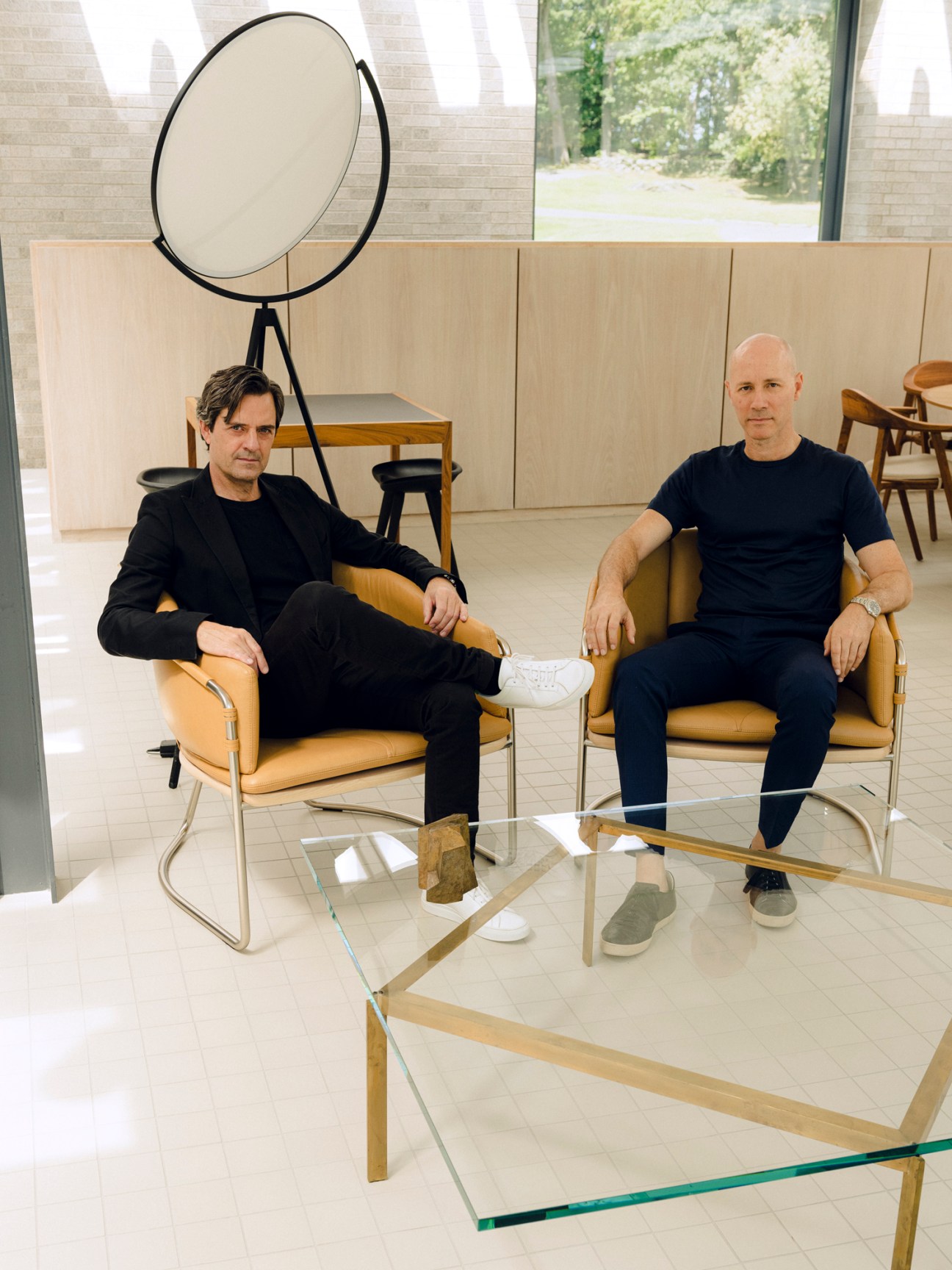
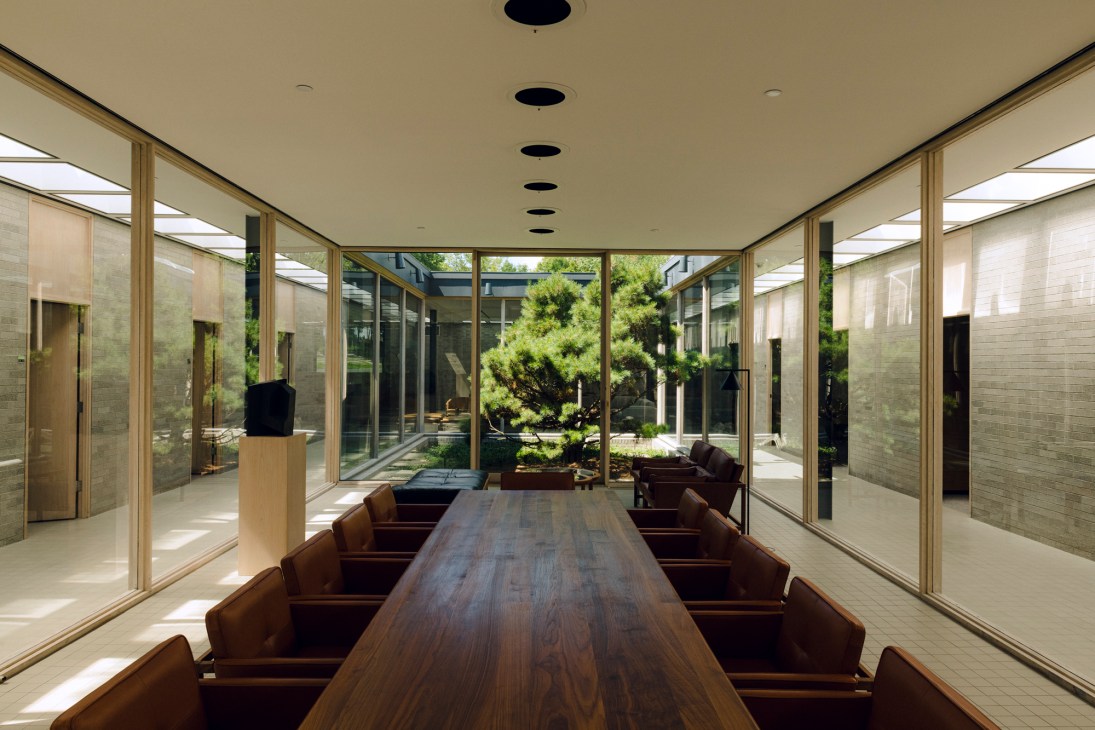
The building is thoroughly modernist: its rectangular steel frame is enclosed with glass walls and a leafy courtyard. The interior, which has a glass-cased meeting room and communal spaces, is awash in natural light thanks to 80 skylights. And ringing the building is a design feature more common to the mid-20th century than today: private offices, each with high ceilings and a large window wall. “It’s very gracious,” says Fellows. “There’s a connection to nature, there’s light everywhere and fresh air in every office.”
“We wanted something that went back to this mixture of private offices and collaborative spaces”
While coronavirus has forced some businesses to reconsider their open-floor plans, BassamFellows was ahead of the curve. As former creative directors at Herman Miller, the pair often heard about how open plans fail to achieve what they touted: improve collaboration and communication. “You’d think it would be collaborative but it’s not,” says Fellows. “Everybody has headphones on because everyone is trying to get their work done. The pendulum swings the other way to where it almost becomes anti social. We wanted something that went back to this mixture of private offices and collaborative spaces.”
And staff “wanted to come back because it’s comfortable and nobody feels unsafe,” says Fellows. “The building is more relevant now than ever.”
On the up
Good year for business
Global
This year might have been bad news for global economies but there are some notable outliers. We highlight a handful of brands that are flourishing thanks to their business acumen and a bit of good fortune.
1.
Thousand
Co-founder Gloria Hwang
USA

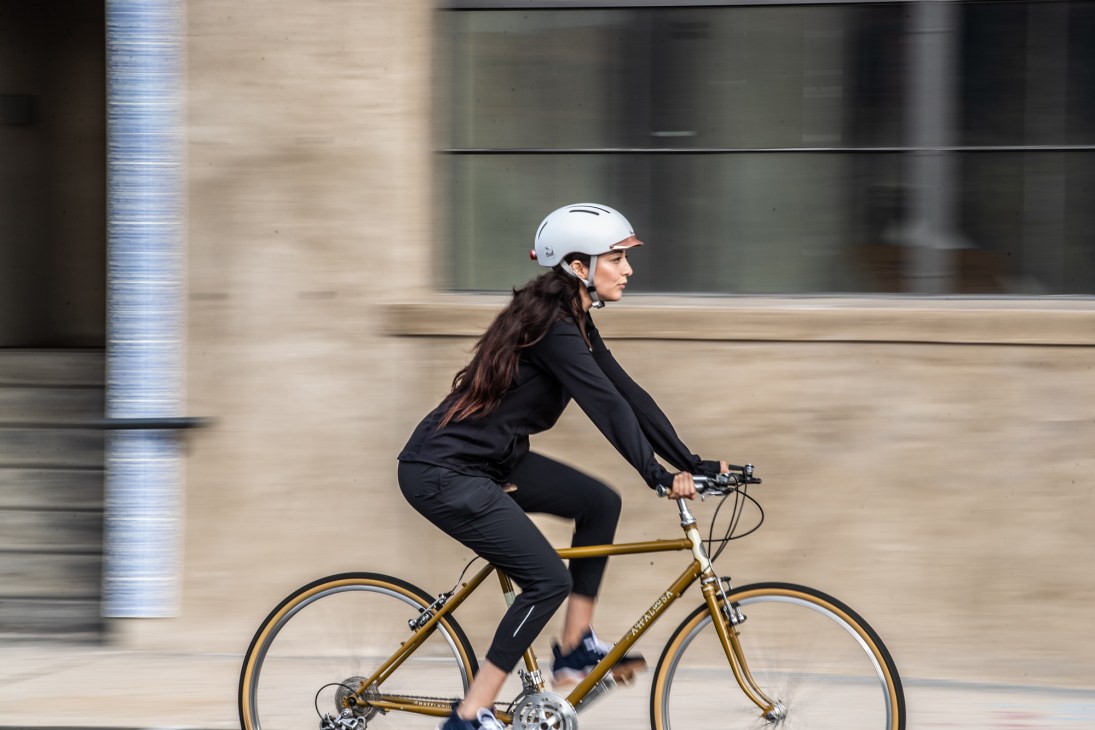
Residents of cities everywhere have taken to cycling with a certain gusto in recent months, kicking off an industry-wide boom that’s seen cities fast-track construction of bike lanes and bicycle manufacturers struggle to meet demand.
Among the businesses seeing an uptick is Thousand, the Los Angeles-based helmet brand that Gloria Hwang (pictured) and Amar Patel launched in 2015. The business started with a good idea: that cycling helmets needn’t skimp on looks. “The idea struck me that if you make a bike helmet that people actually want to wear, you’d help save a lot of lives and I really felt like it could encourage cycling within cities,” says Hwang.
“About three or four weeks in, we started seeing this huge surge in anything bike-related”
The product has resonated with consumers and since launch, Thousand has seen sales double or triple every year. Yet the business was threatened in early 2020 when coronavirus ground the global economy to a halt. “But about three or four weeks in, we started seeing this huge surge in anything bike-related,” says Hwang, explaining that the boom was kicked off by people in need of an alternative to public transit or those simply looking for an activity. As a result, Thousand’s e-commerce sales grew by 800 per cent, while the brand’s dealers requested hundreds or even thousands of helmets at a time. “We couldn’t keep anything on our shelves,” says Hwang.
While the past months have posed plenty of logistical challenges, from backed up supply chains to product launches co-ordinated from home, business is looking bright. “It has been a challenge to keep up but we’re happy that we’re on this side of things,” says Hwang.
2.
Faunatar
Founder Johanna Valo
Finland
As the pandemic hit Finland in the spring, Finns moved to remote work and generally spent most of their time tucked away inside their homes. And in a bid to stave off loneliness, more Finns than ever have felt the urge to acquire some company from the animal kingdom.
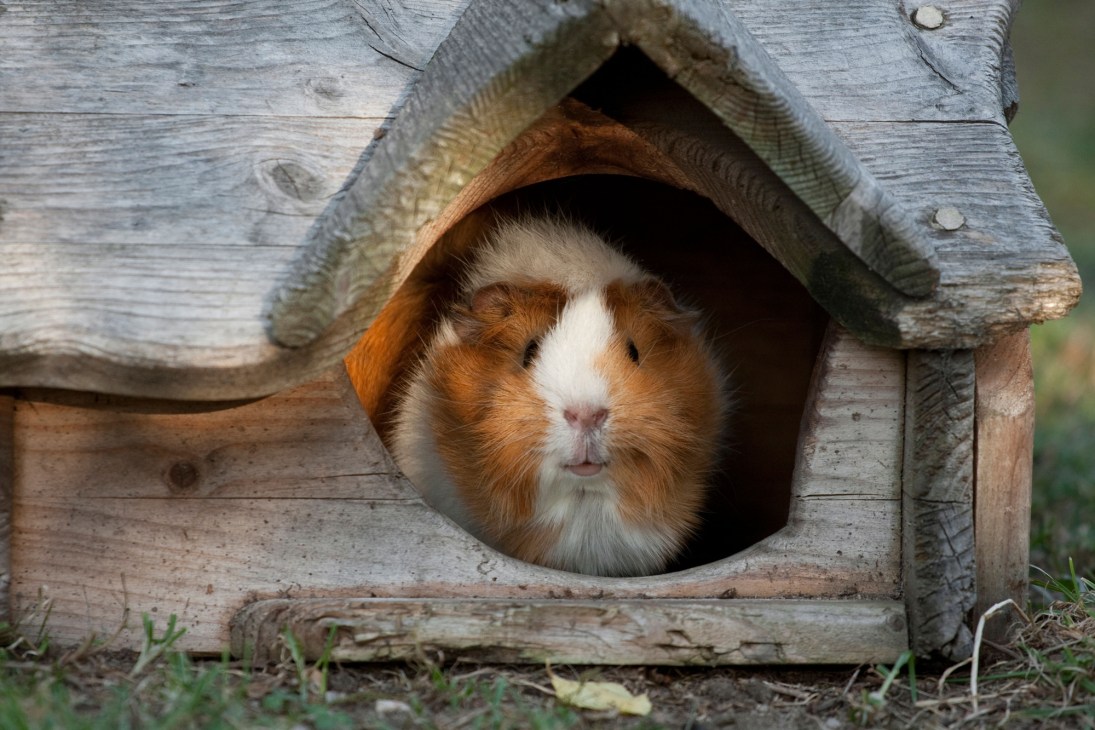
“Our sales of hamsters and guinea pigs have more than doubled. It’s clear that the upsurge in sales is due to the fact that people have been spending more time at home,” says Johanna Valo, the founder and CEO of the independently owned pet supply retailer Faunatar. Founded back in 1980, Faunatar now has more than 20 shops throughout Finland – from Helsinki to Tampere – which employ close to 100 people.
While Faunatar sells everything that Finnish pets like to snack on and play with, from dog bones to scratching posts for cats, the retailer also sells all kinds of small animals, such as fish, spiders and even snakes. Snakes have been popular during the pandemic (don’t ask us why) but it’s the small furry animals such as guinea pigs and hamsters that have been the biggest hit thanks to their cuddly nature. And for good reason: plenty of studies have found that owning a pet can be a boon to both physical and mental health.
Although life in Finland has become less isolated, the pet-shop boom, according to Valo, is still very real, with demand outstripping supply.
3.
Raze
Founder Vincent Fong
Hong Kong
As Gary Ling and Jolly Tse stand inside their empty lifestyle shop in Kwun Tong, a two-man team from Raze, armed with spray-paint guns and a compressor, coat every shelf, table, mirror and flat surface with an invisible film that promises to kill viruses and bacteria for up to six months.
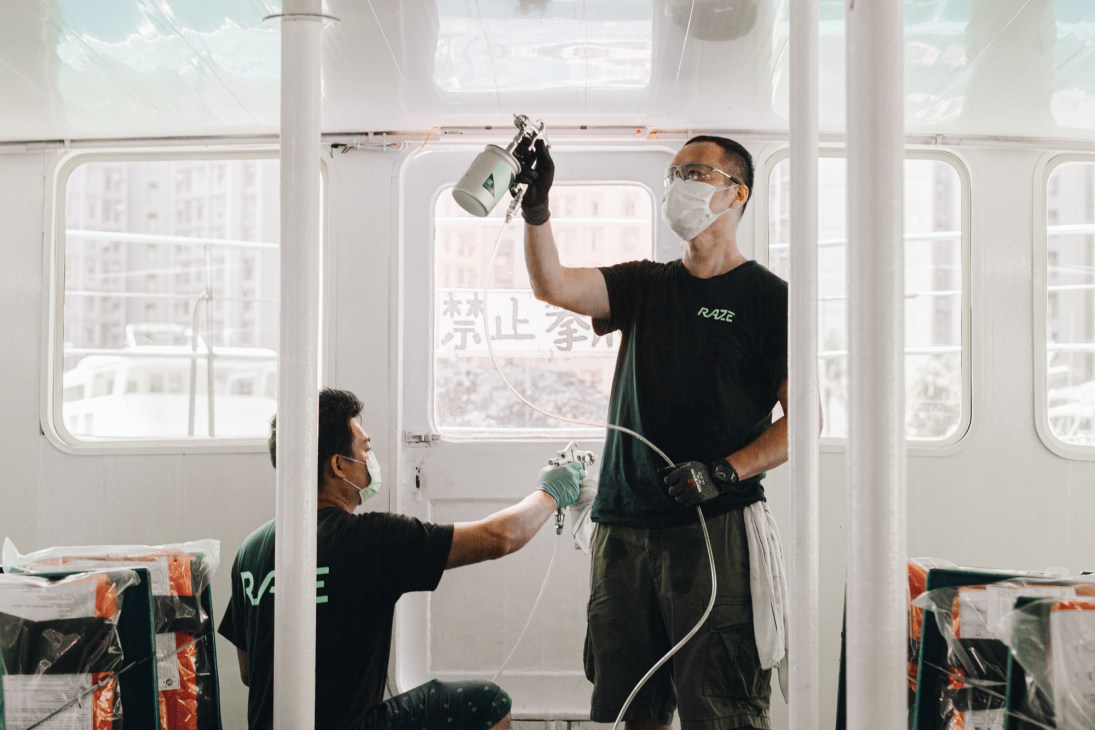
This photocatalytic technology is all the rage in hygiene-obsessed Hong Kong and Raze – now working in a crowded market – has a growing customer base that includes retailers, offices, restaurants and much of the city’s transport network. “This year has massively accelerated our plans and consumer education is the most important part,” says 28-year-old founder Vincent Fong, who recently signed up four joint ventures in Italy, South Africa, Macau and the UAE.
Timing is everything for a new enterprise and the two-year-old start-up only began developing a consumer product last year. Fong’s original plan for commercialising the chemistry, developed by scientists at a Hong Kong university, was to sell it to pig farms – the dirtiest proof of concept he could imagine. “That’s where I got my validation that it works,” says Fong. Raze makes no specific claims to protect against Covid-19 though; surfaces covered in Raze still need a regular clean.
With consumer interest likely to peak during the pandemic, Fong is making long-term plans by recruiting third-party brands to incorporate its technology into their own products, similar to Gore-Tex. A virus-killing wall paint will be released soon to test demand. The buzzy start-up has not forgotten its roots: Fong remains excited about pig farms and Raze still intends to clean up in agriculture.
4.
City Grange
Co-founder LaManda Joy
USA
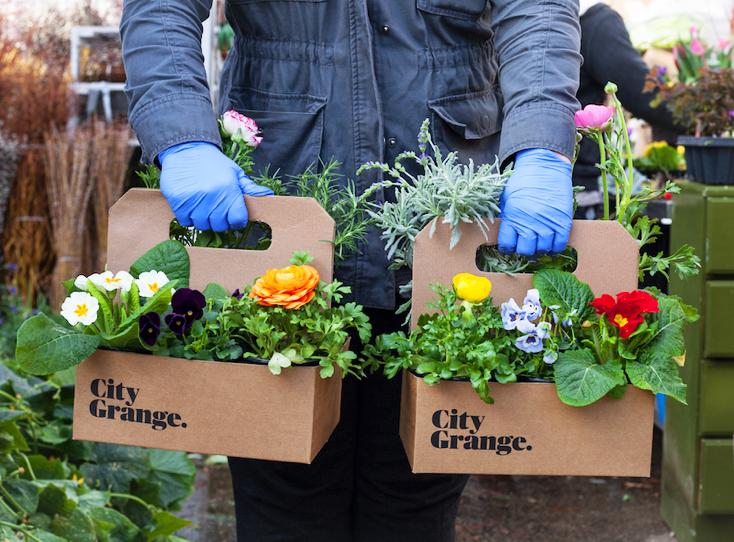
“Our belief is that the world would be a better place if there were more gardeners in it,” says LaManda Joy, founder of Chicago’s City Grange gardening shop. Joy’s wish, if the recent success of her business is any indication, is bearing fruit.
Founded in 2019, City Grange, which has outposts in Lincoln Park and Beverly, has seen a spike in online sales in recent months. “But in-store sales have also been fantastic,” says Joy. “[And] we’ve definitely seen an uptick of new gardeners.” Many first-timers have arrived not with ambitions of vibrant flower beds but growing their own veggies. While that interest was initially driven by the same supply-chain fears that emptied grocers’ shelves of toilet paper, many novice gardeners have since become repeat customers after realising just how rewarding growing your own greens can be.
Others have simply wanted to add a dash of colour to their homes, through house plants or windowsill garden boxes. “A lot of people have just wanted joy; to beautify their places. When you’re stressed out, stuck at home and reading the news, plants are a real antidote to that,” says Joy. Also an educator, City Grange’s class about pollinating plants has proved to be especially popular (attendance for all its classes has doubled since moving online), as Chicagoans hope to lure butterflies and birds to their windows.
Coronavirus hasn’t sheared City Grange’s plans for growth. New shops are in the works, while Joy recently signed a lease for a new space that will be exclusively dedicated to making house plant and flower deliveries. Coronavirus may have cast a dark shadow in recent months but at least it’s driven many to get their hands into the earth.
Other products doing well in 2020:
- Skipping ropes: Judging by the big boys and girls skipping in city streets (jump rope for our friends in the US), this is the year when you could really make money from old rope.
- Paint: The DIY boom triggered by lockdown saw paint sales soar as cracks were filled and fresh coats of white applied. Alternatively the paint just sat there. So a pretty good time to be a proper painter-decorator able to pick up the pieces – and the brush.
- Bird feeders: As we connected with nature, sales of kit to attract our avian chums boomed. But this could not get rid of a nutty issue: the millions of mini packets of nuts no longer required by airlines.
Illustrator: Christophe Jacques
Making that idea a reality
If this issue catches you in the southern hemisphere then it’s likely that you’re shaking off the winter (given our distribution I’m assuming that you’re in New Zealand, Australia, South Africa or Brazil) and are now ready to give your business a final jolt before holiday season sets in. Up here in the northern hemisphere it’s full-speed ahead as we leave behind a disjointed summer and hurtle into Q4, year-end re-forecasts, cash-flow remodelling and the other essentials that come with keeping businesses nimble, responsive and, most importantly, solvent. But no matter what hemisphere you’re sitting in, this is the moment to do the following:
1.
Give your existing business a shake-up and be in front of your customers more than ever. And we mean in person, if possible.
2.
Quit your unfulfilling corporate job if it’s not delivering. Yes, you can certainly hold on for a payout but don’t wait so long that you lose your fire to do something new.
3.
Pull together all the outstanding elements for the brilliant idea that you had a few weeks ago and make it happen – team, business plan, investors, architects – whatever it takes to get your idea off the ground.
Should you still find yourself stuck and unable to unlock the idea that has managed to get lodged above your left earlobe, then try this little exercise. If you already know how to play “house” by fantasising about your dream set-up, mentally decorating it and eventually turning it into reality, then why not devote a weekend to playing “village”. All you need is the makings of a settlement (butcher, baker, high-speed broadband and so on), decent property prices, a very open mind and an informed guide.
In the days running up to the completion of this issue, my friend Andreas showed me around his village in the Lower Engadine region of Switzerland. I was dazzled by the amount of opportunities. Due to a transition between generations in the village, a few people are selling their properties, while many folk from Zürich and elsewhere are looking for a not-too-time-intensive return to the land. After coffee and fresh apricot cake, Andreas took us for a stroll around town (I cannot say its name as he fears an invasion). I spotted at least five ideas to establish businesses that could range from micro to massive. We saw one building that could be a perfect little 12-room hotel and café; a dairy beyond the town square with all the charm and potential to become an international cheese brand if it had the right branding; and those slopes full of wildflowers and pines could surely act as a base for a beauty and wellness business with super-regional reach.
By the time I got back in the car, I had not only mentally decorated a mini-headquarters and farmhouse but thought about semi-rural life in the Alps: felt caps, boiled-wool vests and goats – but still good rail connections. If you want to dream about a similar set-up, you’ll enjoy meeting the men and women who’ve opted for less-urban arrangements and many more informed, daring and wise characters in this issue of The Entrepreneurs. Remember, we’re around every week on Monocle 24 with our radio programme and podcast of the same name, which is where it all started. Enjoy!
Our editor in chief on giving businesses the best survival tools
Remember the first time you asked for a Swiss Army knife? You might have launched your first appeal sometime around your seventh birthday, already armed with a host of reasons why you not only needed one but why you were perfectly capable of managing such a device. After all, if you were allowed to use an unwieldy Spanish steak knife to cut into a beef tenderloin on a Sunday evening then there should be no issues with a pocket-sized knife designed to extricate you from all kinds of difficult situations. I got my first Swiss Army knife when I was about 10. Before that I had other pocket knives but they didn’t quite compare to my Victorinox with its toothy saw, tweezers and scissors. There was a certain rite of passage that came with getting that knife and although it’s not in active use I still know where it’s safely stored.
For this second edition of The Entrepreneurs we’ve employed a “Monocle-ised” version of the Swiss Army knife as our cover star for a variety of reasons. In many ways it informs almost every aspect of this current edition as it’s resilient, multi-functional, reassuring and a constant classic. It offers all the basics that you need to perform the simplest tasks without any distractions. At its core it’s a survival tool and, for many a start-up and business owner, it’s more than a metaphor for what’s required in these turbulent times.
Despite the complications of remote working, a largely shuttered Midori House in London, printing and logistics based in Germany and a worldwide audience, we’re happy that this issue has reached you wherever you happen to be building, restoring or launching your business. We have always counted entrepreneurs as our core audience and, through this edition and our weekly audio series of the same name, we want to be a source for the freshest ideas and most inspiring stories, as well as a compass for the opportunities that so frequently spring from a crisis.
If there’s one thing that this virus has brought to the fore it’s the importance of small to mid-sized enterprises and their contribution to innovation, employment and also the community. In too many countries, governments and banks stumbled with their assistance packages, not recognising the need for speedy solutions and swift liquidity. At the time of writing (6 April 2020), G7 economies are still fumbling around and attempting to figure out how to unpick the bureaucratic frameworks that simply don’t serve the entrepreneur who needs to meet payroll, buy services and ensure that there’s stability for the coming quarters.
Which brings us back to the knife and to Switzerland in particular. At the outset of the pandemic the country’s Federal Council promised fast bridge loans and even faster deployment of funds. As a Swiss-based enterprise, we were happy to hear about the scheme, applied through our bank and within 24 hours had more than chf500,000 (€470,000) in our account – interest free, no penalties, repayable in up to seven years – with six basic questions to answer. This should serve as a benchmark to all nations moving forwards when it comes to recognising the importance of small to mid-sized enterprises and how they should be managed.
As the world marches out of this dark period, you can count on us to be here as a sounding board, a source for enlightening reportage and an empathetic peer. Thank you for your support. Cheers.
Lessons learnt
1.
Businesses need to be nimble
It’s a truism that businesses must learn to roll with the punches. But, wow, some unexpected uppercuts have landed in 2020. Disruption has beset absolutely everything, from the supply chain to getting into the office. But wait, there’s hope. Look at the textile factories making masks when we needed them most, the perfumers turning their hands to sanitisers or the restaurants that now deliver. Many businesses will have learnt how to regroup at speed in a time of crisis and dodged a knockout blow while they’re at it.

2.
Small, traceable supply chains work
This means knowing the fisherman who supplies your restaurant and the mill that makes your yarn. For years companies have sought savings by cutting corners and moving production to that lovely clean factory in Dhaka or Hangzhou. Despite words to the contrary, this is often about cost rather than quality. As we rethink the complexity of global supply chains, there’s an opportunity to simplify and seek options closer to home. As many businesses have learnt, those plastic components are no good stuck at customs.

3.
Business isn’t (always) fair
Some have unexpectedly won big thanks to the pandemic: supermarkets, board-game manufacturers and the soap industry, for instance, all cleaned up. But those bubbles will burst and daily life’s rhythm and rituals will return in time. Sadly, some honest independents who couldn’t keep it together when their shop shut will fade and our cities will be worse off for a while. Still, we’ll appreciate the survivors all the more. And we can’t wait to see entrepreneurs bouncing back with more robust businesses.
4.
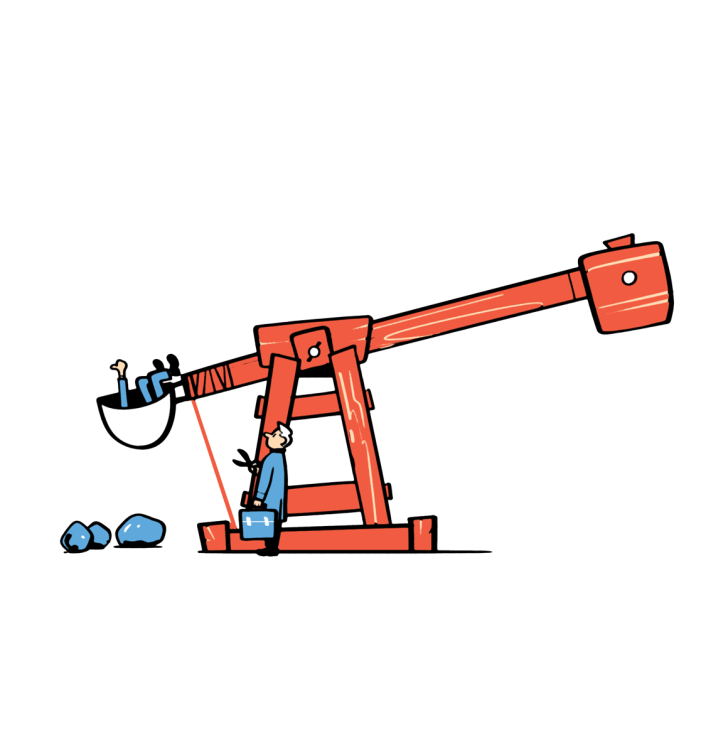
We all need support
One thing many people, from one-person shows to CEOs, have seen is who’s on their side: from family to employees and lenders to board members – even governments. Tough times show who’s pulling in the right direction (and whose two cents you could keep for petty cash). We’ve also been humbled by the once-great beasts of business needing bailouts. Let’s stay grounded moving forward.
5.
Speak up (with something to say)
There’s a time to tell your brand story but only speak when you’ve got something to say. In times of crisis we’re realising which brands we need and which we could live without. Not everyone needs a newsletter. It’s heartening to hear how the local bakery is donating profits to carers or that the family-owned furniture company is pulling through on its orders; less so that this company or that is thinking about making ventilators (often just to get their name out, we suspect). Also, if you’ve made your career running a successful clothing brand, then there’s a good chance your hunch about epidemiology isn’t that important.

6.
Face-to-face is vital
Technology has promised to take away the need for a physical office but being on lockdown has taught many of us that we need proximity. Hard as we’ve wished for it, our own homes haven’t simulated a sparky social space and video calls haven’t been a substitute for real conversation. Remote working can be less efficient and lacks the creative energy of being together. There’s space for a rethink. Do we all need to come into the office (desks are expensive)? Do we all need to be in every day (presenteeism isn’t ideal either)? Let the rebalancing begin but don’t forget: some things need to be said, sold or solved in person.

7.
Bring back privacy
Who would want to have a stranger in the kitchen? Get into a pooled taxi or even share door handles with the flat downstairs? Car, office and home ownership were all being challenged until recently but the pandemic has revealed some of the shortcomings of sharing. Things are a little more precarious for you if you opted for co-working or co-living arrangements or for public transport instead of a safe and secure four-by-four. What was once seen as wasteful, unsustainable and self-serving in big cities is now proving vital to safety and independence. Expect the fallout of this crisis to include a customer who still values some privacy. Shares in the sharing industry are down.

8.
The news renews, part one
One thing that the outbreak has confirmed is that media matters: magazines, newspapers and TV news are still important for cutting through the fuss and fake headlines, and keeping us informed. There’s still great value in accurate and robust journalism. Sadly ad revenues have fallen, which means that another lifeline for a shrinking industry has been withdrawn. We need a new model and companies concerned with telling the truth, spreading a message and projecting integrity should be stumping up now to help fund the fight.

9.
The news renews, part two
Radio has come into its own. With people feeling isolated, out of the loop and alone, many stations have found a voice and become increasingly relevant. It’s an intimate medium and brands are realising its potential. It’s often the most convincing way to take customers by the ear. There’s space for some clever broadcasts about resilient businesses bouncing back or moving interviews with people you can be inspired by. It’s a good way to get people listening – and Monocle 24’s recently relaunched programme The Entrepreneurs is a fine place to start.

10.
Pity the PR
Great PR could help your company in a crisis. That’s what you thought when you signed up to that expensive Manhattan agency. But it turns out that when tough times hit, many of the people on your payroll are churning out desperate marketing that’s a world away from the mood at HQ. We’ve also seen a nasty spate of companies being name-dropped by politicians: if you’re planning on making useful items, that’s great – but leave the marketing bit until afterwards. At their best, PR folks turn tough times into opportunities but these are the times that prove their mettle.

11.
Be honest
Things are tough for everyone so don’t be a martyr: level with people but don’t beg. Some firms have struggled and sought help and found it, others have buckled before reaching out. It’s OK to sincerely stress that you need support. We’ve seen amazing examples of people stepping in when owners and businesses need a boost.
12.
Micromanagement doesn’t work
It was hard enough monitoring what delicate David with the mint-tea fascination was doing all day in the office, it’s impossible now that he works from home. Trust that this will come out in the wash and focus on the headlines. Every second spent sweating the small stuff is a distraction from staying in the black. Now is the time for your colleagues to swing into action and take these minor concerns off your plate.

13.
Working from home is OK…
It’s not an emphatic lesson – but it’s not an emphatic feeling either: working from home is fine not fantastic. What many have noticed, though, as the workday creeps closer to both dawn and dusk is that it tends to heighten our feelings about work, the feeling of whether we love or hate what we do. If you’re in the latter camp then now is a great time to recast the way you work and rethink the kind of company you want to run and if you’re in the right business at all.

14.
Have cash
If you didn’t realise why you needed some assets set aside to weather the storm then the thunderous disruption of the pandemic will have set you straight. The boring folks with back-up plans who always say “yes” to the optional insurance and don’t drain their current accounts at the end of each month have been proven resolutely right. We’ve always advised being bold but some savings are necessary too.
15.
Being nice helps
A little kindness (to employees, a charity, each other) goes a long way when the chips are down and things are uncertain. Everybody from director to intern has noticed that humanity is vital during uncertain and hard-to-fathom times, so it’s all right to let the hierarchy slip a little (rest assured, they haven’t forgotten you’re the boss). Let’s hope that we remember this when we’re out on the other side – employees who were treated fairly and humanely now will be loyal when you need them.

16.
Targeting the home won big
From allowing those fitness firms to eye up your puny home gym (see issue 133) to ordering those window boxes, that wine by the crate and even the outdoor furniture that you recently splashed out on, many of us now appreciate nesting as the virus has meant more time at home for most. We’ve repainted, bought new pictures and fluffed every pillow a thousand times and all those people bemoaning the blight of home-delivery services have been rather quiet recently.

17.
Small businesses really do make neighbourhoods
It could have sounded twee in January to say that baristas hold communities together – but they do. So do small hardware shops and wine bars that have seats on which to snack. The whole verve of urban life has been lost as high-street shops shuttered and social distancing strode on. Things will return to normal: cafés are quiet, rather than extinct – but they have been sorely missed.
18.
We miss trade fairs
Those of us who work at Monocle know that there’s at least one must-visit trade fair in the diary every month that’s essential to understanding the health of a particular industry and its place in the world. Whether they cater for watches at Baselworld or Geneva, furniture in Milan or Köln, or art in London or Miami, trade fairs work. They’re the lifeblood of industries, facilitating the pencilling in of deals for the year to come. An email doesn’t suffice: you can’t place big orders or buy art on a screen. We miss these trade fairs and we need them back.
19.
We miss travel
The internet is vast but feels very small, especially when you spend more time in its company. The same few boring memes and headlines seem to crop up with dull regularity and we realise that despite the endless possibility of the web, most of us reside in a rather dinky echo chamber. We should remember this when we’re out and about again and the travel bans have lifted. All too often the internet offers a narrow view. Real insight comes from meeting people, exchanging ideas, being present and seeking answers (not googling them). Here’s to getting back out there.
20.
Business will look different afterwards
You don’t know what you’ve got ’til it’s gone. Without going too Joni Mitchell, the pandemic has put things in perspective and shown which businesses are there for personal gain and which can benefit customers and the community. If you panicked, sacked everyone and hoarded the profits for yourself without paying suppliers then that’s a real shame – and people will remember.
21.
Influencers aren’t good in a crisis
It sounds like a cheap shot (and yes, maybe it is) but as the world turned in an unexpected direction a lot of these preening, self-obsessed “brand ambassadors” became instantly irrelevant and lots more of them disappeared. We’ve long questioned the wisdom – and, more importantly, integrity – of the influencer model and maybe a deep intake of breath was what companies needed to realise that online tutorials, dubious endorsements and paid-for posts aren’t a panacea for the ills of lazy marketing. Maybe there’s even hope for a little more creativity in the world of advertising? Fingers crossed that this is a wake-up call for canny campaigning that talks up to customers rather than down.

22.
Stick to your guns
You need to keep hold of your vision – it’s far too easy to throw your beliefs overboard in a storm. Don’t. If there’s one lesson that’s stuck with us it’s that things can change for the better or worse in the blink of an eye. And while you need to be quick on your feet and shrewd with it, you also need to stick to your brand and be yourself. If you don’t have that then what’s left?
23.
Not all governments are equal
When it came to backing entrepreneurs, not everyone stepped up to the plate. The state often gets bigger in a crisis but it’s telling where it throws its weight. Too little has been done to protect small businesses and too many loopholes were left open for sole traders and just-out-of-the-blocks businesses to miss out on funding and fail all too quickly.
24.
This is a time to think and rethink
This pandemic has not been fun. But some things are suddenly very clear for business leaders, such as which industries need protecting and when, which parts of the economy have been hardest hit and which areas require investment. Many firms found clarity – hopefully most of them in time to save their businesses.

25.
Shopkeepers should think again
Retail has further to fall than we thought. Lockdowns have deprived people of the high street but it turns out that a lot of its services can be fulfilled just fine by delivery. It’s a quandary but also maybe a good time to go back to the drawing board. Small retailers won’t be able to afford extortionate rents in future. So will property firms finally figure out that offering cheaper spaces to good retailers should be integral to their placemaking strategies? This approach would also lower the overheads for small businesses and encourage competition.

On the map
As much of the world remains hunkered down due to coronavirus, thinking about what’s outside your four walls – let alone considering a move to a new city – can feel like little more than daydreaming. How long the present situation will last is anyone’s guess. But this is not forever. Life will return to a new version of normal and by the time it does, you’re likely to have mulled over a few important questions. What have you missed? What can you do without? And, ultimately, how do you want to live?
For those with an entrepreneurial itch that you’ve been looking to scratch, or those simply in search of a gentler pace of life, the destinations we’ve selected for this edition of our Business Cities series – Bayonne, Adelaide and Boise – are resilient ones. While they, like all cities, will not emerge unscathed after the cloud of coronavirus lifts, we are confident that, once the world gets moving again, they will present an appealing climate in which to live and work – and plenty of opportunities – in the months and years to come.
Bayonne
Basque Country, France
“Let’s leave it all behind and go live in the sunshine,” says a postcard on the wall of the atelier where Belgian-born designer Mieke Mertens crafts lampshades and vases from recycled materials for her brand Emekitu. “This was our only plan when we relocated to Bayonne three years ago,” says Mertens, a former surf champion who quit a successful advertising career in Brussels for a better climate and more professional freedom in the French Basque Country. “Life here is sweeter, plus I can surf all year round. In comparison to the sea in Belgium, the water feels like a Jacuzzi.” Whether her simile is valid is a matter of opinion but, as the morning sun shines in, there is indeed a certain sweetness in the air.
Mertens’ studio and home, which she and her illustrator partner Gaston de Lapoyade rent for €600 a month, is nestled between the slender, colourful houses of Bayonne’s old town, rubbing up against leafy squares and lively tapas bars. While the nearest surfing beach is a 10-minute drive away in Biarritz (a new tram-bus connects the cities), the couple prefers the laid-back atmosphere of inland Bayonne to its glitzy coastal neighbour. And they are not alone: creative studios and boutiques have popped up across town. “Unlike Biarritz, where most shops shut down outside the high season, Bayonne is dynamic year round,” says perfumer Claire Bergognon, standing behind the counter at Pepiteko, a shop selling Basque-made espadrilles, ceramics and Bergognon’s own perfume brand, Touches de Parfum.
With the Atlantic to the west and the Pyrenees to the east, Bayonne is marked by a rich food tradition that a new generation of entrepreneurs is busy reviving. Among them is Cyril Pouil of Monsieur Txokola. Along with his business partner Ronan Lagadec, Pouil has made it his mission to reconnect the city to its rich confectionery history. “Bayonne was the first place in France to receive cocoa from Spain,” says Pouil. “We want to bring the scent of chocolate back to the streets of our town.” Although there are dozens of chocolatiers trading in Bayonne, Pouil and Lagadec are the last to produce bean-to-bar confections in the city itself. Regionally inspired flavours include Espelette pepper and Salies-de-Béarn salt. As Monsieur Txokola’s shop is in Petit Bayonne, across the river from the old town, its rent is below those found in the city’s commercial centre. Yet footfall in the shop is near guaranteed: city hall is planning to turn the area into a cultural hub. It’s already home to the Musée Basque and the Bonnat-Helleu art museum, which is currently closed for renovations.
Bayonne’s manageable size makes for a business environment where collaboration trumps competition. “People here are used to working a lot,” says Cédric Duplessis, a reference to the Basque country’s flourishing economy fuelled by the food, tourism and surf industries (40 surf companies manufacture in the region). “Those who have started out on their own know that we are stronger if we’re working together and sharing clientele.” Since founding his smoked-fish business in 2017, Duplessis has been supplying an ever-growing network of chefs in the area, including David Legeay, whose eatery Janine is down the road from Duplessis’ épicerie. While lunch is served at Janine, tables spill out onto the pavement and the bustle reflects the entrepreneurial spirit of Bayonne, where conviviality reigns.
Punching above its weight
Population: 52,400.
Average residential rental price: €1,180 for a 100 sq m flat in the old town.
Average monthly salary: €2,211.
Nearest airport: Biarritz Airport serves 16 national and international destinations.
Process for registering a new business: A number of documents are required, such as a trading licence, a statement certifying that no criminal convictions are held and a justification of the origin of funds. Applications take about a week.
Adelaide
South Australia
As a young architecture graduate, it didn’t take much to convince Ryan Genesin to leave his home city of Adelaide and head to Melbourne for a job. It was only after he decided to found his own interior-design studio – behind projects such as Korean restaurant Ban Ban, womenswear retailer Denim Iniquity and Sydney coffee shop Story – that he made the choice to go home. “There’s so much goiang on in Adelaide,” says Genesin, who was also contemplating starting a family when he returned to the city. “The stigma of being a small town is quickly shaken off when you head out to some of our amazing nightspots.”
For years the South Australian capital had been almost forgotten by the rest of the country. In the meantime, this hardworking city was quietly building its own fortune. “We do more with less in Adelaide,” says Genesin. “There are some really great firms that are small yet are winning the big national gongs for design.”
This coastal city is booming thanks to local companies that pick up defence contracts, the relocation of the nation’s space agency from Canberra, the country’s most prolific cluster of wine regions and a packed cultural calendar. Between 2016 and 2019, the city’s gross regional product increased by 5.9 per cent; it currently sits at €12bn.
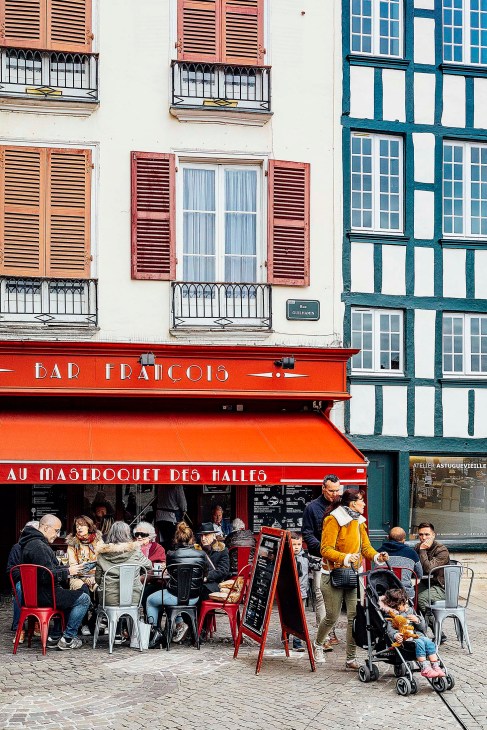
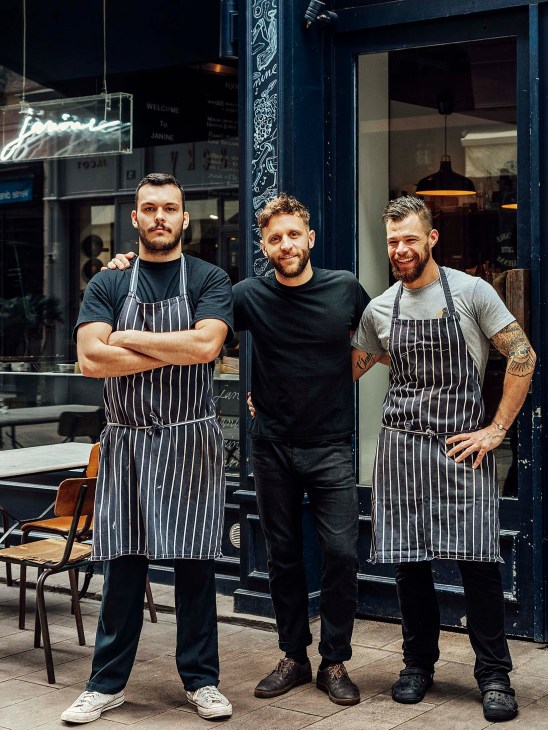
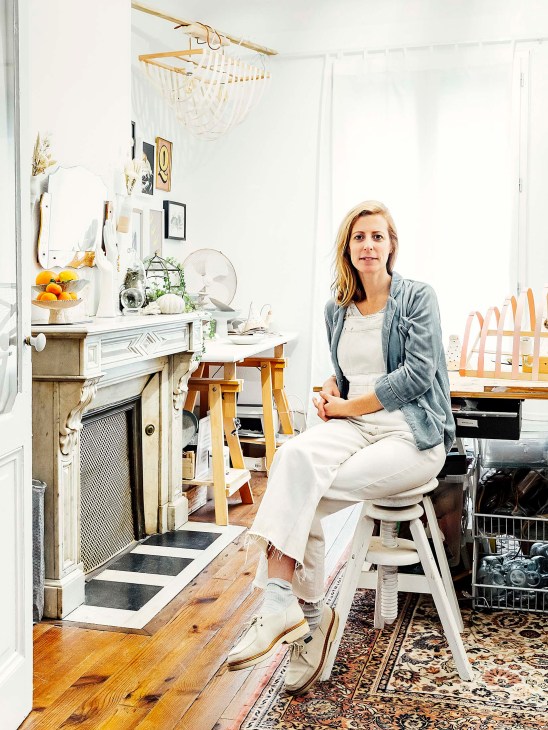
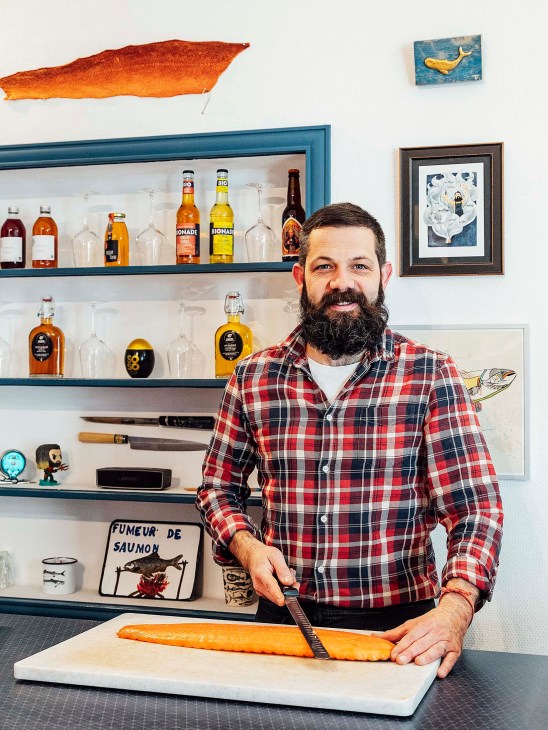
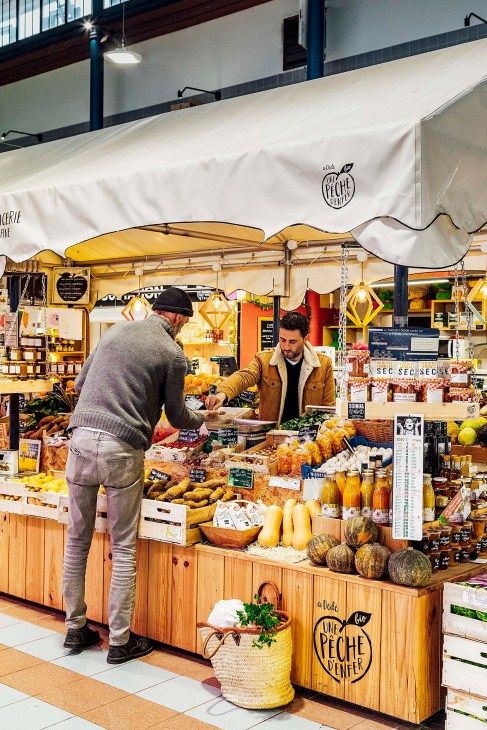
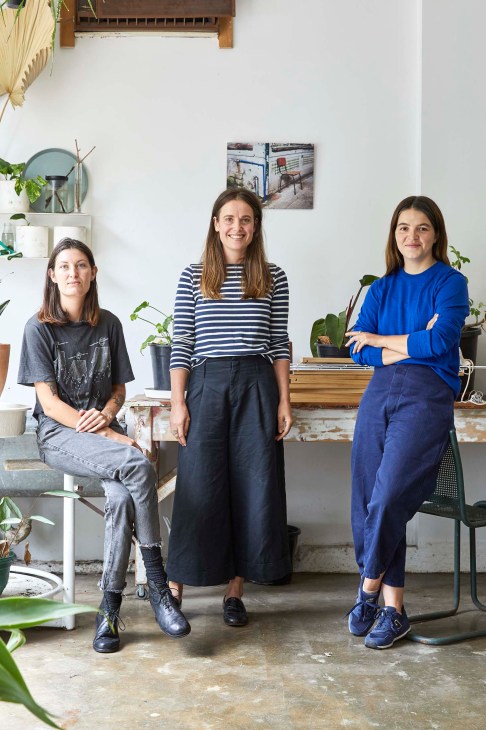
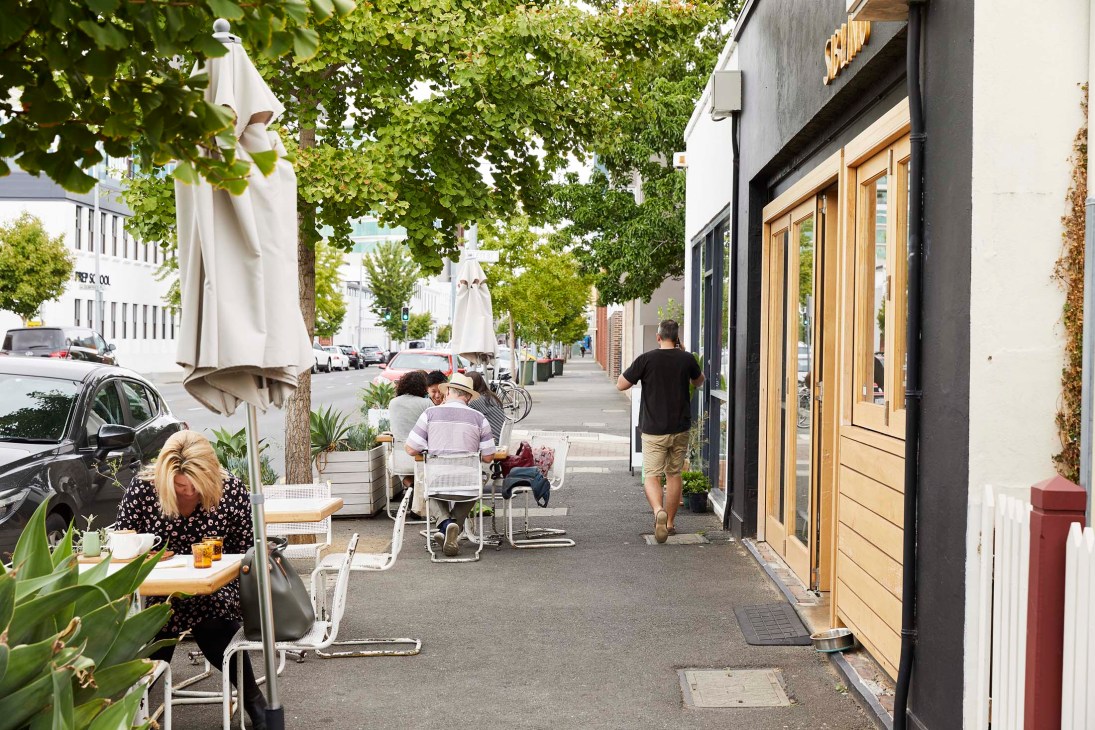
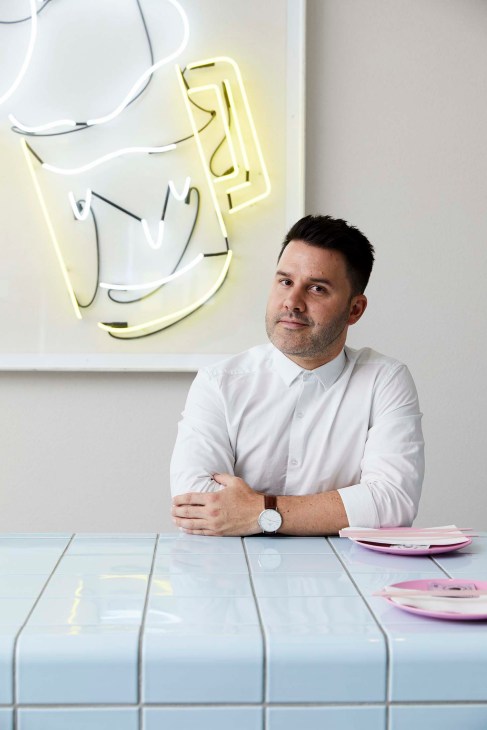
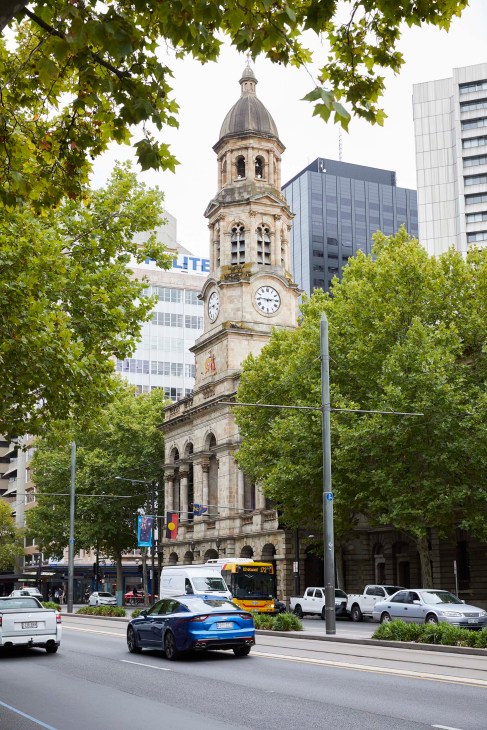

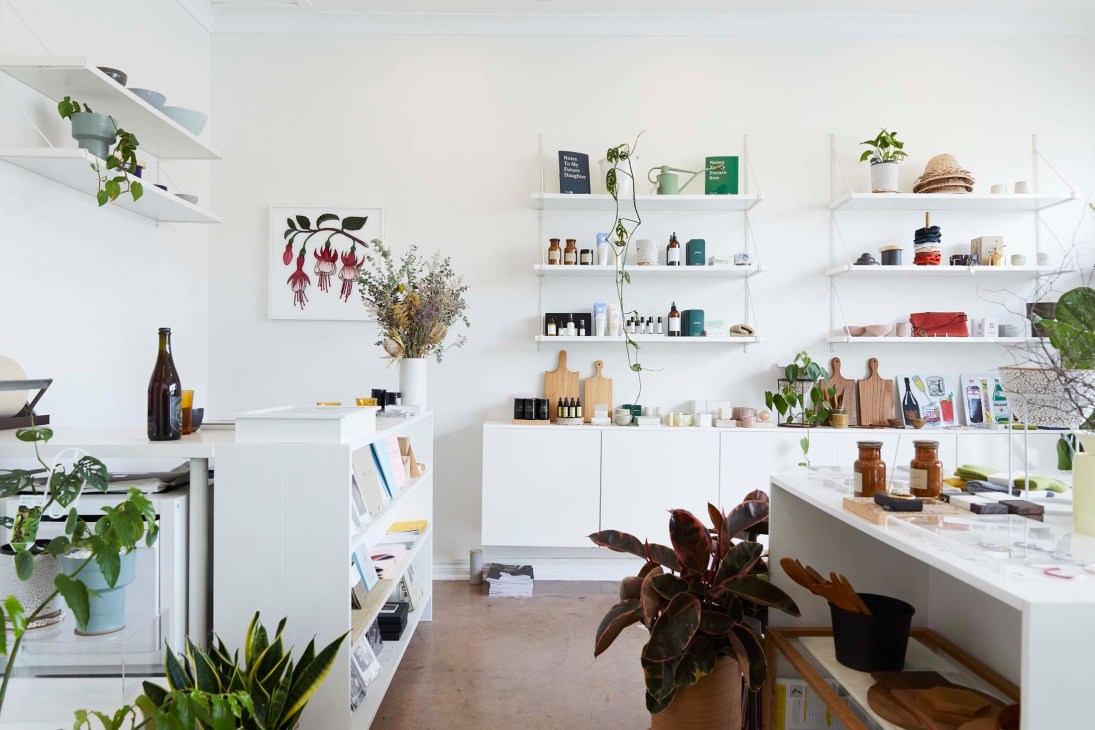
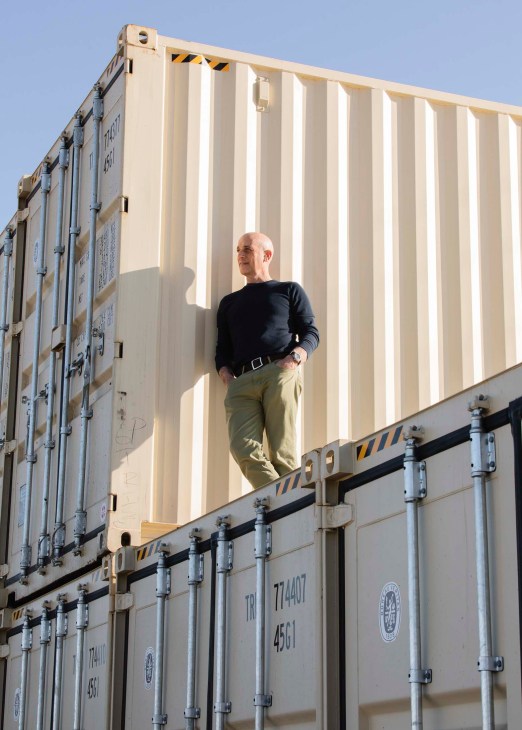
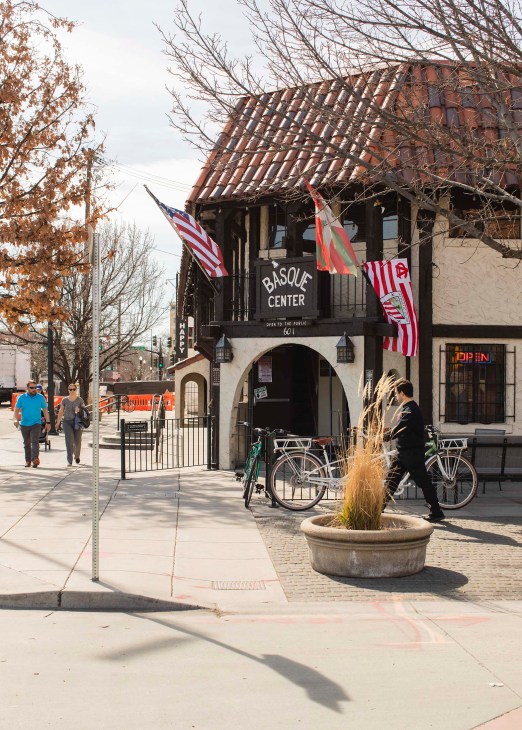
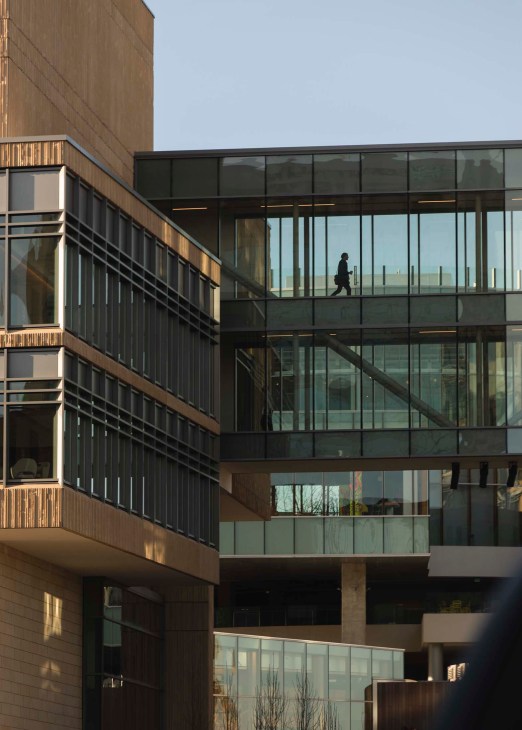
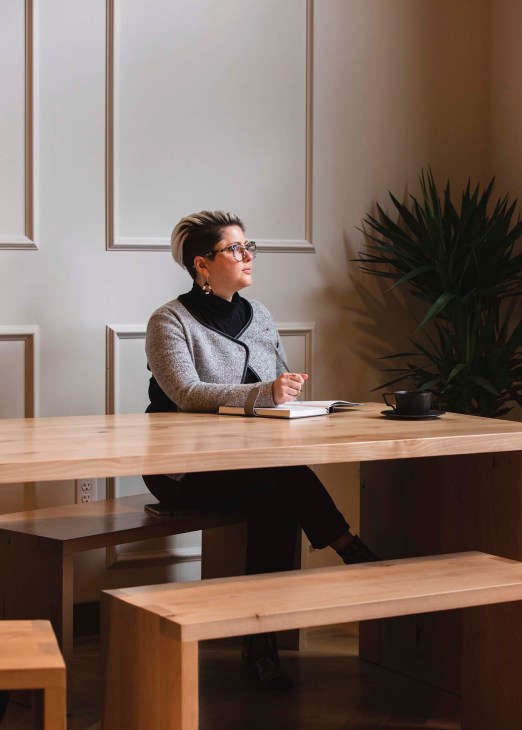
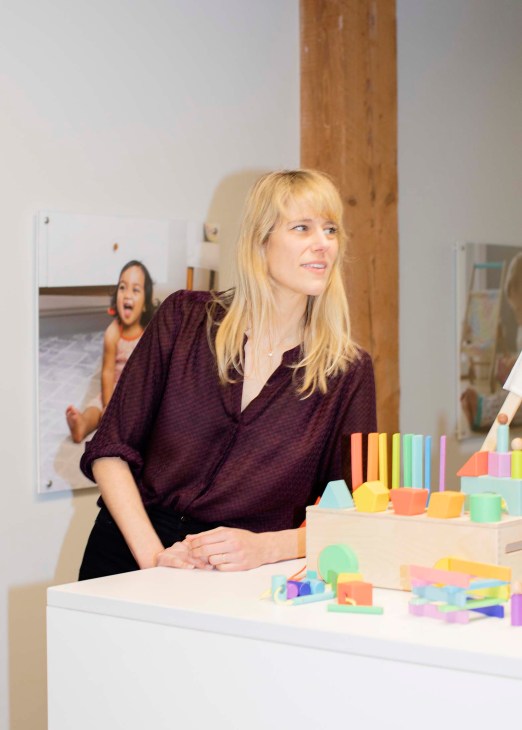
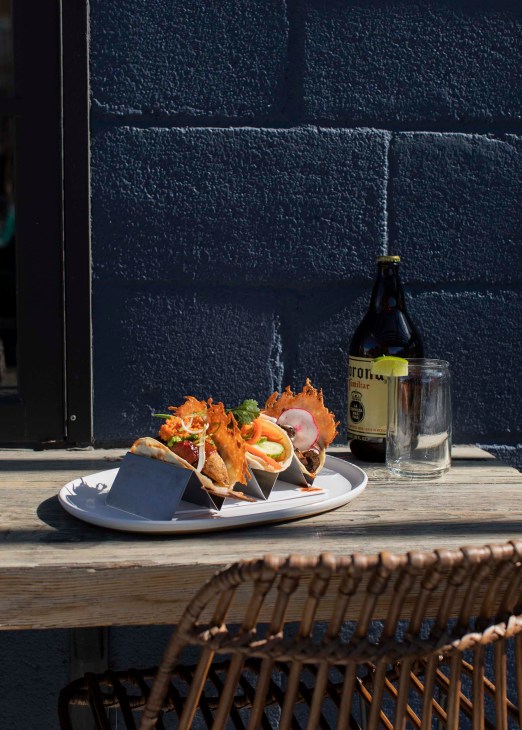
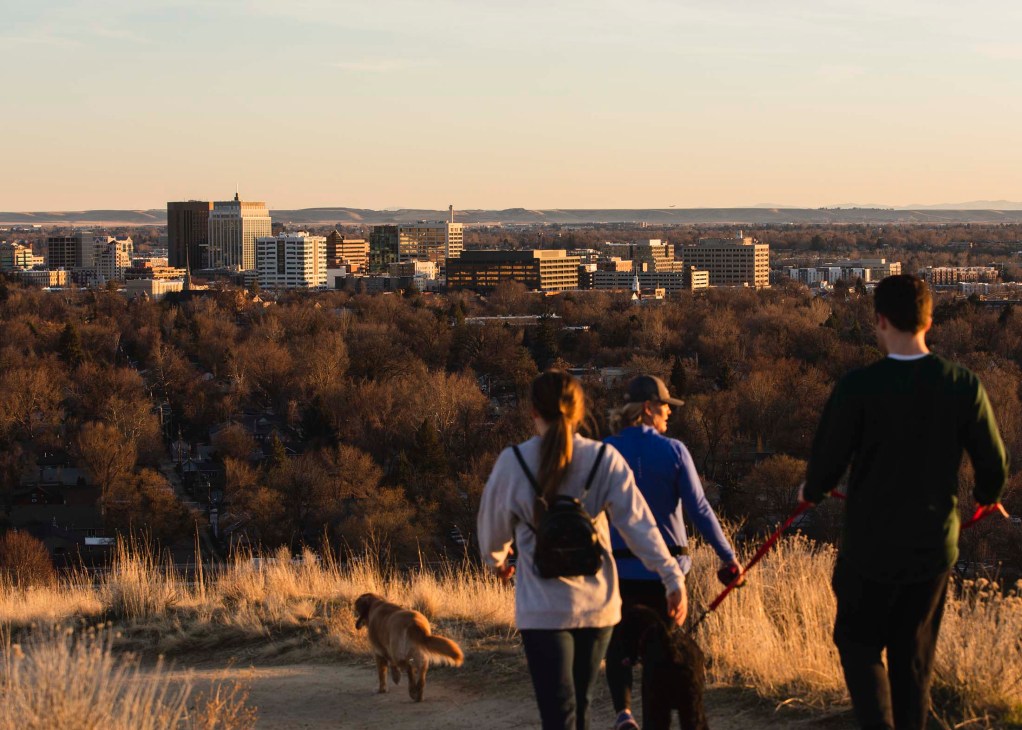
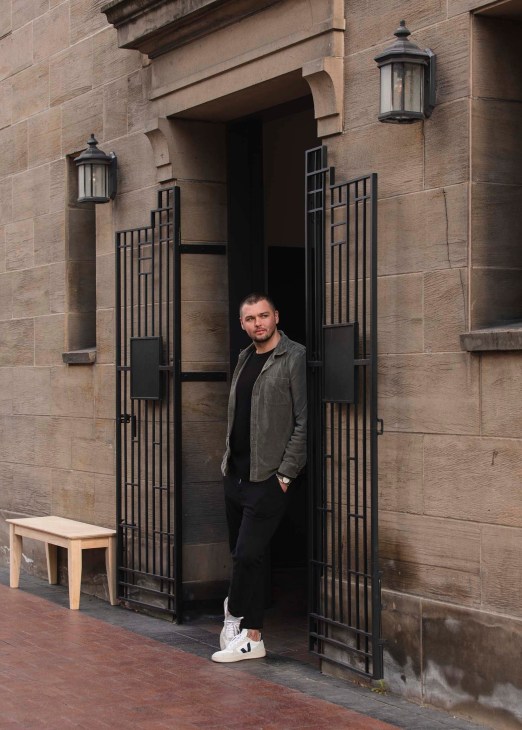
Adelaide initially grew out of British wealth in the late 19th and early 20th centuries and then saw major investment again during the 1970s thanks to the car-manufacturing industry. This series of economic highs can be seen in the skyline of stately colonial-era builds and looming brutalist blocks. And the current boom is marked by cranes on the horizon, which are building €2.2bn worth of city infrastructure and commercial developments.
“It’s the most exciting time the city has seen in decades,” says Lord Mayor Sandy Verschoor. “Liveability is incredibly high and, paired with the current dynamic city culture, it’s fueling residential growth, which then triggers business growth. It’s a virtuous cycle.”
Part of this is down to the 2013 introduction of an affordable small-bar licence. It has allowed more than 100 small bars, cafés, restaurants and galleries to open within the city centre. It’s a far cry from the draconian laws that stifled night-time economies in Sydney and Brisbane.
“I didn’t think I’d be able to stay and do something I really loved in Adelaide,” says Oliver Brown, director of hospitality group The Big Easy, which is responsible for some of the hottest tables in town including pizza bar Anchovy Bandit and Greek taverna Yiasou George. “Adelaide has grown up quite a lot in the past five years and the small-venue licence was a big catalyst for this change.” Brown studied wine-making at university before setting up pop-up bar Red Trousers during the annual Adelaide Fringe arts festival. “Then a landlord who was also the chair of the board of Renew Adelaide allowed us to open our first outpost, Nola, back in 2015 in a really great space,” he says. “Far more experienced operators were tendering for the space but the landlord saw an opportunity in change.”
The Big Easy’s sharply designed and bustling three-restaurant stronghold in the city’s East End owes its success in part to industry-led nonprofit initiatives such as Renew Adelaide. A network of property owners provides subsidies in order to fill empty city lots with young entrepreneurs who want to test their food or retail concepts. It’s a smart move for a state that has traditionally haemorrhaged young talent.
On the southern border of the central business district is concept store Ensemble. Co-owners Bing Rowland, Beccy Bromilow and Emma Thomson impressed their landlord with grand self-funded renovation plans to win the contract for the nearly 200 sq m shop in the once sleepy inner neighbourhood. “There were tumbleweeds rolling down the street a few years ago, so we were nervous about opening in this spot,” says Rowland. But, at €1,650 per month, the place was a steal.
The shop selling leather shoes, womenswear and plants occupies the front of the site, with an exhibition space and artist in residence at the back, and Bromilow’s shoe workshop sandwiched between. “We receive a lot of support from our neighbours and our customers are very loyal and make the effort to support our growing business,” says Bromilow.
The cheaper rents and greater availability of central property compared to other cities mean that people can take risks they might not be able to elsewhere. For example, Rowland’s sister Caitlin and her husband left the Melbourne hospitality scene to open Sibling, a café, next door, all while she was pregnant. “The climate is changing and people are going out and trying things,” says Rowland. “There’s no harm in trying and there seems to be a consensus in Adelaide that we don’t get caught up in our failures. We would much rather celebrate our successes.”
French immersion
A whopping €49bn worth of defence projects is predicted to be manufactured in Adelaide in the next 20 years. That’s the lion’s share of Australia’s total materiel spend. A large portion of this – more than €44bn – was set to go towards building 12 new “attack class” submarines.
Back in April 2016, the Australian government announced that French state-owned firm Naval Group had won a bid to lead the design but that the work would be done on home soil. With the project now underway, a wave of French engineers, technicians and their families have made the move Down Under. Some primary schools are embracing the change by teaching French in their classrooms and there’s been a parallel transfer of skilled migrants into the region’s wine industry. The quality of croissants and baguettes is also said to be on the rise but commendable pastry aside, assimilation hasn’t been entirely smooth.
Tensions bubbled to the surface in 2019 when French Naval Group workers expressed frustration with short (or no) lunch breaks and the insistence on to-the-minute punctuality. Australians were reportedly shocked upon learning about les grandes vacances: the French tradition of businesses closing for chunks of July and August. But even with workshops put in place to ease cultural clashes, the project continues to falter. Delays were announced by the French company earlier this year, pushing its design delivery from July 2022 to September 2023. Long lunch breaks included, the first subs are due to enter the water by the mid-2030s but the entire fleet isn’t expected to be completed until 2053.
On the up Down Under
Setting up:
Obtaining a working visa for Australia remains difficult. But there are options; a nomination by a government organisation or an investment close to €1m certainly helps.
Growth sectors:
The South Australian government is heavily investing in the space-innovation, defence and film-making sectors. An old city hospital and a former Mitsubishi manufacturing site are currently being transformed into education and innovation precincts.
High-speed connections:
City hall’s 10 gigabit Adelaide network will bring lightning-fast internet to the central business district and North Adelaide.
Air travel:
Adelaide Airport offers direct international flights to nine destinations including Dubai, Singapore, Hong Kong and Auckland. It’s also serviced by all major domestic airlines and offers a wide range of regional and charter options.
Quality of life:
They call Adelaide the “20-minute city” for a reason: it’s just a short drive to the beach and wine regions, commutes are quick and you’re never far from a park.
Boise
Idaho, US
One surefire way to gauge the desirability of a place is by asking residents where they hail from. In the city of Boise (pronounced “boy-zee”), you’ll soon discover that the answer is almost anywhere but the Idahoan capital itself. Some settled 20 years ago; others have been in town a few months. But all seem to have been attracted for the same reasons: a small-town slice of the West with a better lifestyle than their previous home. More recently, the appeal of hiking, skiing and mountain-biking in the surrounding Rockies has been matched by a growing economy. And it’s putting Idaho, a state that many would struggle to locate, on the map (clue: it’s nearer the Pacific Northwest than you might think and nowhere near the Midwest).
“The first question I get is: ‘Oh, you’re new – how much do you love Boise?’” says Jennifer Hensley, executive director of the Downtown Boise Association, sitting inside Neckar Coffee, the sort of gourmet café that wouldn’t have existed here a few years ago. Originally from Texas, Hensley lived in Minnesota before a roadtrip with her husband brought them to Boise. They were immediately hooked; within a year she was back with a job. Hensley, whose organisation oversees everything from rubbish collection to flower-planting, mentions 28 business that have either recently opened, or are due to do so soon, in the downtown area.
One advantage of a thriving but fledgling scene is the glut of opportunities it presents for those with entrepreneurial ideas. Michelin-starred chef Cal Elliott might be from Boise but he spent more than 20 years in Williamsburg, New York, where he ran Rye restaurant. He felt the pull of home for various reasons but also sniffed the chance to do something that others weren’t. “It’s like a blank canvas,” he says. “As a restaurateur, I don’t feel like, if I do something interesting, there will be 10 people like me [but] with more money in less than a year.” With partners, Elliott has purchased a 119-year-old brick building in the heart of downtown that he plans to convert into a 39-room hotel with two street-level restaurants by 2022. “It’s a lot easier than doing something in New York,” he says.
Part of the ease of migrating from a larger metropolis is lower overhead costs. That was the case for Madre, a gourmet taquería run by couple John and Julie Cuevas in the Lusk District, over the bridge from downtown. Like over 40 per cent of people currently moving to Boise, they came from California. “We would always talk about having a restaurant of our own but it would have cost a lot of money in California,” says chef John. “Boise was an untapped [culinary] market and we’re very outdoorsy people. So it was perfect.” Julie adds that Idaho is more business-friendly than California and, for them, a better place to raise a family.
While Idaho’s capital might not be the well-kept secret it once was (home prices are spiking), good deals can still be found. Lucas Marshall moved here from Los Angeles in 2018 and, a year later, bought a four-bedroom home for his family in the Bench neighbourhood for €230,000 – a fraction of what it would have cost back in Venice Beach. Marshall Goods, his menswear shop that’s due to move to bigger digs on Main Street in April, is what he calls a “pioneer space” in his bid to expand fashion tastes in the city. He’s aided by affordable rents and what he describes as a “consumer-friendly” sales tax.
Boise is a town with its fair share of quirks, including a block of Basque restaurants, a legacy of the sheep herders who moved here in the late 19th and early 20th centuries. But is also nurturing larger enterprises. IndieDwell is a modular home construction company that was founded in Boise in 2017 with the aim of creating quality affordable housing with a focus on sustainability. Co-founder Pete Gombert, originally from Chicago, talks about the “fantastic quality of life” and says that running a business in the region works if you’re prepared to get on a plane. “The operation costs are fantastic,” he says. IndieDwell plans to grow from 73 to 300 employees by the end of the year and to open seven more factories around the US.
At the nearby offices of early childhood toy brand Lovevery, co-founders Roderick Morris and Jessica Rolph are also eyeing ambitious expansion, this time to Europe. Lovevery tripled its revenue last year and it now provides jobs for software developers who previously had to work remotely for Californian companies. Rolph, also a founding partner of one of the US’s fastest-growing baby-food companies, moved to Boise when her husband, Decker, landed a venture-capital job in town. She wasn’t originally sold but her experience of growing Lovevery has shown just how far the city has come. “Decker is a bit of a futurist,” she says about her husband’s ability to predict Boise’s boom. “I don’t always believe him – but I come around.”
Where living is easy
Population: 228,790.
Average residential home value: €306,500 (median value on Zillow).
Average salary: €50,000 (median household 2014–2018).
Nearest airport: Boise Airport serves 20 destinations within the US.
Process for registering a new business: The city of Boise has online tools to calculate zoning and permits for new businesses. Trailhead, a co-working space aimed at start-ups, has two sites, one of which is supported by the city and the Capital City Development Corporation, Boise’s redevelopment agency.
Ticking ahead
With many of us housebound and the global economy in an uncertain state, now is the time to invest in things that will last. And there’s no better investment than a watch – whether it’s a cutting-edge sporty design or a more classic model with a soft leather strap.
The watches industry, like most other consumer sectors, has been hit hard by the coronavirus pandemic. Its biggest trade fairs – Baselworld and Geneva’s Watches & Wonders – were due to take place in April but have been cancelled, while Geneva Watch Days has been pushed back to August.
Although watch brands big and small are dealing with challenges, including delays to production, there are plenty of exciting new releases on the market. These pieces will help you stay ahead of the game once life speeds up once more.
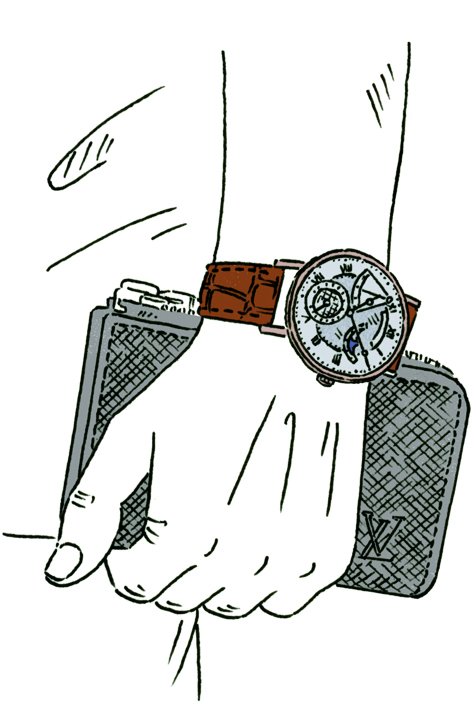
Breguet Classique 7137 watch, Breguet (MEN’s)
A classic, refined look from the historic house founded in 1775.
breguet.com
(Coin purse by Louis Vuitton)
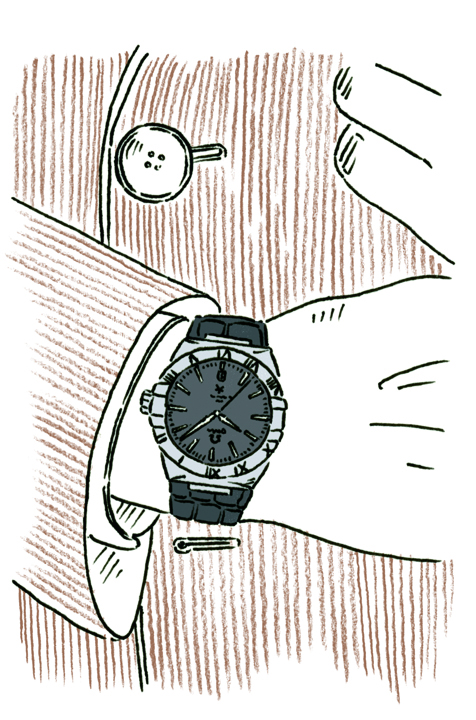
Constellation Gents watch, Omega (MEN’s)
With a 39mm steel case and leather strap, this model is smart yet understated.
omegawatches.com
Tudor Black Bay watch, Tudor (MEN’s)
An attractive, functional diving watch inspired by the brand’s 1950s designs, it’s waterproof up to 200m and comes in a choice of accent colours.
tudorwatch.com
Portugieser chronograph watch, IWC Schaffhausen (MEN’s)
A new addition to the brand’s popular Portugieser line, this handsome automatic timepiece is finished with a blue dial and an alligator strap.
iwc.com
Master Control Calendar watch, Jaeger-LeCoultre (MEN’s)
This model looks to Jaeger LeCoultre’s triple-calendar moon-phase timepieces from the 1940s and 1950s. The case comes in steel or rose gold.
jaeger-lecoultre.com
Maillon de Cartier watch, Cartier (WOMEN’s)
Cartier’s latest design – with its elegant interlocking wristband – looks likely to become a future classic.
cartier.com
(Earrings, rings and bangles by Cartier)
Égérie Moon Phase steel watch with diamonds, Vacheron Constantin (WOMEN’s)
A star of the Swiss brand’s recently launched Égérie collection, it’s accented with a diamond-set bezel.
vacheron-constantin.com
Classic Fusion Gold Crystal watch, Hublot (WOMEN’s)
A striking model with a polished black dial that’s decorated with gold crystal (made using flakes of gold).
hublot.com
J12 Paradoxe watch, Chanel Watches (WOMEN’s)
An arresting black and white addition to the French house’s j12 collection.
chanel.com
(Coco Crush Rings by Chanel Fine Jewellery)
Alpine Eagle collection watch, Chopard (WOMEN’s)
This delicate model from the brand’s recently launched Alpine Eagle collection features a “Bernina Grey” dial inspired by an eagle’s iris.
chopard.com
Stylists: Shun Katakai and Kyoko Tamoto
Urban developers
“Good work isn’t possible without good commissions,” says Melbourne graphic designer Patrick Scanlan, discussing the realities of his profession. Luckily for the co-founder of Studio Hi Ho, the firm he set up with Wesley Waddell in 2011, good design projects are present in the city, which within 10 years is set to become Australia’s most populated. The work of Scanlan’s three-man team – known for sharp typography and bright, clever illustration – has become lauded in design circles. Yet most of Studio Hi Ho’s best creative art direction is commissioned by an unlikely source: property developers.
As foreign investment flooded the city in recent years, Melbourne’s property market boomed and, according to Scanlan, smart developers realised that Melburnians were under-serviced. Boutique estate agent, and long-standing Studio Hi Ho client, Milieu Property was one of them. Milieu began to commission designs for sensitively built apartment blocks in up-and-coming neighbourhoods such as Brunswick. The projects would be beautiful (and make for wise investments) but as they went up behind construction hoardings their stories needed to be told to potential buyers. This is where Studio Hi Ho found its niche.
“Architects talk like they are talking to other architects,” says Scanlan. “So we had to find a simple way to communicate [with potential buyers].” He rolls out an elegantly crafted property brochure for a Milieu project in Fitzroy. Here, on tactile stock, the character of the city’s architectural vernacular is highlighted through bold photography and warm renders of the forthcoming property, with eloquent writing outlining its design. “It’s pretty simple: people tend to love good design, which these projects were about, so we just had to strip all the jargon away,” says Scanlan. “For us it’s always about boiling things down to their most simple form and stripping the clutter away.”
Aided by smart marketing, many a Milieu property has been sold off-plan. As this boutique style of development has grown in popularity, so too has the clever collateral that’s commissioned around it. In the property industry, however, the style of communications has become painfully similar to that forged by Studio Hi Ho.
Unfortunately, copycatting is a familiar story in Melbourne, particularly in the hospitality trade. Before the pandemic slowed things down in 2020, new coffee shops and restaurants seemed to be opening constantly, all hoping to provide a small point of difference but often presenting themselves in unoriginal ways. As a result, the hospitality businesses that tend to survive in Melbourne have a common trait: they apply design-conscious, original art direction to bolster their appealing menus and service.
Graphic-design firm Studio Round, which operates from a light-filled venue in the agency-laden suburb of Carlton, knows this well and has built its business around the f&b industry. One of the company’s most successful partnerships has been with chef Andrew McConnell, who is responsible for many of Melbourne’s most-loved modern dining destinations. For McConnell’s popular Asian-fusion restaurant Supernormal, which opened in 2014, Studio Round designed Tokyo-inspired takeaway boxes for lobster rolls, complete with cut-out cardboard lobster trimmings, and serviettes featuring illustrated Super Mario-style clouds. Scenography is key at such venues and, at McConnell’s restaurants, good graphic design is in abundance.
It is also present inside informal wine bar Marion, the latest collaboration between Studio Round and McConnell. Designed as a sibling to McConnell’s flagship Cutler & Co, Marion is imbued with a lived-in authenticity; Studio Round’s tagline for this new venture is: “A bar that feels like it’s always been there”. The site’s historic urban context inspired the condensed heavy signage that sets the tone for Marion’s wider identity. “Brand to us is not a veneer,” says Studio Round co-director Robert Nudds. “Instead it builds a project from the inside out.” He notes that the wine bar’s identity is cohesive and considered: the menu boards, tableware and uniforms all reflect its brand ethos. Nudds believes that Melbourne’s “isolation has allowed [Studio Round] to take on a bigger role”. Rather than being purely about graphic design, the firm’s work could alter an item on a menu or impact service culture – in a positive way.
Another Melbourne firm that’s enlivening some of the city’s restaurants is Projects of Imagination (POI), whose work includes designing for Australian-Asian favourite Chin Chin. poi’s business model fuses branding with interior design. Directors Nick Cox and Dion Hall believe that, as a result of Melbourne’s remoteness, they’ve been able to develop a collaborative model that’s outside the norm for a graphic-design studio. “Typical client-creative boundaries are ignored in favour of an approach based on curiosity and problem-solving,” says Cox. For a recent project for Collingwood gelateria Piccolina, for example, poi took references from mid-century Italian design, drawing on iconic fonts and forms articulated in shades of green, white and red. This base provides a palette that can be adapted when new items are added to the menu, or when the owners change the interior design. “The visual cultures that we create evolve as our clients’ menus evolve, as their customers evolve, as their businesses evolve,” says Cox.
These ideas come full circle at Congress, a wine bar that Studio Hi Ho worked on with both Milieu and the interiors firm Design Office. Studio Hi Ho was tasked with creating the bar’s brand identity and scenography, and designing its menus, glasses and tableware. It was a dream brief for Scanlan, who says that the style is “Bob Hawke, 1980s boardroom”, referring to Australia’s eccentric former prime minister.
Design influences include old parliament clocks. Interestingly, the red and green lights that indicated an imminent vote in the House or Senate have been referenced here in a device showing when Congress is open and closed. The success of the bar has seen its owners recently open another outpost, with the design brief again awarded to Studio Hi Ho. Like its entrepreneurial contemporaries, the firm is embracing the theory that, in Melbourne, graphic design goes beyond the screen or printed page. As Scanlan says: “It’s that idea that the whole is greater than the sum of the parts.”
The city according to type
Typographers such as Dennis Grauel, who created the Frisky Freadman font for Studio Hi Ho’s branding of architecture firm Freadman White, are taking the urban texture of Melbourne and transforming it into characters. Grauel’s work is imbued with Melbourne-isms including a typeface that is an ode to Brunswick, a suburb known for its arty, bohemian culture. Reflecting this, Brunswick Grotesque is mixed with five different character widths that reflect the huge variety of signage across the district.
Calming influence
In March the UN set out a challenge for designers across the globe to “translate critical public-health messages into different languages, cultures, communities and platforms, reaching everyone, everywhere”. It was much needed. In a time where calm and clear information should have been the order of the day, much of the Western media ran away with sensationalising the pandemic – and so did the art directors who they employed.
Of course, there have been examples of graphic artists plying their craft more positively, such as the deliberately aloof shaping of type around the images in a New York Times piece on social distancing. The artistic representation of important information can mean the difference between life and death. We’re confident that the UN notice will seed plenty of clever, creative and helpful results from designers.