A letter from Magdeburg to Sydney: terror, grief and the road to justice
Writing in the wake of a terror rampage in Sydney, and one year after a deadly car attack shattered Magdeburg’s Christmas market, Blake Matich reflects on grief, resilience and how communities restore order.
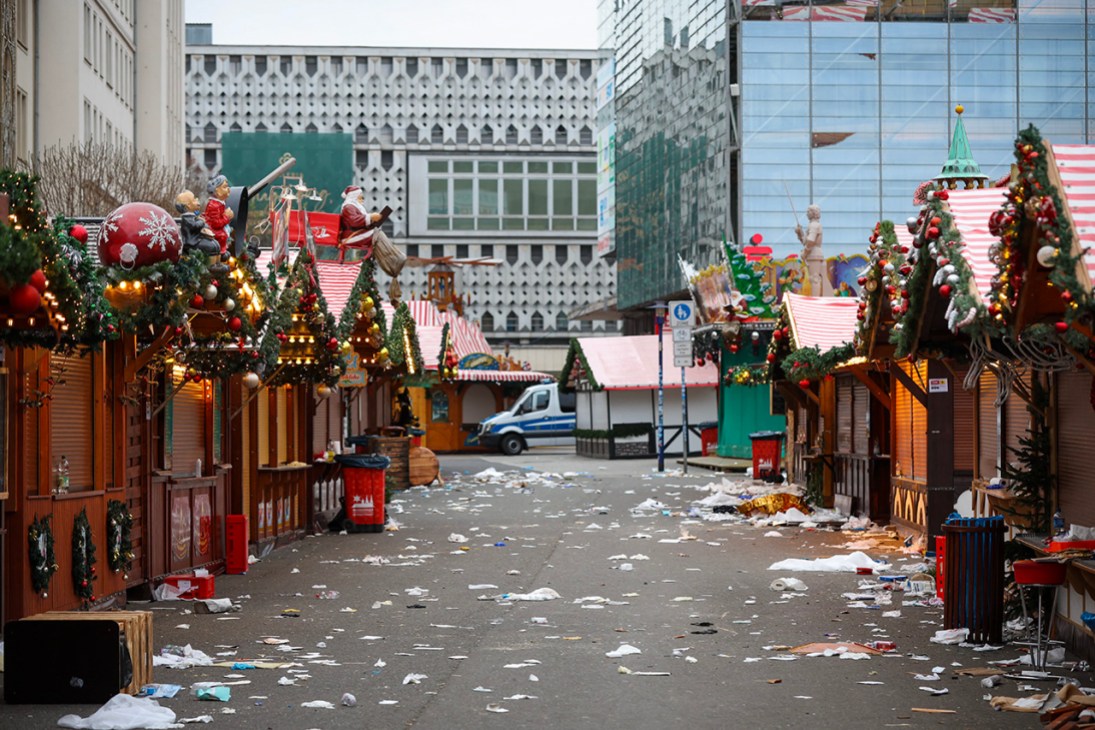
A year has now passed since the crowds lining up for glühwein, deep-fried Lángos and Gebrannte Mandeln at a Christmas Market in Magdeburg, Germany, were replaced by police tape, boarded-up stalls and candlelit vigils. It was on the evening of 20 December 2024 that a man driving a rented BMW accelerated into the crowded market in the city centre, killing six people and injuring more than 300. The city went into shock. The carousels stood still. Christmas was all but cancelled. When I arrived in town shortly after the attack, the streets were deserted and the market bestrewed with the detritus of disaster. The only people I could find were huddled outside church doors, standing solemnly and shaking in the winter wind like the flowers laid at their feet.
This year the markets are back on and, from here, it is hard not to think of my hometown, Sydney. Across the globe – in what must seem like a summer fever dream – my fellow Sydneysiders are still reeling from a terrorist attack targeting a Hanukkah event at Bondi Beach that claimed the lives of 15 people. The shock will eventually subside but what follows is the slow, painstaking work of restoring order – judicially, culturally and socially – to a city shot through with violent chaos.

Unlike Australia, which has little in the way of history when it comes to terrorist attacks on its own soil, Germany had been here before. In 2016 an Islamist attacker killed 13 people when he drove a stolen truck into a Christmas market in Berlin. And just this past weekend, German police arrested five men for planning to attack a Christmas market in southern Bavaria. Still, nobody expected the terror to arrive in a mid-sized city such as Magdeburg, which last found itself in anything approaching international headlines in the 10th century, when Holy Roman Emperor Otto the Great chose it to be his imperial centre.
This year’s markets feature a strong security presence with a combination of concrete barriers and heavily armed police surrounding the event, plus more patrolling within. But much like the glow of Christmas lights punctuating the shadow of last year’s tragedy, Magdeburgers are embracing a defiant spirit. Nevertheless, that shadow is close at hand. In early November, the man accused of carrying out the attack went on trial. Taleb A – his full name redacted under German privacy laws – is a Saudi Arabian doctor and refugee, now facing life in prison. Chief public prosecutor, Matthias Böttcher, told the court that Taleb A planned the attack over a matter of weeks. His aim? “To kill an indeterminate number of people”.
At the time of the attack, officials described Taleb A as an “untypical” perpetrator. He had publicly criticised Islam and expressed support for the far-right Alternative for Germany (AfD) party. The state of Saxony Anhalt, of which Magdeburg is the capital, is considered an AfD stronghold. In the courtroom, however, ideology must give way to evidence and the methodical machinery of German justice.
Due to the sheer number of victims, a temporary courthouse has been erected at Jerichower Platz in the city’s east. The 2,000 square-metre structure, which by trial’s end is expected to cost several million euros, has space for 700 people and security measures that wouldn’t look out of place in The Hague. The defendant sits in a glass-enclosed dock. A gallery with seating for up to 450 is available for the hundreds of plaintiffs, while a further public gallery separated by another glass partition is supplied with a livestream broadcast. At the building’s unveiling, justice minister Franziska Weidinger said it’s about giving the huge number of victims a chance to participate. “We owe that to the victims of the attack.”
The trial is expected to last for about a year, with 47 hearings already scheduled. Weidinger expects the trial to be one of the largest in postwar German history, likely to surpass in scope the National Socialist Underground trial in Munich.
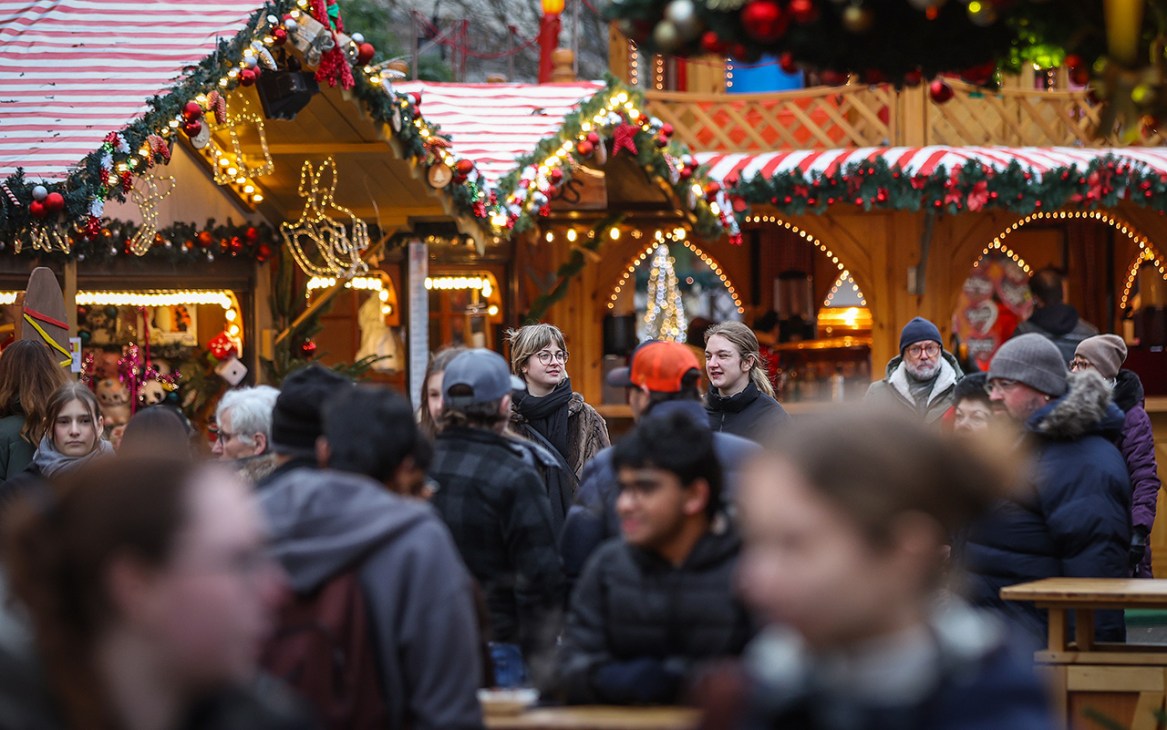
The fact that Magdeburg’s Christmas Market is back under way across the River Elbe while Taleb A is in the dock is a sign that justice, along with glühwein, is already being served. Among the wooden stalls, steam from many cups of hot spiced wine rises in unison through the cold air. The feeling might be somewhat subdued but there’s still Bratwurst im Brot, Santa sightings and my personal favourite, Quarkbällchen – deliciously sugar-dusted doughnut balls made using quark. The people of Magdeburg are not letting fear and hatred hollow out their community spirit.
For further proof that the German city is refusing to let terror win, we need look no further than its Opera House. This year’s Christmas schedule includes a ballet adaptation of William Shakespeare’s A Midsummer Night’s Dream, which might not sound on point seasonally, nor particularly German – but as one of my literature professors at Freie Universität Berlin joked at the beginning of a lecture: “Germany has three great writers: Goethe, Schiller and Shakespeare.” It was tongue-in-cheek but only just. And that’s because the Germans fell in love with the Bard almost as soon as the English did. They embraced Shakespeare the way the Italians embraced the tomato – wholeheartedly. August Wilhelm Schlegel called him “ganz unser” (entirely ours). Today, there are more productions of Shakespeare in Germany than in England.
Shakespeare’s habit of timelessness is sure to be re-enforced when Magdeburgers hear Lysander utter the line, “So quick bright things come to confusion”. And yet, so slow confusion takes to untangle, so arduous the arc of justice, so interminable the course of grief.

The play’s development from confusion through transformation to eventual harmony is apposite. But what is more, the play is set in an enchanted forest. And while other nationalities, such as the British, like to cosy up at home in the wintertime, Germans like nothing better than to get into the great outdoors, to feel the brisk air among the pines, beeches and oaks.
A year on, Magdeburg is a city living in two emotional seasons simultaneously. It is serious, reflective, legally meticulous. And it is also determinably alive, responsive to life’s slings and arrows. The markets are open. There are dancers in the enchanted forest. And so the people come to the Christmas markets, they walk along the River Elbe, through the Romanesque cloisters and past the Gothic cathedral whose stones have seen sackings, fires, plagues and rebuildings before. The people of Magdeburg are not letting fear and hatred hollow out their community spirit.
From here, it’s possible to imagine what Sydney might look like a year from now. I’d like to think that we’d see a city similarly defiant in the face of terror and anti-semitism, comfortable enough in itself to come down to that fatal shore in droves, as they have been doing already to grieve and give blood. Then, as long swells beat in from the horizon and the sun slouches westward, Sydneysiders will gather on the beach or paddle out beyond the breakers to remember the brave and the lost, and to restore order from confusion not through rhetoric, prevarication or forgetting but through justice, ritual and coming together.
To listen to an audio version of this article read by the writer, tune in to ‘The Monocle Daily’.