Following the killing of Iran’s Supreme Leader, the Gulf’s promise of stability faces its starkest test
Missiles over Dubai have shattered the Gulf’s illusion of insulation. After Ayatollah Ali Khamenei’s killing, cities built on stability and commerce find themselves exposed – caught between neutrality and retaliation.
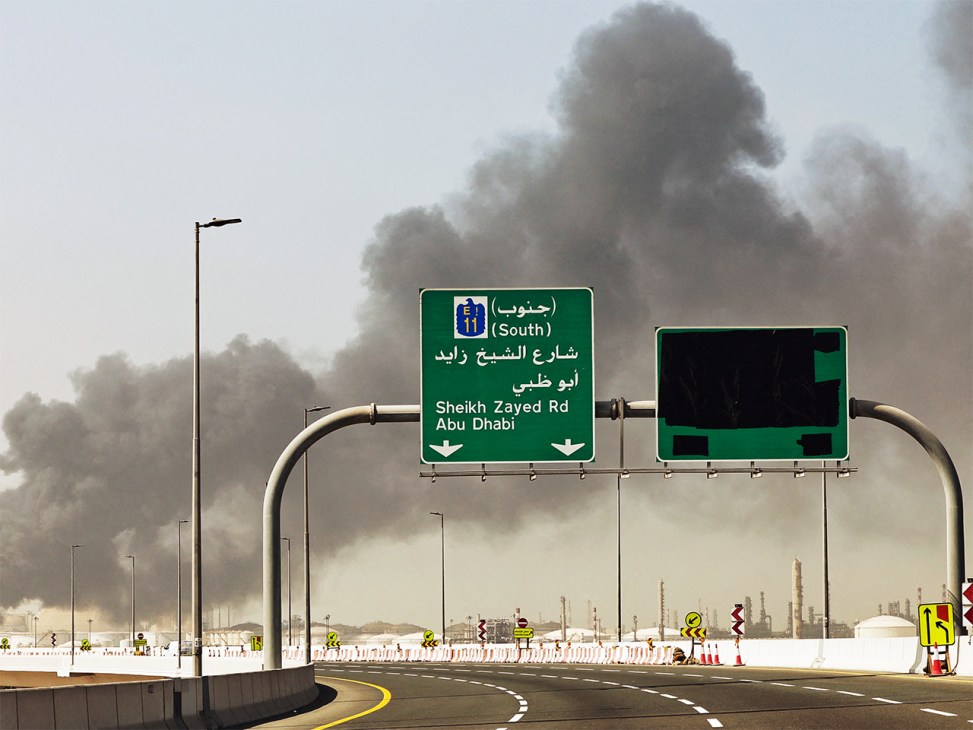
From my balcony in Dubai, the first thing that I registered was the sound. Not the sharp crack of impact but a low, rhythmic thud rolling across the coastline. Then another. And another. In the half-light, faint streaks cut across the sky above Dubai Marina before blooming into brief flashes.
Many of those thuds, it became clear, were not impacts but interceptions. The UAE’s air-defence systems were engaging, punching holes in incoming Iranian drones and missiles before they could reach their targets. The percussion was, in part, the sound of protection working as designed. Yet even successful interceptions take a toll. Dubai is not accustomed to the acoustics of war.
Following confirmation of Ayatollah Ali Khamenei’s death, the instinct is to look ahead. But it is difficult to do so while missiles are still in the air and targets extend beyond military facilities to civilian infrastructure. Airports, ports, hotels. Places where people work, holiday and live. This is not abstract geopolitics, it is national infrastructure with civilians inside, forced to calculate shelter routes between supermarket aisles and basement parking lots.
The UAE has said that Tehran crossed a red line and that the Gulf is reviewing its options. The phrasing is deliberate. For years, Gulf capitals urged de-escalation, arguing that diplomacy was the only route to protect the trillions invested in cities built as global hubs for finance, logistics, tourism and aviation. Safety here is not simply a policy objective, it is a commercial proposition. Stability underpins sovereign wealth, property values and airline schedules. That proposition has been stress-tested before. But rarely so visibly.
Mahdi Jasim Ghuloom, junior fellow in geopolitics at the Observer Research Foundation, described the assassination of Iran’s Supreme Leader as “the worst-case scenario.” The killing of a figure who was not merely a political authority but a spiritual one has pushed the regime into survival mode. Crucially, he notes that Khamenei was killed alongside other senior figures, disrupting established lines of communication. Even if back channels technically remain and interim leaders dictate the Iranian response, it is unclear who now holds decisive authority in Tehran. That uncertainty makes Iran “very unpredictable and more dangerous.” It also complicates the question that many in the Gulf are pondering: “Does the region feel safer with the Ayatollah gone?”
In the immediate term, the answer appears to be no. The dangers that Gulf cities are now facing are a direct consequence of the assassination. The distant prospect that Iran might eventually produce a more pragmatic leadership is overshadowed by the immediate need to halt attacks causing casualties and disruption.
But there is another uncomfortable truth. The Gulf didn’t choose this fight; it has been drawn into the crossfire, effectively reduced to collateral damage. Gulf states host US bases but did not author the decision to decapitate Iran’s leadership. Yet retaliation rarely distinguishes between the architect and the host. Neutrality offers limited shelter when revenge becomes emotive.
This is also the moment when questions about planning surface. It is not clear that any amount of preparation could fully manage the fallout. But if Washington’s objective extends beyond decapitation to durable stability, then the transition in Tehran – and the reactions across the Gulf – will require more than tactical success.
Strategically, the Gulf faces a narrowing corridor. If Iranian strikes increasingly affect civilian areas, Ghuloom warns that the region might feel it has “no choice but to deter by confronting.” That shift from reluctant collateral to active combatant would further entangle the region in a confrontation that it has long tried to contain.
As night falls, life in Dubai resumes with studied normality. Traffic slowly hums along Sheikh Zayed Road, restaurants remain open and supermarket shelves still carry imported fruit from continents away. Yet the psychological rupture is real. The thuds overhead are reminders that safety, even in cities built as sanctuaries of order, is no guarantee.
Looking ahead is necessary. But for now, the Gulf’s future feels suspended between interception and impact, between red lines and retaliation. Whether this moment marks the beginning of a safer regional order or merely the start of a more volatile chapter will depend not just on what was destroyed but also on what, if anything, is built in its aftermath.