How Japan’s schools teach life lessons beyond the classroom
There’s far more to Japanese schools than rote learning and cramming. Our Tokyo bureau chief explores the country’s best-in-class approaches to moulding responsible citizens.
Anyone who goes through secondary education in Japan will be familiar with bukatsu (after-school clubs). Though participation in these activities isn’t compulsory, almost everyone does something, whether the focus is on sports or culture. (The Japan Sports Agency identified 47 types of the former and 26 of the latter.) It could be a daily commitment, such as baseball, which some say is the most demanding club of the lot, or a weekly martial-arts session (kendo, for example). Others join a brass band or choose calligraphy, anime or photography. Not long ago, being clubless was considered so anomalous that those who weren’t part of one were referred to slightly derisively as the kitaku-bu (“go-home club”).
As with so much of Japanese education, the purpose of bukatsu is bigger than the clubs themselves. When Thomas Blackwood, an American sociologist and professor at Tokyo International University, asked adults in the country about the importance of bukatsu, more than 70 per cent said that participation in them during their school days had been useful in later life. What they valued wasn’t always the technical skills they acquired but rather the life lessons they had picked up along the way: the ability to read a room, consideration for others and persevering after failure.
Japanese education always scores highly in formal global rankings but many abroad wrongly assume that it’s all rote and no fun. There is, of course, a certain amount of drilling out of necessity. The written Japanese language is among the trickiest to master; to read a newspaper, you need to know 2,000 to 3,000 kanji characters (mainly derived from Chinese ideograms), as well as two phonetic alphabets: hiragana and katakana. Even for native speakers, learning it all is a slog and there’s no way of cutting corners. But beyond that, the public school system is built around the goal of creating decent citizens, as well as literate ones. The result of this effort can be seen in the sense of cleanliness, order and calm that so impresses visitors to the country.
The idea of cleaning has an elevated place in Japanese culture, influenced by the concept of do (“way”), which frames the honing of any skill as a journey of self-improvement. In disciplines including judo and sado (the traditional tea ceremony) cleaning is a key part of training and seen to be good for the practitioner’s character.
Buddhism in Japan also prioritises the act of cleaning over study or chanting. The ministry of education set out detailed procedures for daily, regular and special cleaning in schools as long ago as 1897. This partly explains why the streets of Japan are so clean. Generations of people have learnt to tidy their classrooms at school and taken this approach to cleanliness with them into their adult lives.
Wielding a mop or a broom (as well as a zokin cleaning cloth, which every child has in their school kit) is a worthy life skill. In this context, it’s no surprise that the Japanese national team left behind a spotless locker room at the 2026 World Cup or that its fans cleared up litter after matches. Osoji (cleaning) isn’t a lesson as such but it’s part of daily life and starts for people when they’re students.
Even the country’s low obesity rate can be traced back to patterns practised in class. The local cuisine plays its part but there’s also an emphasis on eating properly at school. Forget chips and lasagne – Japanese children eat a balanced diet of rice, fish and miso soup (though what they buy in konbini when their parents and teachers aren’t looking is another matter). The pressure from some teachers to eat every last grain of rice isn’t always welcome but it teaches kids to appreciate the food that they’re given. Serving lunch to peers is another student responsibility, even at nurseries (where preschoolers given the task wear an adorable white hat and apron – surely this should be exported?).
The school sports days that I have attended have been organised with Olympic efficiency. They’re also inclusive and never designed for individual glory. The school divides pupils into two teams for the day and sports aces and less accomplished athletes compete together.
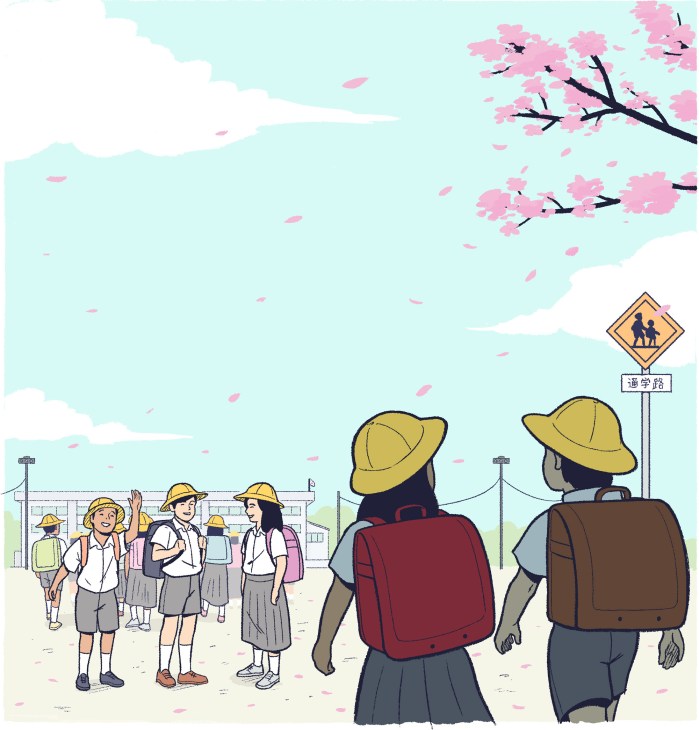
Most students also walk to and from elementary school solo from their first week, lugging on their narrow shoulders their distinctive, boxy randoseru school bags. Waving goodbye to a small child for their first unaccompanied commute is a nerve-racking moment for parents but the journey to school teaches kids plenty too – how to conduct themselves in public and be aware of the world around them.
Japanese education is built on tradition but it isn’t set in stone. Even bukatsu are being re-evaluated for modern Japan. Some after-school clubs are being moved into the community to give hard-working teachers a break, particularly those conducted at weekends.
It also helps to pool students in areas where the depopulation problem is most acute. In some places, the ageing population means that high-school rolls are declining and small schools can’t muster a sports team. No system is perfect and there are exceptions to every rule but, beyond academic achievement, the purpose of a Japanese education is to impart life skills. Don’t we all want a generation of polite, independent people who are considerate of the world that they inhabit? Surely there’s something here that we can all learn from.
Inside the ‘randoseru’
Today’s randoseru dates back to the late 19th century, when the Gakushuin school was opened to educate the children of the imperial aristocracy. Its students carried a black-leather hold-all, whose name was borrowed from the Dutch word “ransel”. By 1897 the dimensions were set and little has changed since. The quality is high and the best cost a small fortune: a cordovan-leather randoseru from Tsuchiya Kaban in Tokyo has 150 parts and takes more than 300 steps to complete. A solid randoseru is an investment – often a gift from proud parents or grandparents. It’s robust and designed to last for the six years of a child’s elementary-school education.
About the writer: Fiona Wilson is Monocle’s Tokyo bureau chief and has been covering the nation – between school runs, clubs and sports days – for more than 20 years.