What we can learn from the UK’s shift away from coal-fired power
There’s still a long way to go before fossil fuels are a thing of the past but change is possible – and recent transitions towards green energy have seeded fresh optimism.
The three cooling towers of Didcot A power station in Oxfordshire, England, loomed up in the grey morning light on 18 August 2019, as they had for half a century. But having stood idle for over six years, this was to be their last morning. At 07.00 demolition charges were ignited and the towers folded gracefully in on themselves as they collapsed to the ground.
The watching crowd got an extra moment of excitement when a large piece of supposed “debris protection material” dislodged and struck a 30,000-volt overhead line outside of the exclusion area, triggering an explosion and a fire. The break in the network left 40,000 homes without electricity. Their power supply was restored a few hours later but the destruction of Didcot A, which in its heyday generated enough power to supply millions of homes, was irreversible.
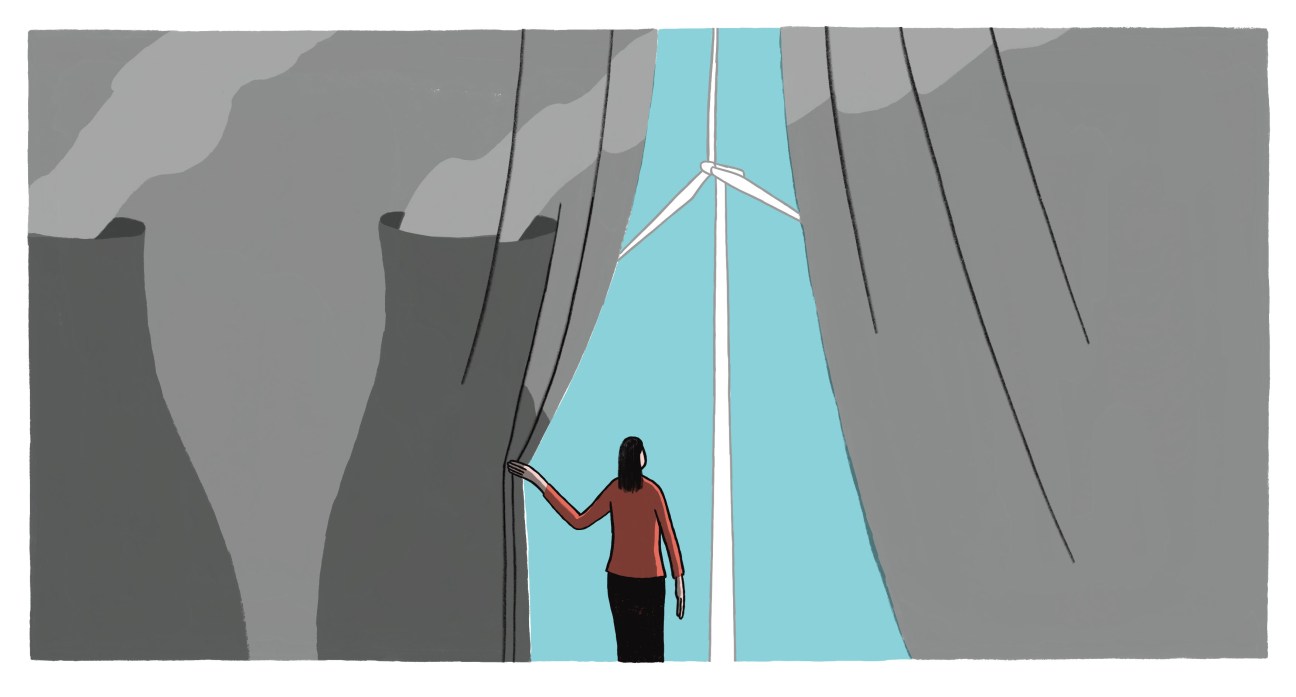
It marked a death knell for coal-burning in the UK, which by 2019 had already fallen to 2 per cent of electricity generation. While seven coal power stations were still operating at the time, two more were decommissioned in 2019, one the following year, another stopped burning coal in 2021 and two more stopped generating in 2023. The last coal-burning power station operating in the UK, Ratcliffe-on-Soar in Nottinghamshire, was closed down in September 2024. Given that coal provided 39 per cent of the UK’s power supply as recently as 2012, that was a remarkable tipping point.
Despite natural-gas-burning replacing coal in the short term, by 2020 – soon after Didcot A was destroyed – renewables including wind, solar and biomass were supplying 43 per cent of UK electricity demand, more than coal had covered back in 2012. Today more than 40 per cent of UK power comes from renewables and wind has become the biggest contributor, providing more than a quarter of the UK’s electricity. This started with onshore wind but now offshore has taken over and is poised to triple its capacity over the next five years. The UK now has about 20 per cent of the world’s offshore wind-energy capacity and in 2023, it generated about 30 per cent of the UK’s electricity.
The success story of the UK (and, incidentally, Denmark) in tipping away from coal power and towards renewables is important for everyone across the globe. That’s because a quarter of global greenhouse gas emissions still come from generating electricity. Positive tipping points away from coal-burning and towards renewables are urgently needed worldwide.
But this process of tipping towards renewables needs to go much faster. Current rates of growth suggest that solar and wind will together provide about a third of global power generation by 2030 but they need to exceed 40 per cent in order to be on track to keep global warming close to 1.5C. Coal power also needs to die, and fast – it has to fall from 36 per cent to about 4 per cent of power generation by 2030.
Overall, about 80 per cent of the world’s population lives in countries that are net fossil-fuel importers and have prosperity to gain in tipping towards renewable energy. As it is inherently more evenly distributed, the transformation will also help to redistribute wealth globally.
Energy can be stored in many forms – for example, in physical form as water pumped uphill or in chemical form as hydrogen or ammonia. But battery storage is the most promising option when it comes to rapidly scaling up. The growth required is enormous. Installed battery storage capacity worldwide was about 56GW by the end of 2023 but it needs to increase at least tenfold by 2030 or double that if we tip rapidly to solar power. Supply of grid-scale battery storage is growing exponentially, with a doubling time of less than two years, but needs to grow even faster to meet demand.
Happily, projections are being continually revised upwards, suggesting that growth will accelerate towards a doubling of battery storage capacity every year and a half. Such rapid expansion is made possible by – and depends upon – the tipping point to electric vehicles because they are projected to make up 90 per cent of the market for batteries in 2030. Passing the EV tipping point is driving down the price of lithium-ion batteries. Every doubling of total installed capacity has reduced their price by nearly 20 per cent and the cost of the energy service that they provide by 30 per cent. This could halve the price of batteries by 2030.
So what stands in the way of accelerating the renewable-energy revolution? Well, unsurprisingly, incumbents with strong vested interests in the fossil-fuel sector are resisting change and they are backed by powerful damping feedback that maintains the status quo. Fossil-fuel subsidies from governments worldwide totalled a record $7trn (€6trn) in 2022, more than a seventh of which was direct subsidies. That is a $2trn (€1.7trn) increase from 2020, and just over 7 per cent of the global GDP. For comparison, the world spends about 4 per cent of GDP on education. Ending fossil-fuel subsidies and shifting that public money towards renewable energy would accelerate change.
About the writer:
Tim Lenton is the chair in climate change and earth systems science at the University of Exeter. He is the author of Positive Tipping Points, published by Oxford University Press, from which this essay is extracted.