Mark Carney’s sovereign wealth fund is a throwback to a harder-working Canada
Carney has announced the country’s first government-owned investment fund, the Canada Strong Fund, beginning with a CA$25bn endowment. How exactly will it work and what will it achieve?
The setting for prime minister Mark Carney’s announcement of Canada’s first national sovereign wealth fund could not have been more redolent of his country’s past ambitions. On Monday, standing at a lectern in the Locomotive Hall of the Canada Science and Technology Museum in Ottawa, Carney evoked the generational effort to construct the Canada-Pacific Railway more than a century ago; the country’s first national project after gaining its sovereignty in 1867.
“Facing at that time an economic depression and threats to our sovereignty from our southern neighbour,” said Carney, nodding to history’s apparent rhyme in today’s context, “Canadians chose to build.” And it’s in that spirit that his government has set up the Canada Strong Fund – a project as consequential as the one represented by the gleaming steam train behind him.
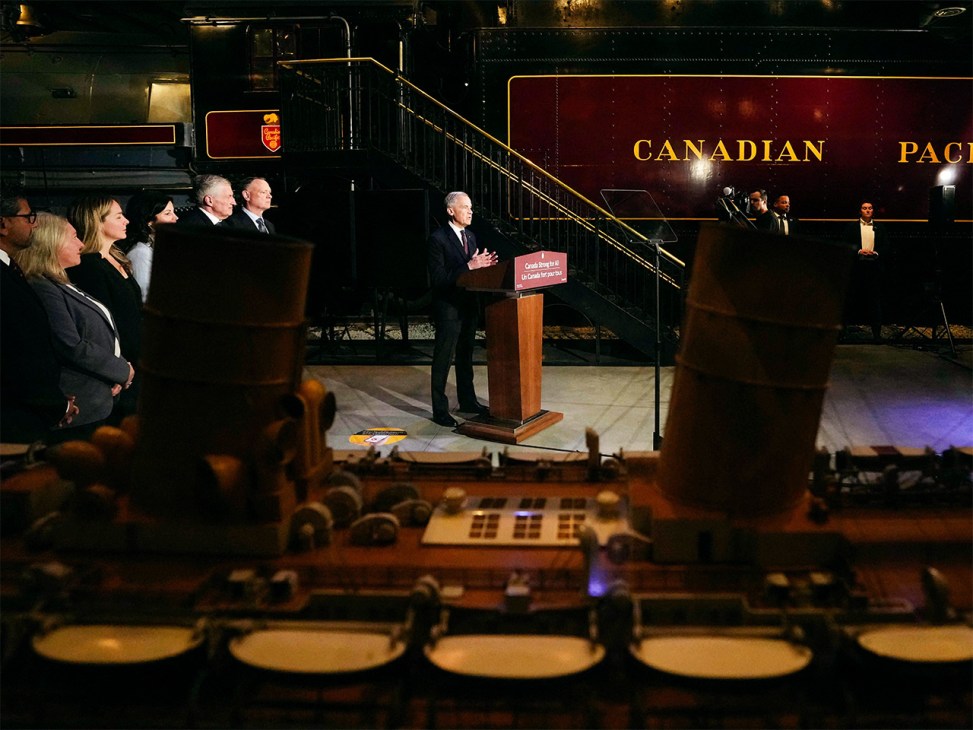
This is perhaps Carney’s boldest move in office so far. It also confirms that the dominant theme that brought him to power a year ago – countering the economic threat posed to Canada by a hostile US – is still very much his guiding principle.
Full details are still to be published by Carney’s government – something his critics have been quick to pounce on. The populist leader of the opposition Conservative Party has already dismissed the endeavour as a “Liberal slush fund” for a government that spends too much. But here’s what we know so far. Set up with an initial endowment of CA$25bn (€15.6bn), the fund will be managed by a Crown corporation, a federal body that operates independently from the government. Its focus will be on landmark domestic-infrastructure investments, initially in mining, ports and technology. It will be open to a mix of stakeholders – public and private, home and overseas – as well as to individual Canadians, who will be able to buy in to some of the projects being financed by the fund, for a return on that investment at some point down the line.
The Canadian reaction to the new fund has been mixed – the conservative-leaning premier of Saskatchewan, for example, was thrilled at the prospect. For others, the unanswered questions surrounding the fund outweigh its promised benefits. “I’m a bit of a sceptic, for a couple of reasons,” says David Soberman, a professor at the Rotman School of Management at the University of Toronto. “The question you have to ask yourself when these funds are put together is: would it be better for the government to take these assets and put them into a sovereign wealth fund to be managed by the government? Or would it be better for them to use the assets that are going into the fund to reduce national debt?” That debt currently stands at about CA$80bn (€49.97bn). “But one of the most important things with a sovereign wealth fund is how it’s managed – if it is taken care of by an independent board that truly knows how to invest funds, that is one thing. But if a sovereign wealth fund becomes politicised, then it becomes a problem.”
There are models already in place in Canada that might prove instructive to how the fund will work. The Canada Pension Plan (CPP) or even the Ontario Teachers’ Pension Fund – Canada’s largest single-profession pension plan with net assets of CA$279bn (€174.8bn) – are each managed independently of the government. They have been very successful in their investments, as well as the yields they’ve earned for those who pay into them.
Carney’s big challenge is to convey to Canadians how profound and, perhaps, permanent, the change is. All spurred, of course, by the manoeuvres of a now-hostile neighbour. “Hope isn’t a plan and nostalgia is not a strategy,” said Carney recently in a video address.
Canada, broadly speaking, is a country whose operating approach often stems from the comfort of the status quo. To mark the first year of the coronavirus pandemic, for instance, one of Canada’s big current-affairs magazines published a memorable editorial that decried that sense of national complacency, stating that for too long “good enough has been good enough”. It explained that the country’s handling of the outbreak, particularly the fragmented and often chaotic roll-out of vaccinations, should push Canadians to want for something better. Did it have the desired effect? Not really. But here we are now, at a time when most of the long-held assumptions about the way Canada’s economy works, and what it’s anchored to, have been cut from their moorings.
Carney is trying to recast basic principles in the minds of the country that he governs, as the old assumptions of how the nation operates continue to get chipped away. In principle, a new national sovereign wealth fund is surely a good thing. Canada is a wealthy country, so it should behave like one, particularly at a time of seismic tremors in the world order. But neither words nor principles alone – much like hope and nostalgia – amount to a plan. That lies in the work, hard though it might be.
Further reading:
‘You can’t be truly sovereign by yourself’: Mark Carney talks to Monocle about geopolitical pragmatism and a confident Canada
On film: Monocle in conversation with Prime Minister Mark Carney