Who is Mojtaba Khamenei, Iran’s new supreme leader?
After the assassination of Ayatollah Ali Khamenei by a US-Israeli strike in late February, his son Mojtaba has been named as the Iranian regime’s new leader. What do we know about this mysterious successor?
Iran has a new supreme leader in Mojtaba Khamenei, second son of his late father and predecessor, Ayatollah Ali Khamenei, who was killed in late February as the war between the US, Israel and Iran broke out. Though the 56-year-old Mojtaba has long been suspected of being influential behind the scenes, he has generally been circumspect, verging on reclusive.
Amid the ongoing war, Mojtaba Khamenei’s appointment is a direct rebuttal of US president Donald Trump, who said the “worst case” scenario was that the elder Khamenei’s successor would be “as bad as the previous person”. Though regime change in Tehran has never been expressly part of the US war effort’s goals, Trump has said that he would expect his country to have a role in the appointment of Iran’s next supreme leader, and has repeatedly pushed Iranians to rise up against their government.
To get a better picture of Mojtaba Khamenei, the ways in which his appointment will impact the war and how he is viewed by Iranians, Monocle spoke with Laura James, deputy director of analysis and a senior Middle East analyst at Oxford Analytica.
This conversation has been edited for clarity and length.
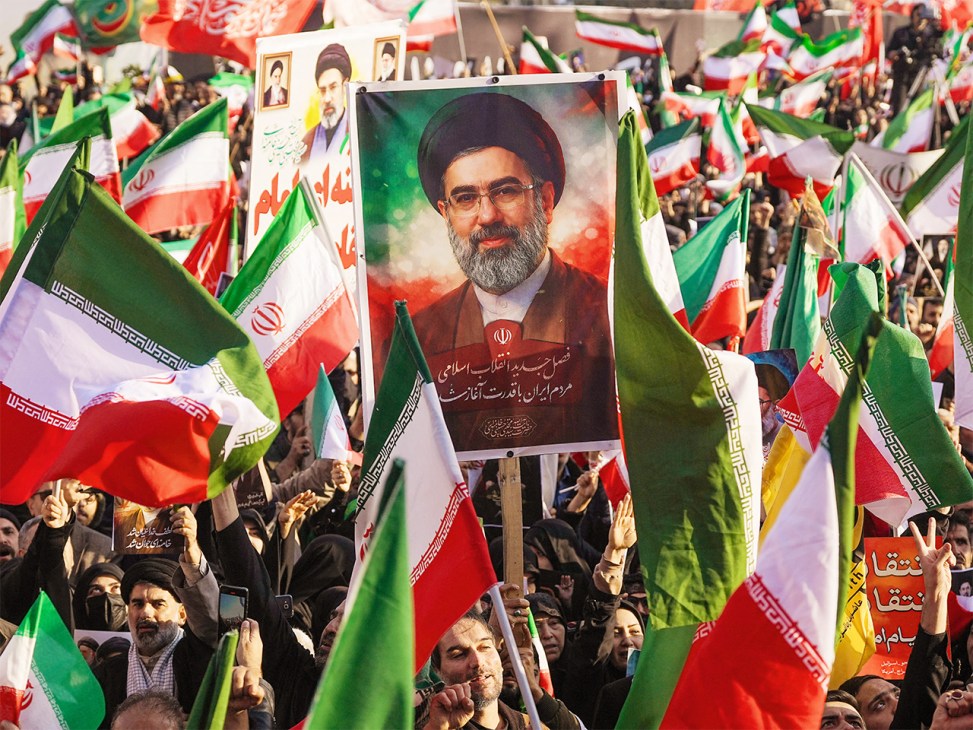
Mojtaba Khamenei has long been suspected of having strong influence behind the scenes but he’s not known to have ever made a major public appearance. What do we know about him?
We know that he was very close to his father, that he was seen as a gatekeeper. We know rumours about him, which are that [his beliefs] are very much on the hardline side, that he has strong military connections. We know that he doesn’t tick all the boxes for a peacetime supreme leader, and that he hasn’t had senior clerical posts or even senior political posts that you would expect. [His appointment] is a wartime decision and the symbolism is an important part of it.
Does it seem more likely that this is Iran’s leadership – or whatever remains of it – sending a signal of both defiance and continuity, rather than anointing somebody who is actually going to be making big decisions?
Both can be true. He might not have succeeded in peacetime but appointing him now says there is continuity, there is resistance, there is revenge on the US. That doesn’t mean that he won’t step forward and take on that role and make it his own, as his father did more than 30 years ago. Much depends on whether he survives; there were rumours that he had been hit by earlier strikes. So there are a lot of unknowns there but what has become clear is that the hardliners are making the dominant decisions at the moment in Tehran.
After more than a week of war, can we discern the chain of command? There have been suggestions that what we are seeing is a pre-war plan enacted by Iran – that power, command and control would be diffused and decentralised. We’ve had mixed messages from president Masoud Pezeshkian, who last week apologised to Iran’s Arab neighbours for the strikes and said they would stop, only for them to continue.
That was definitely a strange mix up. It followed earlier comments by the [Iranian] foreign minister that strikes on Oman hadn’t been intended, and there were warnings even before the conflict that Iran had plans to devolve command and control [to allow] individual commanders to make independent decisions. That is certainly happening but I don’t think that necessarily means a full loss of command and control. We’re not looking at a collapsing state. The leadership has decided that it makes sense to increase the threat that it’s posing to the region and the implicit threat to the global economy as leverage on the US president.
We are talking about a regime that has long been fond of the idea of martyrdom. Is it a reach to suggest that might be a factor underpinning its strategy? Do they care whether this goes well for them?
There’s a possible case that the former supreme leader himself didn’t hide away because he was prepared to accept martyrdom. For the regime it’s not so much martyrdom as an existential struggle. The idea is that if they surrender now, they will be picked off later. They’re absolutely convinced of that. They don’t trust Trump, they don’t trust Israel. They’re worried about popular pressure from the protests in January. Hence why this conflict turned out so differently from the war in June 2025. It’s not: ‘we must destroy ourselves as martyrs’. It’s: ‘if we don’t fight now, we will be destroyed anyway, without a way to push back’.
The US is likely [feeling] disheartened that the populist revolt they envisioned didn’t materialise. Do we know how Iranian public opinion, with all due acknowledgement that it is not a monolith, will respond to a hereditary supreme leader, given that the revolution of 1979 was waged to overthrow a dynasty?
We know very little about Iranian public opinion at this point, simply because anybody who takes the initiative to reach out past the internet blackout is already expressing some kind of ideological view. What we can say is that there will probably be some pushback among the base against the hereditary principle but not as much as would have been the case before the war. This pushes back at the US, and particularly against Donald Trump’s statement that he didn’t want [Mojtaba Khamenei] to succeed. The hereditary principle will be something else to push back at them with but it won’t fundamentally change their views.
Listen to the full conversation on ‘The Briefing’ on Monocle Radio.
More stories about the war in Iran:
– Meet the Kurdish peshmerga fighters waiting to enter the war against Iran
– The view from the Strait of Hormuz: Ground zero for Iran’s war on global commerce
– With Bahrain and Dubai under fire, Riyadh has emerged as the Gulf’s unlikely refuge