
Ablaze with more protests: France is in a vicious cycle that the state struggles to break
As France braces for more unrest following nationwide protests, the government’s security escalation renews questions about policing strategy.
France is preparing for another weekend of unrest following this month’s protests against rising costs of living and the deterioration of public education. What began as peaceful public demonstrations quickly escalated into widespread violence, with police deployed across the country in a bid to prevent further looting and vandalism. According to justice minister Gérald Darmanin, more than 2,000 people were taken into police custody last weekend alone.
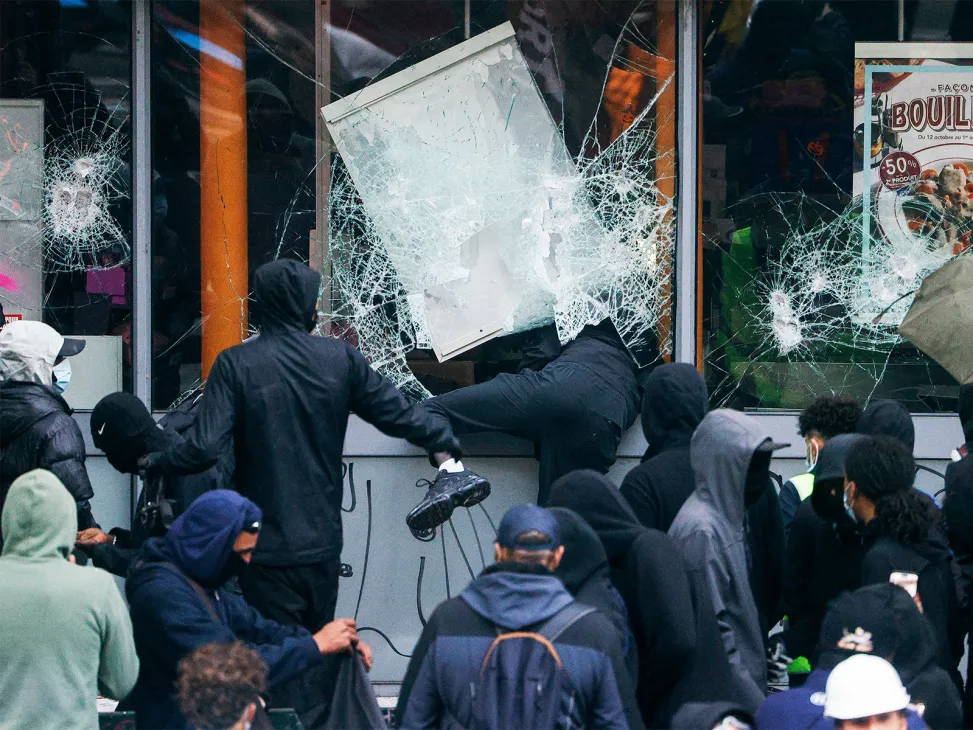
In Strasbourg-Saint-Denis, dark plumes of smoke rose from trash-can fires, while looters – hundreds, by some estimates – broke into shops. “They came out of nowhere,” said Vincent, the owner of a tobacco shop in the neighbourhood. He added that he tried to find and call the police but no one came. “They said that they were completely overwhelmed and that they couldn’t help.”
The riots across the country exposed both the government’s lack of preparation for the protests and a deeper issue with its strategy for maintaining public order. Opposition politicians blamed the administration for the misallocation of police forces, questioning why so few specialised units were deployed to quell the unrest and why it took hours to put forces on the ground. In Marseille, only one riot unit was on hand to monitor the demonstrations. Far too few officers were there to respond when several hundred rioters arrived in the city by early morning, breaking into the town hall and tipping over a statue.
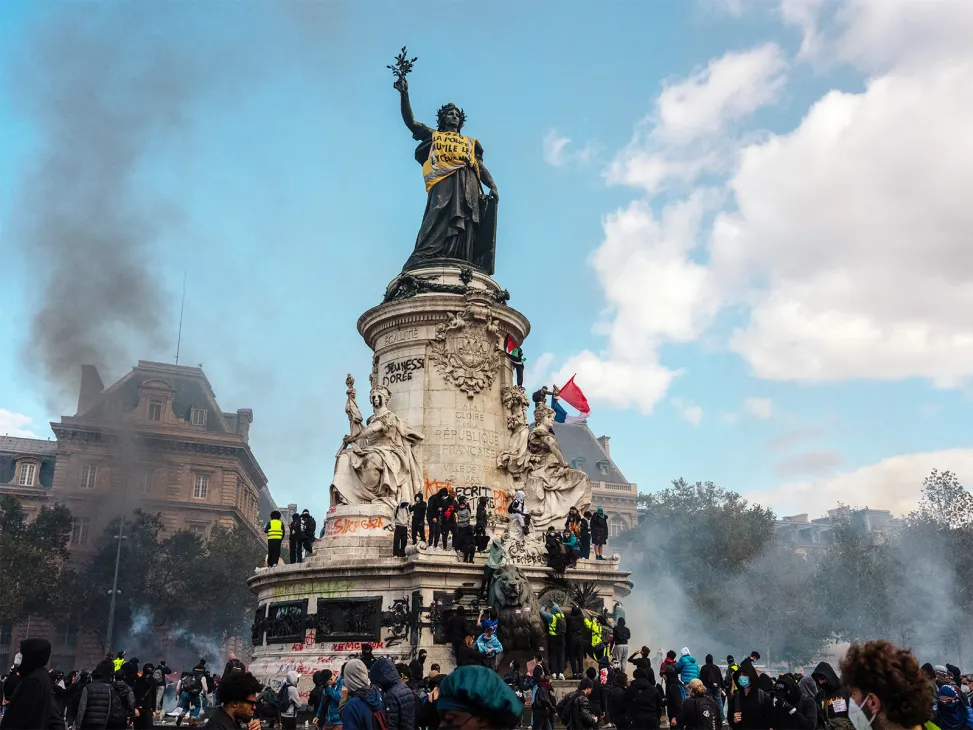
Despite weeks of social-media buzz leading up to the demonstrations, French intelligence services allegedly underestimated their size. On the day of the protests, about 550,000 people took to the streets, which dwarfed the some 60,000 security forces that had been deployed to keep the peace. “In certain large cities, we lost control,” said interior minister Laurent Nuñez on France Inter, acknowledging “a lack of anticipation.”
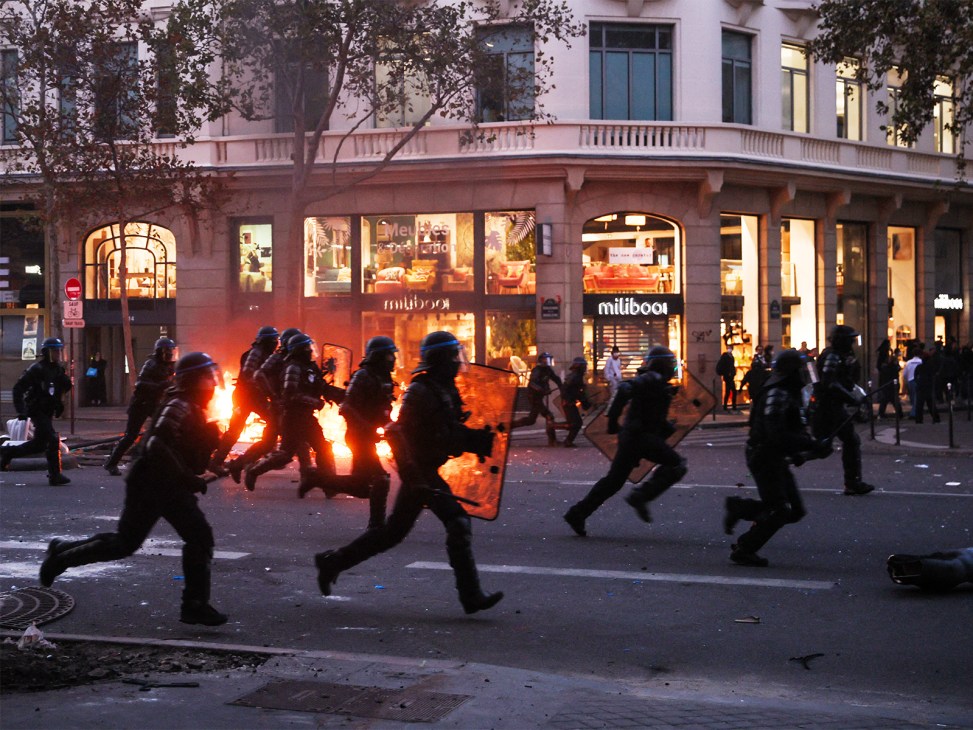
That limited foresight coincided with the complexity of policing a crowd as varied as the day’s demonstration. Officers had to manage “three topics at once: peaceful demonstrators, opportunistic looters and more organised ‘breakers’ attacking state institutions”, said Sébastien Malzieu, senior police commissioner at the Compagnies Républicaines de Sécurité (CRS) central directorate. The CRS is part of France’s national police force, dedicated to security and crowd control. The group has several specialised units, such as the CRS 8 – a highly mobile and trained riot-policing unit that acts as a Swat team – but these were only deployed in the late afternoon of 17 October to assist with the riots.
“Stopping the violence was difficult and time consuming,” said Malzieu. Police tracked looters throughout the night and over the next two days. “Officers had to go street by street, shop by shop, following the long protocol for making arrests,” he added, arguing that the operation did not result in the collapse of public order. “A great majority of institutions were protected.”
While citizens have expressed outrage over looted businesses and affected town halls, many have also criticised the government and police response to the demonstrations. On the ground, the police used tear gas, rubber bullets and stun grenades in an attempt to stem the unrest. French regulations require several warnings to be issued before force is used but videos circulating online reveal tear gas at peaceful gatherings. Reports also show that the CRS used la nasse (kettling), a controversial tactic that involves surrounding a group of protesters and preventing them from leaving, often trapping peaceful demonstrators alongside those suspected of violence.
Ahead of this weekend’s demonstrations, the government has opted for a drastic escalation of its security measures. On Tuesday it asked local authorities to establish curfews in several cities. To protect sensitive sites, it also announced the deployment of troops from the army’s long-running counterterrorism operation, who were last mobilised during the Yellow Vests protests of 2019. The Brigade de Recherche et d’Intervention (BRI) and Brav-M motorcycle units are also involved today, the latter of which is infamous for several court convictions related to brutalising protesters and journalists.
Mobilising such a battery of militarised police forces reflects a textbook pattern in the government’s handling of street unrest in recent years. During the student protests in early October, interior minister Laurent Nuñez ordered that authorities use anti-riot weapons with “no restraint”. The declaration contributed to renewed public outrage over police violence, particularly around the CRS units, whose use of anti-riot grenades and rubber bullets have maimed several high schoolers during those demonstrations.
“[The government’s] strategy is one of political desperation,” said Sebastian Roché, research director at France’s National Centre for Scientific Research and co-author of La Police Contre La Rue. “The use of the army, for example, is not a strategy that will add efficiency to dealing with public disorder. It sends a message about waging a war against the youth and people who are angry about their purchasing power.”
Where France goes from here is yet to be seen. Its politicians have used the riots as an opportunity to trade blame. Prime minister Sébastien Lecornu attributed the violence to the far left; La France Insoumise’s left-wing leader, Jean-Luc Mélenchon, criticised the government’s policing strategy; and Marine Le Pen’s far-right Rassemblement National blamed the government and immigrants (there is no proof that migrants or the far left were responsible for the riots).
As France prepares to head to the polls next year, policing will surely be at the centre of the debate. Mélenchon and Le Pen offer sharply contrasting visions of law and order. The next presidential election will not only shape how France responds to future unrest but also whether it can find a way out of the cycle of escalation between protesters and the state.
Monocle contacted the French Interior Ministry, which declined to answer questions.