‘I can’t take it anymore’: School blockades spark national crisis as French students continue to protest
France’s youth is making the education crisis impossible to ignore but only time will tell whether the protests will lead to tangible change.
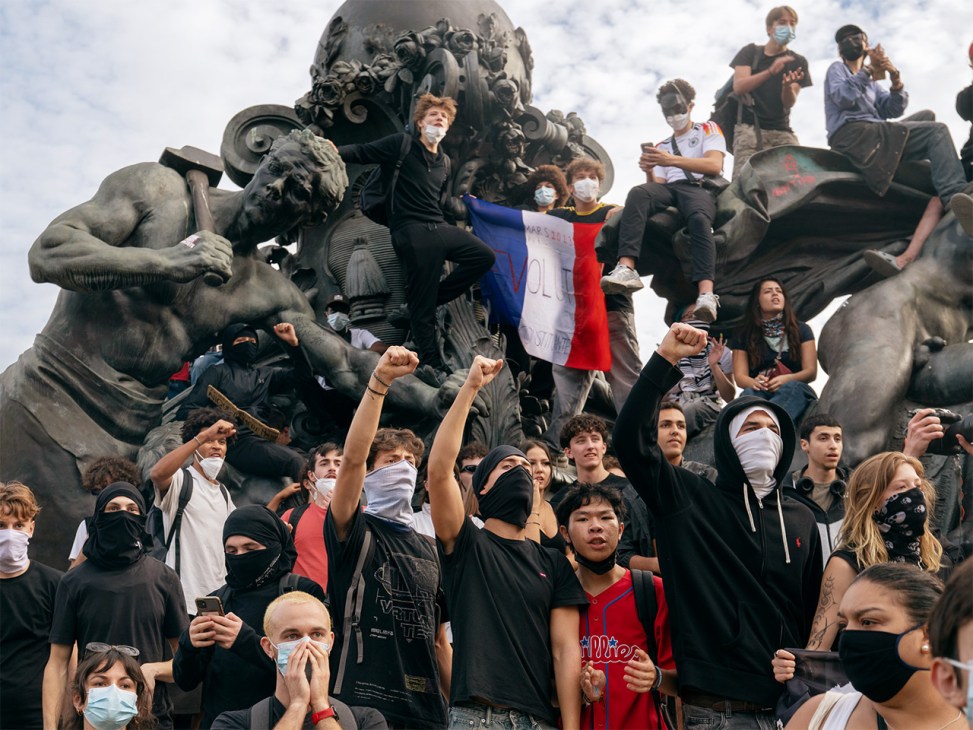
This year’s European protest-fest is headlined yet again by a repeat booking: instead of poring over philosophical texts, French teenagers are opting for a practical course in barricade construction. What started as piecemeal protests east of Paris turned nationwide in early October. On Tuesday roughly one in four of the country’s secondary schools were blocked, while more than 260,000 students, teachers, parents and trade unions took part in demonstrations across France.
“I’m here because I can’t take it anymore,” said Daniela, 15, sitting by her school’s blockade. “We have one nurse for 2,000 students, no maths teacher, no toilet paper and classrooms that reach 40C in the summer.” Throughout the day teens built picket lines, sang the national anthem and faced off with riot police.
Schools around the country have rallied around a list of urgent demands: more teachers to fill staffing gaps, investment in crumbling schools and reform of the university admissions platform. France’s presidential race was shaping up around affordability, security and healthcare. Now a mass movement over public education has caught Emmanuel Macron’s appointed government on the back foot.
Prime minister Sébastien Lecornu was quick to frame the movement as “urban violence”. Recalling the yellow vests protests that paralysed the country in 2018, Lecornu fell back on a tried-and-tested method: deploying one of Europe’s largest specialised anti-riot forces to break the blockades. Interior minister Laurent Nuñez said that police were to use “all crowd-control weapons” to “put an end to” disorder.
The gamble quickly backfired. Videos of violent confrontations between teens and riot police went viral. Since the protests began, 24 schools have been burned or ransacked, while widely shared footage of a 15-year-old losing his hand when a police stun grenade exploded has sparked public outrage.
Candidates for the presidential election next April rushed to capitalise on the protests. Far-right poll leader Marine Le Pen doubled down on “violence in schools” and the need for “more security”, while left-wing candidate Jean-Luc Mélenchon called for a human buffer between police officers and students, hoping to turn anger over public services into votes.
Faced with a bad-press spiral, Lecornu changed his tune on Wednesday, opening dialogue and promising “solutions” by the end of the month. But France’s debt crisis leaves the government with little room to offer more and barricades rose again on Thursday.
But France’s education crisis, like that of many European countries, is not just budgetary. On paper, education is one of the government’s biggest spending items, set to reach €65.5bn in 2027 (about €2bn more than defence). But as the number of students and costs rise, headline spending can mask a squeeze on resources per pupil.
In France, public spending per student on higher education and research has fallen by about 20 per cent in real terms since 2017. The UK offers a similar example, with spending per secondary-school pupil at three per cent less than its level in 2010-2011, according to the Institute for Fiscal Studies.
Across Europe, the decay of public services amid rising living costs seems to be culminating in a political ras-le-bol – a colourful French idiom that depicts a bowl filled to the brim and about to overflow. In Belgium, students have started their own blockades, while in Spain, the eviction of an elderly woman rallied thousands of rent-fatigued Spaniards onto the streets.
This year’s youth-led protest season raises the question: who will turn that anger into political change? In France and Spain, the left is positioning itself around affordability, housing and public services, while the far right doubles down on immigration. Both sides have made gains among younger voters.
For now, electoral calculations remain far from the minds of French teenagers. “I don’t know much about the right and the left,” said Jeanne, 16, listening in as a student in a Spider-Man costume gave an impassioned speech through a megaphone. “I just hope that they’ll vote for a president who makes the schools better.” Politically, the protests have already succeeded in putting public education back on the presidential menu – all thanks to a generation that can’t vote.