‘Give the people the choice’: The separatist Southern Transitional Council wants Yemenis to decide their future
The south Yemen group abruptly dissolved in January after escalations in tension between separatist factions and Saudi-backed forces. But despite its apparent collapse, the movement’s supporters insist that the cause remains alive.
For more than a decade, Yemen has been ravaged by two distinct conflicts. In the north, Iran-backed Houthi rebels have taken over the capital of Sana’a and driven out Yemen’s UN-backed government. Down south, an independence movement based in the city of Aden and backed by the UAE has sought to reinstate south Yemen as an independent nation, as it was from 1967 to 1990.
Yemen was reunited in 1990 after the fall of the Soviet Union but unity between the regions didn’t last long. The Houthis re-entered the picture as a separate force in 2014, capturing the capital and driving Yemen’s government to Aden. There, southern independence forces entered into their own uneasy partnership with the exiled government and, together with a UAE-Saudi coalition, have tried and failed to drive the Houthis out of northern Sana’a. A truce brokered by the UN in 2022 ended the fighting but did little to resolve the underlying dynamics, instead ushering in an unstable stalemate.
This past December, the stalemate came to an abrupt end, as the anti-Houthi coalition in the south went up in smoke. Across the span of a few days, southern independence forces moved to capture the nation’s southeastern regions, taking control of the resource-rich governorate of Hadhramaut along with a key trading port of interest to the UAE. But the sudden landgrab turned Riyadh against them: the Saudis pushed their erstwhile allies, the UAE, out of Yemen and forced members of the umbrella group for independence, known as the Southern Transitional Council (STC), to disband. The Saudis also pushed the STC out of the unity government in Aden, in favour of the UN-backed government that hopes to one day take back the rest of the country.
Amr al-Bidh, a senior official with the STC and special representative of its president for foreign affairs, tells Monocle that the forced dissolution of the STC “definitely leaves a huge scar” in the nation. Al-Bidh visited Midori House for a conversation with Monocle’s senior news editor, Chris Cermak, about the future of his movement and of southern Yemen. The following transcript has been edited for clarity and length.
On 3 December, forces affiliated with the STC launched Operation Promising Future, capturing Yemen’s eastern provinces of Hadhramaut, Al-Mahra and Shabwa. After years of little change to the status quo, what prompted the move?
The situation was at a stalemate and it wasn’t improving. In fact, it was getting worse security wise. For the STC, which was also part of the [southern] government at that time, we thought that we needed to move into these areas, especially into Wadi Hadhramaut. It’s a path for Houthi smuggling and lots of AQAP [al-Qaeda in the Arabian Peninsula] were mobilising freely in that area, threatening other regions we controlled.
From the beginning of the southern movement 30 years ago, it was the STC’s objective to liberate the whole area. We had a war in 1994 against the north, who then occupied us, and there were remnants of their occupation in Wadi Hadhramaut. We had a few reasons for why we thought that now is the time to move: in order to make sure that the Houthis don’t get weapons; that we extend our operation against AQAP and also to liberate the south.
At the end of December, Saudi Arabia bombed the southern Yemeni port of Mukalla and accused the UAE of backing southern forces. Riyadh said that it considered the moves by the STC to be a threat to its national security and that a red line had been crossed. Did the STC miscalculate?
Definitely not. We don’t understand why it was a red line. We had been allies for 10 years. Why were we now a threat to them? The area [we captured] is not by the border to Saudi Arabia – it’s hundreds of miles away. The organisation by the border is the Houthis, not us. So we never thought that Saudi Arabia was going to bomb our soldiers and kill them. People say that we made a miscalculation but no – we didn’t expect them to bomb their allies. That has definitely left a huge scar in our nation, in the south, that our friends did this to us.
In addition to military strikes by Saudi Arabia, the UN-backed Yemeni government gave the UAE a 24-hour deadline on 30 December to leave Yemen. The UAE complied, leaving the STC to fend for itself. This must have made the south feel like it was a pawn in a wider geopolitical game. Was it?
We are allies and we’ve been conducting counterterrorism operations together. The government of Yemen and Saudi Arabia asked them to leave Yemen. Is the call legitimate? We doubt that. But the UAE said yes and left. We’ve been following our goals [for 31 years] and we have to take responsibility for our own actions because the only thing that matters is our people.
On 2 January, an STC delegation that was sent to Riyadh to negotiate a peace with Saudi Arabia wound up announcing the group’s departure from the Yemeni government. The move was not recognised by the STC’s remaining factions, who claimed that the dissolution was announced under duress from the Saudis and was therefore invalid. What was that moment like?
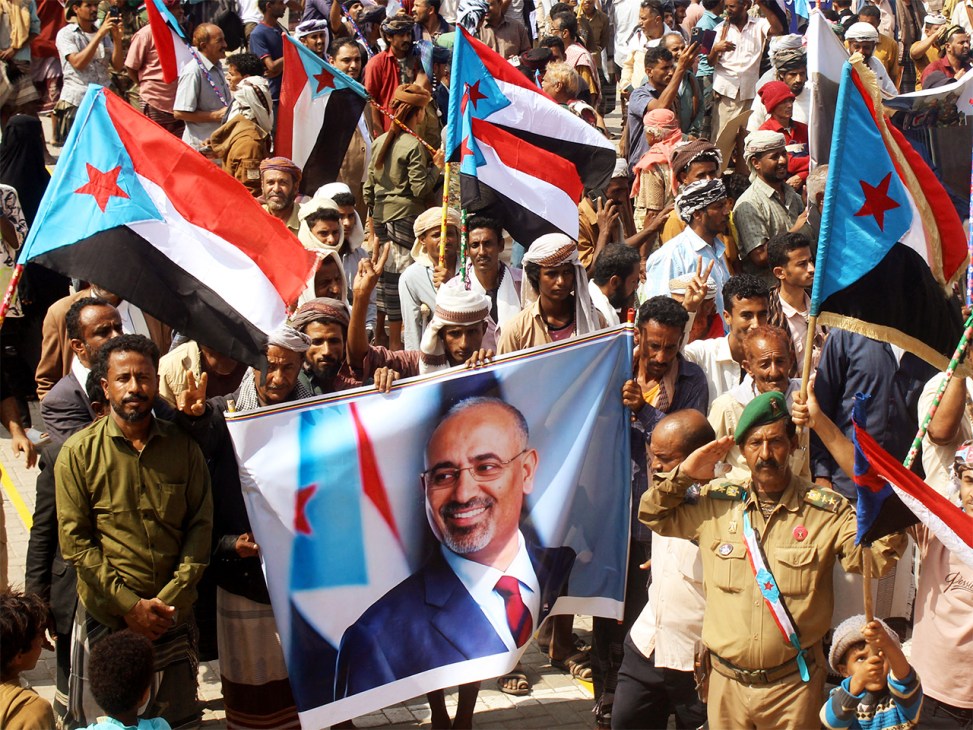
We were shocked. We had lost contact with the delegation in Riyadh – and then suddenly we saw them on TV. We didn’t know what was going on. It definitely wasn’t [a decision] based on our protocols, so it cannot be treated as the dissolution. But we also didn’t understand this move by Saudi Arabia. They asked for a dialogue and dialogue needs to be inclusive. Dissolving a major party in the south, which represents the aspiration of our people, immediately [triggered] a reaction on the streets of Yemen. People held massive rallies, reiterating that the STC is still [here].
Since then, every Friday in Aden has seen weekly demonstrations. In January, demonstrators were barred from the STC offices in Yemen’s second city – but that didn’t stop the protests.
They tried to stop our people from going to the headquarters of the STC; they banned us from going to our offices. That is the message [we must spread]: that our objectives are supported by our people, and that it’s our duty to make sure that these aspirations are achieved.
On 7 January, Aden was captured by Saudi-backed Yemeni government forces. The STC, or what’s left of it, now finds itself having to work with a UN-backed government that has been installed in its place with goals of one day reuniting Yemen. How will the STC work with a government that it doesn’t recognise?
We had been part of the government for a couple of years. There was an agreement to provide services and security, which we were a part of, until we could find a solution with the Houthis. That was the main objective of this period of war. But now, the government has said that they’re not accepting anyone from the STC returning from Riyadh to Aden. They are now responsible for providing services and security. We will definitely ask for dialogue, to see how we’re going to shape the next phase together.
It’s obvious from the messages we received that the idea of taking back Sana’a by force is no longer there. In which case, they should open a dialogue and reach a deal with the Houthis. They can’t stay in Aden for long – people will go out and protest.
What else does the government want? What is the best solution for Yemen as a whole? Is it a federal state? A two-state solution? What’s next? At the STC, we have our own solution, which is to establish a federal state in the south called South Arabia, but that has to be approved by our people through dialogue and a referendum. That’s our main message now.
Today, a measure of stability has returned to southern Yemen. While there might be rallies in support of independence, many Yemenis crave a situation without conflict. How is that squared with the southern independence movement’s goals?
The rallies on the streets do not contradict authorities on the ground seeking to establish stability. The rallies are an expression of what these people want. After that, they go back home and live a normal life. They protest in plazas that are known and safe. This is what is different now, compared to five years ago – and that’s what makes me admire this nation. Through the past 30 years, I haven’t seen any rallies in the south as large as the ones that we have had in the past three weeks. That’s an indication that, even if you fail militarily, you can still win the support of the people.
I understand that Yemen has been a headache for the region and international community for a long time. It was a headache for our own people. We have a long history of the elites deciding on the setup for the people and we have always failed to find the right model. This time, what we want is to give the people the choice, to decide what they want. Let them decide the unity of Yemen.
This interview originally aired on ‘The Briefing’ in two parts, on 5 February and 6 February.
Read more of our coverage on the region