Ski mountaineering is the Winter Olympics’ newest sport. It is also its noblest
In its most majestic form, skimo races traverse rugged terrain. At the Milan Olympic Games, athletes will sprint on a short made-for-tv course.
An apocryphal quote attributed to Ernest Hemingway goes something like, “There are only three sports: bullfighting, motor racing and mountain climbing; all the rest are merely games.” Papa would likely approve, then, of the newest Olympic sport making its debut next week at Milano Cortina: ski mountaineering.
The discipline consists of a ski race, something that the Winter Olympics already have plenty of. But “skimo”, as it’s known for short, demands more of its athletes. While alpine skiers approach supersonic speed – or at least that’s what 150 km/h looks like on the television – they are lent a mechanical ride up to the starting line. Cross-country skiers most certainly put in the aerobic work but they never carve a downhill turn, even during the 50km ski marathon.
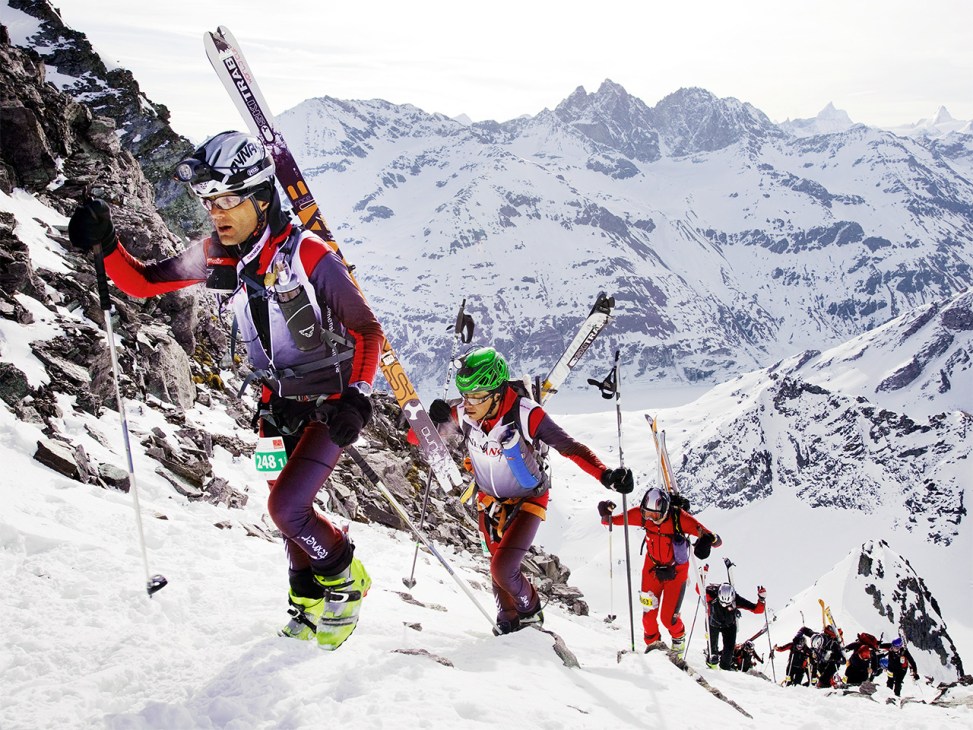
Skimo does it all, just like in the old days before chairlifts and gondolas. Competitors clip into ultralight alpine touring skis, which have an adjustable binding that works like a cross-country ski on the ascent and an alpine ski on the descent. With a pair of mohair climbing skins strapped to the bottom of their skis for friction, skimo racers bolt uphill. At the steepest sections, they lash their skis to their packs and sprint on foot. At the top, there’s a touch of triathlon as competitors can make or break a race on their transition: a perfectly timed hop during which they rip off their climbing skins in a single motion, then transition into downhill mode where they navigate pistes on impossibly narrow skis.
In its most majestic form, ski mountaineering races traverse rugged terrain. The Swiss military organises the biennial Patrouille des Glaciers between Zermatt and Verbier, which winds 57.5km with 4,386 metres of ascent across glaciers and over mountain passes, with an average finishing time of around 12 hours. Teams must wear harnesses, equip themselves with ropes and don crampons to negotiate icy climbs.
The version of ski mountaineering that will beam from Bormio onto our screens on 19 February is an admittedly contrived incarnation by comparison. Lycra-clad racers will sprint on a short course looking faintly ridiculous as they essentially run with skis on. The mandatory skis-on-pack section (or “bootpack”) consists of running up artificial stairs to the top, from where they can let gravity take over. The whole thing will be over in three minutes.
But even though ski mountaineering has been bastardised into a made-for-TV spectacle, the sport taps into a noble heritage of mountain exploration. The mechanics and equipment used by skimo athletes during their Olympic races is fundamentally the same as what alpinists have been using to climb and ski the world’s great peaks for more than a century. As the Summer Olympics lean further into faddish urban sports – think Raygun breakdancing at Paris 2024 – skimo’s debut retorts that the essence of winter sports is a connection with the natural world.
While Milano shines, the spiritual heart of these games are Alpine villages such as Cortina d’Ampezzo, with its refurbished century-old bobsleigh track and the striking backdrop of the Dolomites and Livigno Alps. Whatever handwringing lingers about the infrastructure that the Italians didn’t complete in time for their fortnight in the spotlight, the skimo racers – and indeed all of the athletes competing outdoors – will still gulp down fresh mountain air in their final push to the finish line.
- Marco Balich on organising the perfect Milano Cortina Olympic opening ceremony
- Skating’s solo act: Donovan Carrillo is the only Latino on the ice at the 2026 Winter Olympics
- The Monocle guide to Milan