The Winter Olympics are a hit. Not even climate change can stop them
It’s January 1964. The hosts of Austria’s first Winter Olympics are facing a dire prospect as the Alps surrounding Innsbruck lack their white winter coat. The culprit? A warm, dry Foehn wind, known in Alpine regions as a “snow eater”. So the organisers get to work, enlisting the Austrian army to carve 20,000 ice blocks from the highest peaks and cart them downslope to fashion bobsleigh and luge tracks. Soldiers truck 40,000 cubic metres of snow to shore up the ski racing venues – and another 20,000 cubic metres for reserves, just in case.
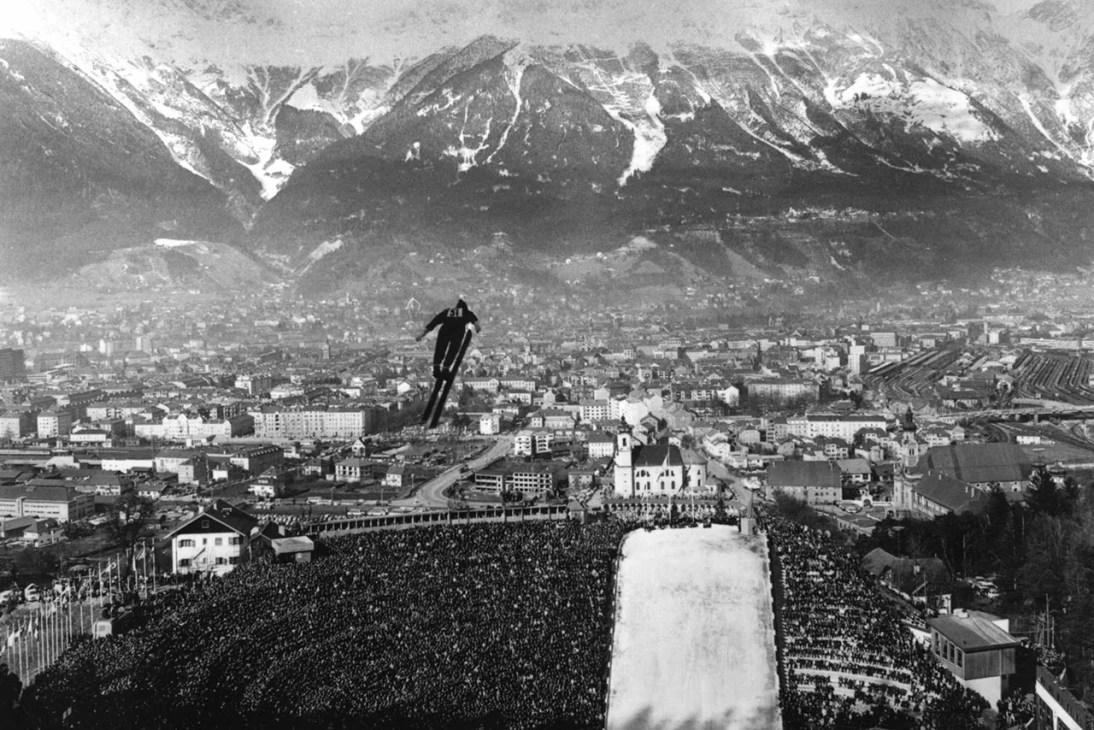
The Winter Games go on as planned, with a whopping 80,000 fans packing the grandstand to watch the ski jumping (pictured). The event is so successful that Innsbruck comes to the rescue in 1976 when Denver turns down the Games after winning its bid.
This piece of Olympic lore is illustrative because it serves as a rejoinder to the naysayers who are convinced that the Winter Games’ days are numbered. Every four years, the chorus grows louder that climate change has doomed the wintry edition of the world’s greatest sporting competition. Media coverage of Milano Cortina has been particularly fond of trotting out a 2024 study, sponsored by the International Olympic Committee (IOC), which found that 52 of 93 past and potential Winter Olympic hosts could still reliably stage the Games by the 2050s. The figure dips to 46 by the 2080s.
The dwindling number of reliable venues is a sad reality but it hardly means that there will be nowhere to stage the Winter Games. The French Alps – one of only four places identified by the study that could still host with natural snow by the 2050s – are already on tap for the next Games, while preparations are well under way for the 2034 Olympics to make a return visit to Salt Lake City. Buoyed by the dispersed venue approach in Italy, itself a concession by the IOC to the new landscape of winter sport, the Swiss are front-runners for 2038. Peering two decades ahead, New York state and a joint Australia-New Zealand bid are already gunning for 2042.
Will these future sites be plagued by poor weather that threatens competition? Almost certainly. Indeed, the very same happened in 1928 at the St Moritz Olympics, when another Foehn wind pushed the mercury in the Engadin to a balmy 24C. After a warm spell in 2010, Canadian organisers trucked in snow, then dumped it by helicopter onto Vancouver’s freestyle venue. The opposite also happens: heavy snow played havoc with ski racing at Sapporo in 1972.
Winter-sport devotees know that fickle weather is part and parcel of our irrational passion. Sometimes our prayers for snow are answered. Sometimes, they aren’t. If Hokkaido’s capital had hosted the Games this year, as once envisioned before an aborted bid, there would have been hand-wringing about too much snow. Utah’s ski resorts are sweating through their worst winter since modern records began. Even as such variations become more frequent, private-sector innovation is helping winter-sports facilities adapt. See, for instance, the ever-more efficient snowmaking from Bolzano’s TechnoAlpin and pioneering Finnish snow-storage technology.
Milano Cortina’s spectacle on snow and ice has given us indelible moments, from South America’s first Winter Olympic medal won by Brazilian Lucas Pinheiro Braathen in the giant slalom and Norwegian cross-country skier Johannes Høsflot Klæbo cementing his greatest-of-all-time status to the sad end that befell US alpine skier Lindsey Vonn’s comeback bid. I have no doubt that there will be many more memorable moments in the quadrennial cycles to come, even if it takes an army.
Gregory Scruggs is Monocle’s Seattle correspondent. For more coverage of the Milano Cortina Games, check out:
– Why the Winter Olympics are better than the Summer Games
– Skating’s solo act: Donovan Carrillo is the only Latino on the ice at the 2026 Winter Olympics
– Ski mountaineering is the Winter Olympics’ newest sport. It is also its noblest