The Board of Peace: Inside Trump’s global power play and Gaza plans
President Trump’s much-ballyhooed Board of Peace offers little indication of being what it purports to be, resembling a clubhouse for the authoritarians he finds most appeasing.
When considering any new initiative attached to the name of US president Donald Trump, the first question to ask must always be: is this really what it purports to be? President Trump’s much-ballyhooed Board of Peace offers little indication that it is any exception.
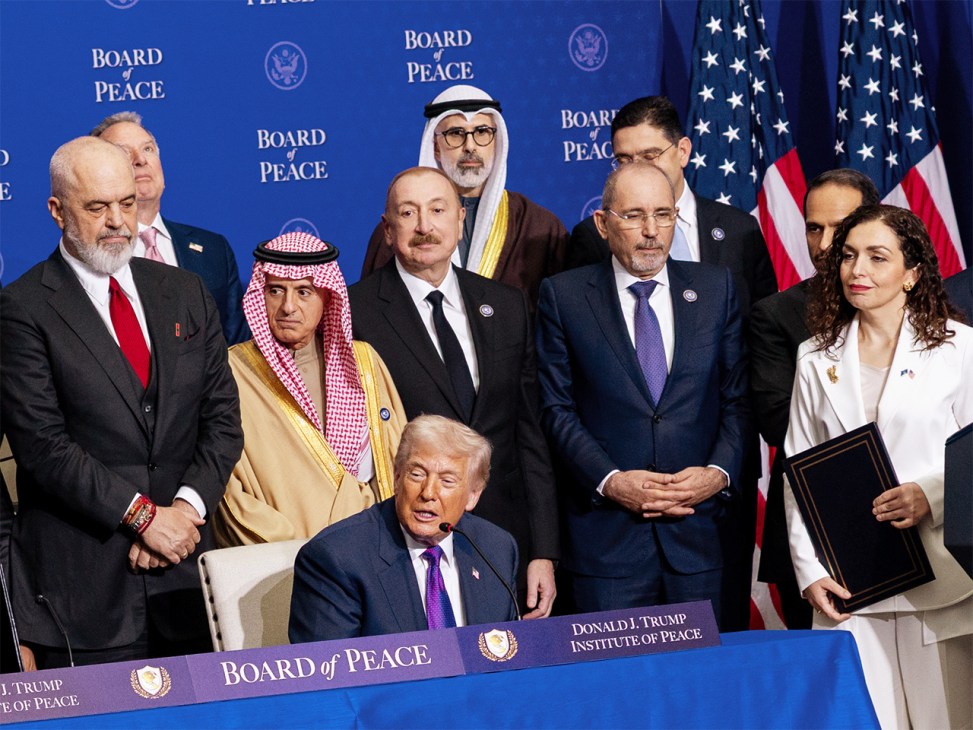
The Board of Peace, officially established in January at the World Economic Forum in Davos, held its inaugural meeting last Thursday with a ceremony in Washington. Founding members gathered beneath signs flaunting the Board of Peace logo, which depicts golden laurels surrounding a globe that is oriented to present a western hemisphere almost completely consumed by North America. South America gets lopped off about halfway across Brazil, and Europe, Africa and Asia are all invisible.
Despite this slight, leaders from all of these continents turned up. The 27 countries that have formally joined the board so far attended the meeting, while 22 others were curious enough to send observers; also present was Fifa president Gianni Infantino.
Who is on the Board of Peace?
Trump has described the board, with characteristic understatement, as “the most consequential international body in history”. While the possibility exists that this might become the case, so far the board resembles a clubhouse of the authoritarians in whose company Trump has always seemed most comfortable. Actual signatories to the charter thus far include Azerbaijan, Argentina, Saudi Arabia, Qatar, Turkey, the United Arab Emirates, Pakistan, Morocco, Bahrain, and El Salvador. Those European democracies which have joined either have somewhat Trumpist tendencies (Hungary, Bulgaria) or are seeking the favour of the US for other reasons (Kosovo, which aspires to Nato membership, and to wider recognition of its existence). Members are invited to serve a three-year term, extendable to permanence upon paying the $1bn fee.
A few countries, and the European Union, attended the Board of Peace’s first meeting as observers, while a dozen or so others have formally declined Trump’s invitation to join. More are yet to respond, possibly hoping he’ll lose interest. There is also the special case of Canada, which was invited and had accepted, only for Trump to abruptly revoke the offer. (Possibly miffed by Canadian prime minister Mark Carney’s recent speech at the World Economic Forum in Davos, during which Carney urged the world to think beyond and around the American hegemon.)
What will the Board of Peace do?
Beyond meeting every so often to nod along at Trump’s estimations of his own marvellousness, the first item on its agenda is allegedly Gaza, which Trump has frequently fantasised about rebuilding as some Mediterranean analogue of Atlantic City. The board’s framework includes an 11-person Gaza Executive Board, which includes Trump’s son-in-law Jared Kushner, Trump’s all-purpose envoy Steve Witkoff, former UK prime minister Tony Blair, Egypt’s senior-most spook Major General Hassan Rashad, Israeli-Cypriot property tycoon Yakir Gabay and not one Palestinian (a proposed new Gaza administration, consisting of amenable Palestinian technocrats, is administered by the Board of Peace).
Nine members have pledged $7bn towards the board’s Gaza project, though it remains to be seen whether this money gets spent. Five board members – Albania, Kosovo, Kazakhstan, Morocco and Indonesia – have offered troops for a putative International Stabilization Force for Gaza, to be commanded by US Army Major General Jasper Jeffers. Though said countries might have done so betting that fellow board member Israel is unlikely to wave in a multinational contingent of militaries from largely Muslim countries.
The Board of Peace does enjoy the legitimacy conferred by UN Security Council Resolution 2803, passed last November, which formally welcomed Trump’s initiative as “a transitional administration with international legal personality that will set the framework, and co-ordinate funding for, the redevelopment of Gaza”. It is hard to imagine that the UN was sorry to hand over a task likely to be expensive, difficult and thankless if possible at all – or that Donald Trump will take any responsibility if (or perhaps when) the effort fails.
Andrew Mueller is a contributing editor and the host of ‘The Foreign Desk’ on Monocle Radio.