The largest US military build-up in the Middle East in decades fuels uncertainty in Tehran
Representatives from Washington and Tehran are meeting in Geneva today for nuclear talks as the US military buildup in the Middle East continues. Are the tables tilting? And what will happen next?
The concentration of US firepower around Iran now looks less like signalling and more like sequencing. For months, tensions between Washington and Tehran have simmered over nuclear thresholds, regional proxies and the careful choreography of red lines repeatedly tested but never quite crossed. What distinguishes this moment is not the rhetoric but the hardware. The assets now in play suggest that the US is no longer merely demonstrating resolve – it’s positioning itself for choice.
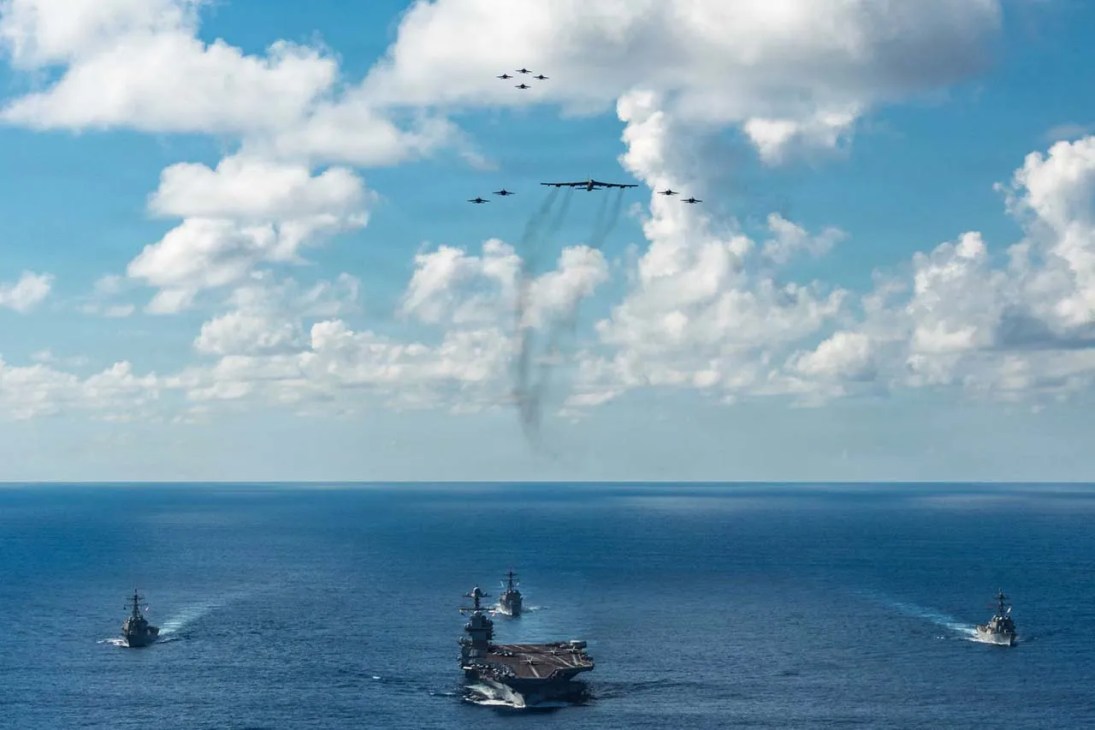
Since late January, a carrier strike group built around the USS Abraham Lincoln has been operating in the region – substantial enough on its own. But increasingly, there are more. The USS Gerald R Ford, the largest aircraft carrier in the world, has been positioned at the mouth of the Mediterranean and is moving eastward. Two carrier strike groups – one in the Arabian Sea and one in the Mediterranean – would give Washington overlapping arcs of airpower and cruise-missile reach. Around them sit at least 11 air-defence destroyers, three littoral combat ships and two to three attack submarines equipped with Tomahawk missiles. That is the naval element of the equation: visible, mobile and readied to project force.
The second part is both logistical and defensive. In the past month, more than 250 US military airlift flights have landed in the Middle East and surrounding hubs, moving large equipment and air-defence assets. Over the past two weeks, C-17 Globemasters and C-5 Super Galaxies – the US Air Force’s broad-shouldered, heavy-lifting aircraft – have been shuttling equipment into American facilities across the Gulf. The likely purpose is straightforward: harden bases against retaliation before any strike begins.
At Al Udeid Air Base in Qatar, aircraft numbers have climbed from 16 to 29, including seven C-17s and 17 KC-135 refuelling tankers. Unlike those behemoth aircraft carriers, tankers are a more subtle indicator of intent. They extend range, loosen political constraints and allow aircraft to operate from further afield if host nations hesitate.
The final element is geographical. Flight tracking over the past week shows multiple waves of KC-135 tankers moving from the US via the UK to bases in Greece and Bulgaria. Six were tracked on 16 February; another 10 followed on 18 February, staging through the UK before heading southeast. The message is implicit. Even if access to some Middle Eastern bases becomes politically fraught, aircraft could operate from southern Europe, with tankers bridging the distance. The movements of US assets confirm that Washington is deliberately widening its geography.
Overlaying all the traffic and hardware is command and control. Six E-3 Sentry AWACS aircraft – the distinctive radar-domed platforms that map the battlefield in real time – are now in theatre. With sufficient tankers and airborne early warning cover, a large-scale air campaign moves beyond theory and threat.
For now, diplomacy provides the choreography. Warships and aircraft provide the leverage. If Washington were to move beyond signalling, its target set would likely be precise, not expansive.
Where might the US and Iran target if negotiations fail?
The most obvious focus would be Iran’s nuclear infrastructure: enrichment facilities such as Natanz and Fordow, centrifuge assembly workshops, heavy-water production sites and supporting research centres. These are hardened, dispersed and in some cases buried deep underground. A campaign against them would require sustained sorties, bunker-penetrating munitions and careful sequencing rather than a single dramatic strike.
A second tier of targets would sit outside the nuclear file but within Iran’s military architecture. Islamic Revolutionary Guard Corps (IRGC) command-and-control nodes, missile depots and drone-production facilities have become central to Tehran’s regional strategy. In recent years, Iran has refined its use of precision-guided missiles and long-range drones via proxy networks stretching from Iraq and Syria to Lebanon and Yemen. Disrupting those supply chains – storage sites, launch platforms and transport corridors – would form part of any broader attack strategy.
Energy infrastructure presents a more politically fraught category. Iran’s oil export terminals, refineries and petrochemical hubs are critical to state revenue but also deeply entangled in global markets. Direct strikes on such facilities would reverberate well beyond the Gulf. Historically, Washington has been cautious about triggering energy shocks that punish allies as much as adversaries.
Tehran’s options in return are asymmetrical but potent. US bases in Iraq, Syria and particularly the Gulf (including Al Udeid in Qatar and naval facilities in Bahrain) sit within range of Iranian ballistic missiles and drones. Maritime traffic through the Strait of Hormuz remains an enduring pressure point; even limited disruption can rattle markets. More plausibly still, Iran could activate allied militias to apply calibrated pressure while maintaining deniability.
A fresh round of US-Iran talks begin today in Geneva, with Oman mediating. The timing is awkward; negotiations are resuming just as the military appears closest to operational readiness. Taken together, the naval mass, reinforced air defences, tanker bridge to Europe and expanded airborne command assets suggest that Washington could sustain a significant campaign. Donald Trump’s administration, perhaps more than others, is capable of tilting leverage toward action. The open question is not capability, it is intent. Hopefully Omani negotiators and a little Swiss hospitality can keep these foes from deadly escalation.
This article was originally published on 24 February 2026 and was updated on 26 February 2026 to reflect the pending talks in Geneva.
Inzamam Rashid is Monocle’s Gulf correspondent. For more opinion, analysis and insight, subscribe to Monocle today.