‘Work with the opposition inside Iran’: John Bolton’s advice to Trump as Operation Epic Fury drags on
The former US national security adviser has adopted a voice of moderation, criticising the Trump administration’s approach as ill-conceived, dismissive of the Iranian people and bound to fail.
You would think that John Bolton would be happier. The former US ambassador to the United Nations and former US national security adviser has been advocating for American military action against the Islamic Republic of Iran for decades. In 2015, Bolton wrote an op-ed for The New York Times entitled “To Stop Iran’s Bomb, Bomb Iran”. Even then, he wrote, “Time is terribly short but a strike can still succeed.”
In the two weeks since US president Donald Trump gave the go order for Operation Epic Fury, Bolton has been noticeably critical of the means, if not the ends. Those with memories reaching back to the early 21st century, when Bolton was regularly caricatured as the sharpest-beaked of hawks, might be bemused to hear him sounding like a voice of relative moderation.
It is no secret that Bolton and Trump do not get on. The president sacked Bolton as national security adviser in 2019, partly because he was weary of Bolton’s uncompromising views on Iran. Last year, Bolton was charged by the Department of Justice with unlawful retention and transmission of national defence information; this might be related to the unflattering depictions of the president in Bolton’s 2020 memoir, The Room Where It Happened. Trump said the book was made up of “lies and fake stories”, and called its author “a disgruntled boring fool who only wanted to go to war”, among other imprecations.
It is Trump who has gone to war, however. Two weeks in and it would be easier to say if Operation Epic Fury was going according to plan if it had ever been made clear what the plan was. With due acknowledgement that nobody knows how this will end, Bolton joined Andrew Mueller on The Foreign Desk to discuss the Iran war, intervention compared with negotiations and the US administration’s aversion to clear planning.
This conversation has been edited for clarity and length.
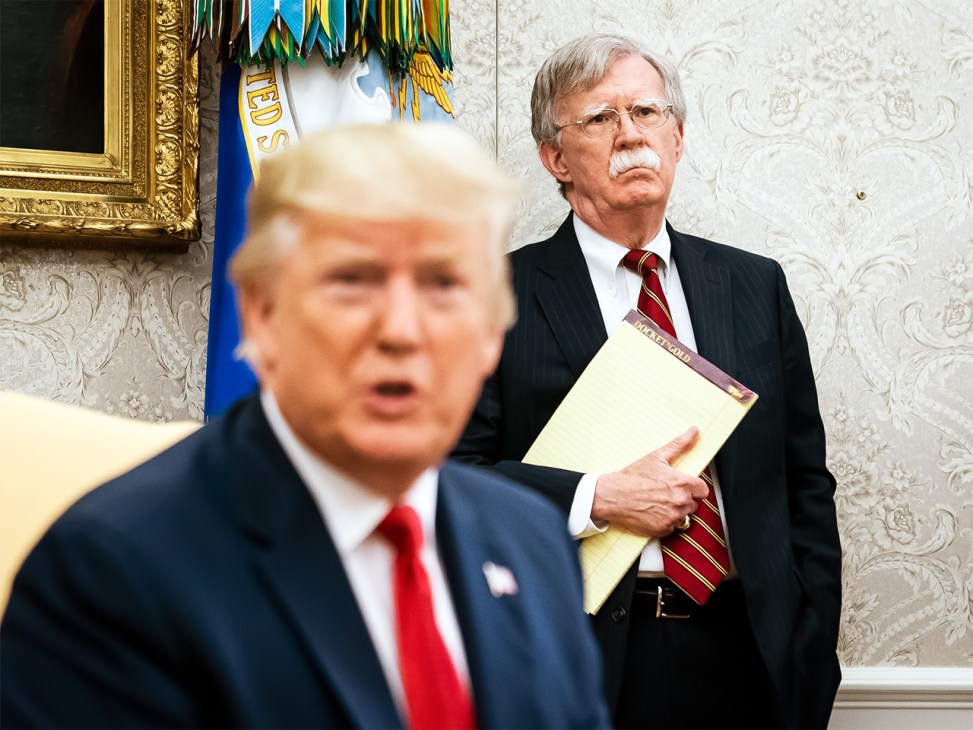
War with Iran is what you’ve long been calling for, at least since that piece in ‘The New York Times’ in 2015. Is this what you wanted or expected it to look like?
What I was advocating then was destroying [Iran’s] nuclear capability, which I think was appropriate at the time and is still a good thing to do today. The real need today is regime change in Iran and that is very possible, given how unpopular and weak the regime is. That doesn’t mean that the way Trump is going about it is going to produce that result. He has made a lot of unforced errors and I’m worried that he hasn’t laid the proper basis for making the case to the American people, Congress or [US] allies.
Is it important that it be done now?
I would have liked to have seen it done 20 years ago. I don’t agree that the threat of a nuclear Iran was imminent but I don’t think we’re obligated to wait until the threat is imminent. Because if we did, we might miscalculate and be too late. Iran’s support for terrorism and the fact that it has, since 1979, been responsible for the deaths of thousands of Americans through its terrorist activity, makes it a perfectly legitimate thing to do.
If a threat isn’t imminent, doesn’t that imply that measures short of war are still available?
It would depend on the regime. This one has never shown any evidence of abandoning a strategic decision to acquire nuclear weapons or to discontinue terrorism in the Middle East and around the world. So negotiation with the regime is futile. The idea that you just have to keep [negotiating]… that’s how North Korea got nuclear weapons. Twenty five years of endless talks while it continued to make progress.
Doesn’t an intervention such as this create an incentive to build nuclear weapons – and not just for Iran but other regimes trying to protect themselves?
That risk is out there today. The fact is that we have stopped nuclear proliferation in the past and we could have stopped it a long time ago. Our unwillingness to do so, and to wait so long in the case of both Iran and North Korea, is really just proof of what Winston Churchill once said about the confirmed unteachability of mankind. How many times do we have to go through this to recognise that some regimes are not going to negotiate in the spirit that we do? They have objectives and they use negotiation not to achieve a resolution of the problem but to give them time to get to the answer they want.
Are your reservations about the current action not so much about the what but the how? Do you ever fear sounding like one of those die-hard ideologues who complain that ‘proper communism’ has never been tried?
No. The end result of regime change is shared by 80 or 90 per cent of the population of Iran. The question is, how do we help them to do it? Of all the mistakes that Trump has made, it’s the lack of co-operation with the opposition, lack of assistance to the opposition, that might be the worst. He seems almost indifferent to the Iranian opposition, as he seems indifferent to the opposition in Venezuela, which he has kicked to the curb in favour of Delcy Rodríguez to replace Nicolás Maduro as president.
Does it not give you any pause that you couldn’t convince several more orthodox US administrations to do this, while the one that has gone ahead is this one?
Well I don’t know why Trump changed his mind. I certainly tried to persuade the same man in his first term to do it and I didn’t succeed. It’s clear that, for whatever reason, he changed his mind. But that doesn’t mean that he also changed his modus operandi. It’s still the same confused, uncertain, disconnected approach that he had in the first term. And that’s a risk.
Is there not a danger that if this operation is being steered by people who are poorly advised, that you end up with a situation even worse than the one we have?
It’s inconceivable to me that you could have a government in Iran worse than the one that we have now.
Are you not concerned about long-term reputational damage to the US? That much of the world sees this as reckless? We’ve heard Pete Hegseth disdaining what he calls ‘stupid rules of engagement’, which are presumably what stops you putting a Tomahawk missile through a school.
Well, you’re talking about defects of personalities, of which there are many in this Trump administration. The policy, the objective, it seems to me, is entirely defensible, unless you’re sanguine about a nuclear weapon going off over your head someday.
How optimistic are you about how this thing, which you have long advocated, is going to turn out?
Well I didn’t advocate for this [war]. I would have done it substantially differently. My criticism is because I think that Trump’s mistakes will quite likely result in this failing and make it harder to instigate regime change in other situations.
So in the admittedly unlikely event that your phone rings and it’s the president saying, ‘Alright, this isn’t working out, what should I do?’, what would you tell him?
Work with the opposition inside Iran. Work with the ethnic groups. Work with people who have been affected adversely by the economy. Get with the young people who despise the regime, who know they could have a different form of life. Get with the female part of the population that has been protesting ever since the murder of Mahsa Amini three years ago for refusing to wear the hijab. The discontent inside the country is enormous. It’s not well organised but there are ways to get to an interim government after the Ayatollah and the Revolutionary Guard are removed – for Iranians to consider what they want their next form of government to look like.
But is that not a recipe for chaos itself? You could end up recreating Yugoslavia with 92 million people.
You could do a lot of things. You could also leave this regime in place and have them murder 30,000 citizens every other month.
To listen to the full interview on ‘The Foreign Desk’, click here.