The UK’s under-16 social-media ban won’t make Big Tech safer
The UK has unveiled one of the world’s harshest social-media bans for young people. Will it actually work? Or will it simply hand more private data to tech giants?
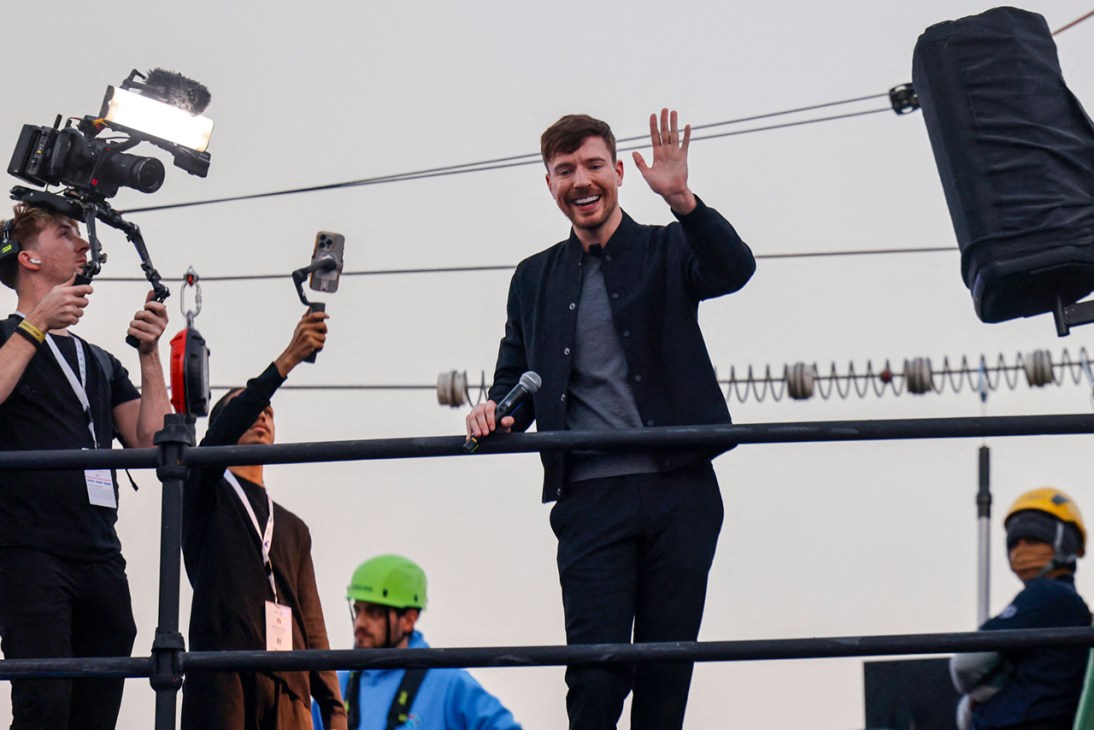
In October 2025, Jimmy Donaldson – better known as MrBeast – posted a short clip on Youtube entitled “Reacting to ‘Hi Me in Ten Years’”, in which the North Carolinian content creator watches a message to himself that he filmed when he was 17 years old. “I don’t think I’ll ever get tired of Youtube,” says the teenaged Jimmy, who was then aiming to reach the milestone of a million subscribers within a decade. Last week the MrBeast account became the first to log 500 million followers and the video-sharing platform’s CEO, Neal Mohan, personally presented Donaldson with a special “Diamond Play Button”, a cool silver trophy celebrating the unprecedented achievement.
Donaldson is one of the world’s biggest stars, with a production team employing hundreds, as well as a thriving spin-off chocolate company, Feastables. Time magazine once called him the “the most watched person in the world” and, with a Youtube presence dwarfing that of pop stars such as Taylor Swift, he probably is. Because of the siloisation of popular culture in the streaming era, his celebrity might seem somewhat remote to those who don’t have children, his core audience. For many teens, tweens and younger, however, he is the limitless promise of the internet personified.
My son, Kurt, is nine years old so we’ve been immersed in the antics of Donaldson and his crew for a few years now. We’ve watched them spend “7 days stranded in the Arctic”, attempt to escape a desert island by building a raft and more. Once, Donaldson buried himself in a reinforced-glass coffin for a week. When a new video drops, usually in the weekend, Kurt sits on my lap with a Feastables chocolate bar in hand and we hit play – my son chatting through the show, offering a rolling commentary not only on the gang’s latest adventure but also about the episode’s production values, effects and effectiveness as a piece of entertainment.
Like many of his schoolfriends, he thinks of being a Youtuber as a potential career. And why not? It’s a fantasy that’s qualitatively no different from mine at his age of one day becoming a film-maker. Donaldson’s business has been mired in several high-profile controversies and legal challenges, including a class-action lawsuit alleging unsafe conditions during the filming of his Amazon series Beast Games, but his blundering as a young CEO doesn’t eclipse his positive contributions: his vast philanthropic efforts; his decision to keep his enterprises based in his hometown of Greenville, North Carolina, helping to turn a stretch of America not known for showbiz into an entertainment hub; and so on. There are far worse things for kids to aspire to than to be the next MrBeast.
Yet the UK prime minister, Keir Starmer, evidently disagrees. This week his government announced that it would block social-media access for under-16s, a ban that is expected to begin in early 2027. Among the platforms affected will be TikTok, Instagram, Facebook, X and YouTube. The policy follows Australia’s introduction of the world’s first outright ban on social media for children in December 2025, as well as similar measures taken in countries including China, Vietnam and Indonesia.
The Labour Party’s acknowledgement of online harms, especially when it comes to child safety, is, of course, welcome. Organisations such as UK charity NSPCC have long warned of the risks of under-16s being exposed to images of sexual abuse and content promoting terrorism, eating disorders or toxic ideologies; AI is also increasingly being used to generate indecent videos, reactionary slop and inflammatory fake news. Yet proscriptions of this kind are bound to be ineffective solutions to a problem that lies not with kids but with social-media platforms, which have persistently been underregulated by supine governments unwilling to disrupt their monetisation of social division. (The NSPCC, meanwhile, has raised concerns that some young people – particularly among the disabled and LGBT+ communities – could be left cut off from supportive web-based groups.) If it’s the algorithms that are at fault, why not target the technology, rather than its victims?
Social media is now an intrinsic part of many people’s lives. It comes as no surprise, then, that Australia’s ban seems so far to have been pretty ineffective. According to a compliance update published by the country’s online safety commissioner in March, about 70 per cent of households continued to have active social-media accounts for their children. Where there’s a will to stay connected, there’s a way – and kids have plenty of will. There is little reason to assume that the results will be any different in the UK.
Starmer’s ban might be framed as a way to protect the young and vulnerable but it can more accurately be described as yet another incursion into our digital privacy. Age verification will require mechanisms allowing tech firms to gather more information about users of all ages – facial recognition, our internet usage, and so on. “Surveillance is not safety,” messaging app Signal recently warned, suggesting that the UK government’s latest efforts to improve child safety might amount to the stealth erection of an “invisible surveillance infrastructure”, ripe for future abuse.
Kerry Moscogiuri, chief executive of Amnesty International UK, has described the social-media ban as “a case of the right diagnosis but the wrong prescription” and it’s hard to disagree. “Too many social-media companies have built products and business models that prioritise keeping children engaged for longer, often at the expense of their wellbeing, privacy and rights,” she said in response to the plan. “The problem is not that children exist on social media. It’s that social-media companies have built platforms that are unsafe by design.”
And then there’s the matter of stomping on aspiring Youtubers’ dreams. Donaldson started his channel when he was 13 years old. Soon, British kids won’t be allowed to follow in his footsteps. That feels mean-spirited to me, as well as unenforceable. It’s the duty of governments to rein in the tech giants, preventing them from permitting online abuses. Providing the likes of Elon Musk and Mark Zuckerberg with yet more free data about UK residents seems like a dumb way of going about it to me.