The US, Israel and Iran exchange violent strikes. But what’s the point of Operation Epic Fury?
US-Israeli strikes targeting Iranian leadership and the latter’s retaliatory attacks have rocked the Middle East. But is there a method behind the madness of Operation Epic Fury?
This fast-changing news event continues to evolve and we will provide updates as new information becomes available. The article was last updated on 28 February at 14.00 (GMT).
It is the kind of decision which would normally be announced in a solemn address from the White House, clearing the prime-time schedules of major broadcasters. Instead, at around 02:30 US east coast time, President Donald Trump cried havoc and let slip the dogs of war with a video posted on his own social media platform, Truth Social. Tieless, sporting a white “USA” cap and standing behind a lectern erected in an indeterminate location, Trump spent eight minutes making some extremely vague arguments in favour of a very large gamble.
Trump declared that the US had launched “major combat operations” against Iran because of “imminent threats from the Iranian regime”. He did not offer any hints as to what these were. For Israel, whose forces have joined the attack, it is – as it has always been – less ambiguous. Israel’s prime minister, Benjamin Netanyahu, focused on Iran’s nuclear programme, which Israel has always regarded as an existential menace. Whether one likes a given Israeli government or not, it should be possible to understand why Israelis generally don’t extend much benefit of the doubt to people calling for their extermination.
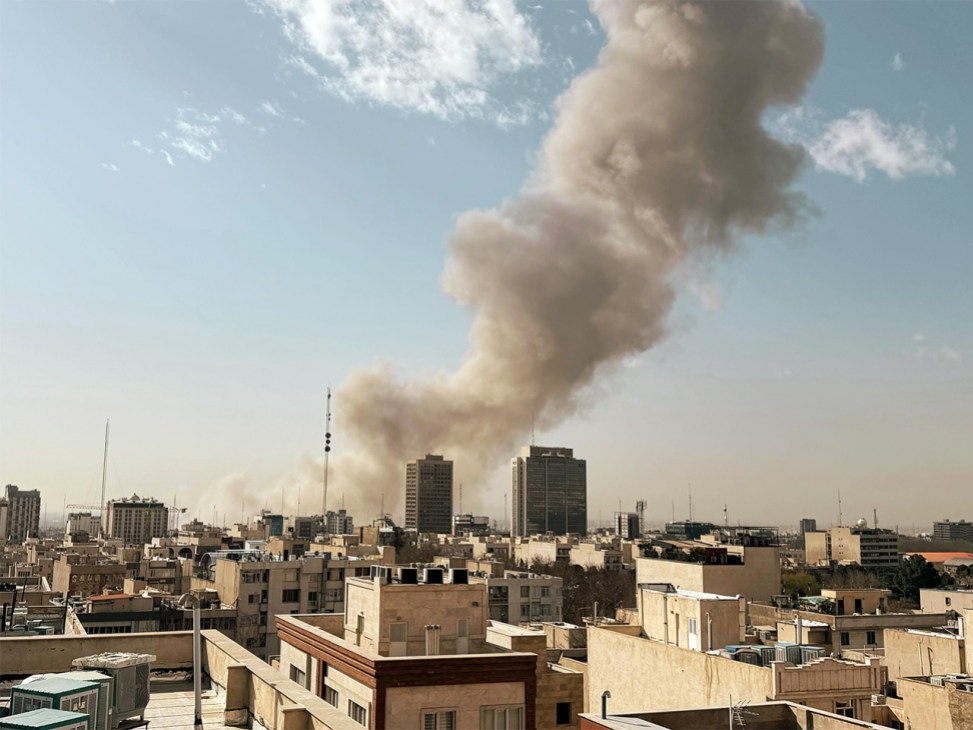
As for the excellent question “why now?” the answer might be, as the US and Israel see it, “why not”? The Islamic Republic is weaker than at any point since the revolution of 1979. At home, Iran’s economy is languishing, its people furious; nobody knows how many demonstrators were killed by the regime in the most recent wave of protests but all estimates run into the many thousands. Abroad, Iran’s proxies across the Middle East have been destroyed, decapitated or disoriented by Israel’s settling of accounts since 7 October 2023. If Tehran picks up the phone now to Hamas in Gaza, Hezbollah in Lebanon, the Houthis in Yemen or the various brigades it sponsors in Syria and Iraq, there might not be an answer.
Atop all of which, last June’s 12-day campaign of air strikes by the US and Israel against Iran demonstrated that Tehran could neither defend its airspace nor muster much by way of retaliation. The initial scattershot of retaliatory strikes that Iran has made against targets in Israel, Bahrain, Qatar, Kuwait, Iraq and the United Arab Emirates look very much of the “use them before we lose them” variety.
This decision by Trump might seem difficult to reconcile with his long-held disdain for foreign entanglements (social media archaeologists are gleefully disinterring old Trump posts in which he accuses former president Barack Obama of spoiling for a fight with Iran as a distraction from his own incompetence). But it also might not be. If there is a Trump Doctrine discernible in the foreign policy of his second term, it is a belief in short, sharp shocks, on the assumption that the results, unforeseeable though they always are in war, will be an improvement on the status quo. In Trump’s first year back in office, US forces were sent to kidnap Venezuelan leader Nicolás Maduro, an American drone and missile blitz was launched against Islamist militants in Nigeria, and further strikes were made on similar groups in Syria, Yemen and Somalia. There was little follow-up, either because Trump believes he has made his point or has lost interest.
The attack on Iran might fit into this framework. Nobody, at least as of this writing, is suggesting that the 1st Marine Division march to Tehran and drape the Azadi Tower in red, white and blue. As it stands, Operation Epic Fury, as the US is calling it, is not inconsistent with isolationist indifference. Speaking recently to Monocle Radio’s The Foreign Desk, Trump’s former national security adviser John Bolton, reflecting on the nation-building hubris surrounding the 2003 invasion of Iraq – for which Bolton was an avid cheerleader – said: “My view back in Iraq was that we should give them a copy of The Federalist Papers and say ‘Good luck’. We’re not good at nation-building.”
Trump’s statement suggests that he believes he is creating the opportunity for Iran’s people to liberate themselves. “When we are finished,” he said of the US action, “take over your government. It will be yours to take.” He further urged “now is the time to seize control of your destiny and to unleash the prosperous and glorious future that is close within your reach.”
It’s a fine idea, and no less than Iran’s people have long deserved. But the list of wars that have panned out as their instigators intended is short, and the list of people marooned in the gulf between Trumpian sensationalism and reality is rather longer.
For further updates from the region, tune in to ‘Monocle on Sunday’ and ‘The Globalist’ on Monocle Radio.