The view from the Strait of Hormuz: Ground zero for Iran’s war on global commerce
Monocle’s Gulf correspondent stands in Oman overlooking the Strait of Hormuz, where tankers sit still as the battle swells. The conflict’s economic consequences will affect markets well beyond the Middle East.
From a rocky ridge on the northern tip of Oman’s Musandam Peninsula, the Strait of Hormuz appears almost serene. The water glints turquoise under the morning sun and wooden dhow boats drift lazily. Farther out, a scattering of large cargo vessels sit motionless on the horizon. Beyond the haze lies the faint outline of Iran’s coast. Between these two shores sits one of the most critical chokepoints in the global economy – a narrow maritime corridor through which roughly a fifth of the world’s oil and a significant share of its liquefied natural gas flows. At this moment, everything is still.
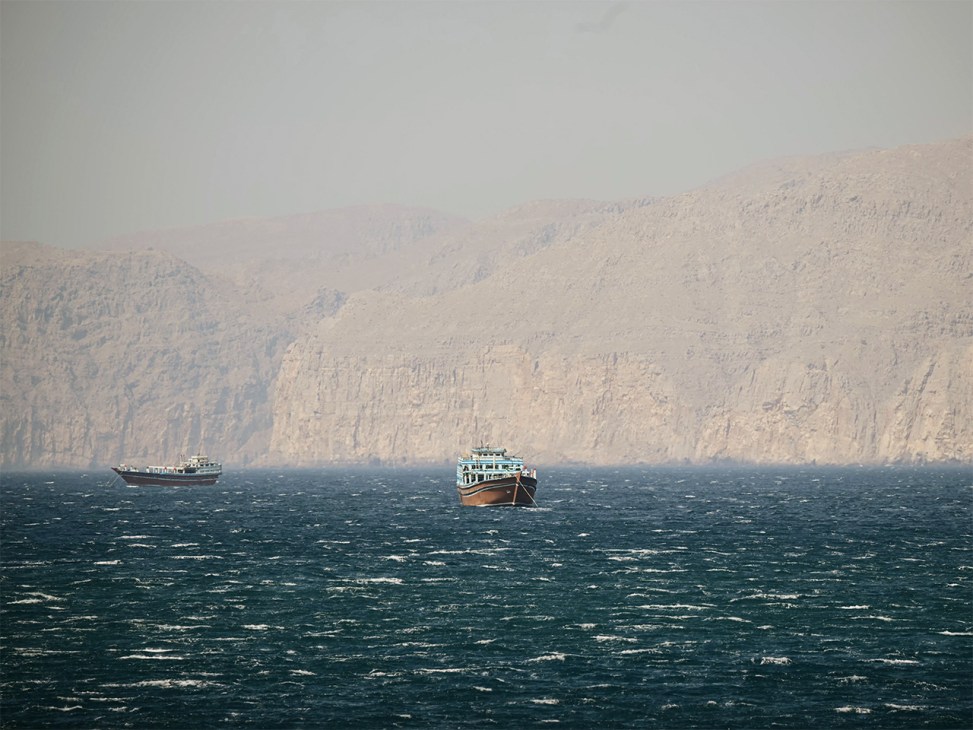
In the days since the US-Israel strikes on Iranian targets, Tehran has shifted the conflict onto a new front: the global economy. Iran’s Revolutionary Guard Corps says that it now has complete control over shipping in the Strait of Hormuz, warning vessels not to cross and threatening to burn any ship that attempts to pass. They have vowed not to let a single drop of oil leave the region. This has resulted in an extraordinary standstill. Some 200 oil tankers and cargo ships are now anchored on either side of the waterway, waiting for the risk to subside. Oil prices have already jumped sharply since the conflict began but the impact of the standoff extends far beyond the barrels of crude trapped in the strait.
“You don’t even need complete control,” says Cauvery Ganapathy, a fellow at the Observer Research Foundation Middle East. “Just the suggestion that cargo cannot move triggers stress in global energy security.” In many ways, the ships themselves are enforcing the blockade. Faced with missile attacks, drone threats and rapidly escalating insurance costs, shipping companies have simply chosen not to move. Tankers have dropped their anchors and captains are waiting, unwilling to risk their crews or cargo. Even a disruption of a few days can send shockwaves through global markets. Countries across Asia and Europe are already scrambling to secure alternative supplies and expand their strategic petroleum reserves. “Oil flows through the strait have crashed from about 22 million barrels a day to roughly 3 million – and backup routes can’t fill the gap,” says Ganapathy.
The waters are becoming increasingly volatile. Over the past few days multiple vessels have been targeted in attacks attributed to Iran. Oman’s navy recently rescued 24 crew members from a Maltese-flagged cargo ship struck by two missiles near the strait. The sailors were unharmed but the incident underscored just how unsafe the corridor has become. “This is far more dangerous than it has ever been – [it’s] effectively a full-blown war at sea,” adds Ganapathy. Crucially, she says, Iran does not appear concerned about the nationality of the ships moving through these waters. “They are not particularly concerned about which flag the tankers are moving under,” she says. “All bets are off.”
The disruption has implications far beyond energy markets. The ships waiting in the strait are not only carrying oil and gas but fertilisers, industrial materials and consumer goods. If the standoff continues, supply chains, from agriculture to manufacturing, could feel the effects. Washington has proposed sending US Navy vessels to escort tankers through the strait – a strategy used during the Iran-Iraq Tanker War of the 1980s, when attacks on shipping threatened the same stretch of water. But analysts warn that the situation today is far more complex. “It has been done before,” says Ganapathy. “But the threat surface now is much larger.” Iran could deploy mines, drones or small vessels to disrupt traffic with minimal cost or effort. “They can use various sea boats to lay mines,” she adds. “It takes very little on their part to shut everything down.” Even if naval escorts succeed in moving some cargo, sustaining such operations in the middle of a wider regional war would stretch military resources and potentially turn the escort vessels themselves into targets.
The deeper problem is structural. Despite decades of warnings about the vulnerability of the Strait of Hormuz, meaningful alternatives are limited. Pipelines in Saudi Arabia and the UAE can bypass the waterway but their capacity is only a fraction of the roughly 20 million barrels of oil that normally transit the strait each day. For now, the global economy remains dependent on this narrow corridor between Oman and Iran.
Iran is also heavily dependent on oil exports that travel through this same waterway – much of the country’s crude is sold to China, its most important economic partner. By choking off the Strait of Hormuz, Tehran is not only squeezing global energy markets but potentially damaging its own economy. For years, analysts assumed that economic reality would prevent Iran from ever seriously closing the strait – that it would never damage a route so vital to its own survival. That assumption might no longer hold.
For now, the ships remain anchored in the Gulf, their journeys paused in one of the world’s most strategic waterways, a silent queue stretching across the horizon. Missiles continue to fly in and out of Iran but it is here, in this narrow strip of water, where the conflict could hit the wider world hardest, turning a regional conflict into a wave that crashes into the global economy.