Selling in a digital age: Euroshop explores how analogue retail is advancing with AI innovations
As Europe’s premier retail fair, Euroshop, celebrates 60 years, we investigate the latest technological advances and find that in-person shopping continues to thrive.
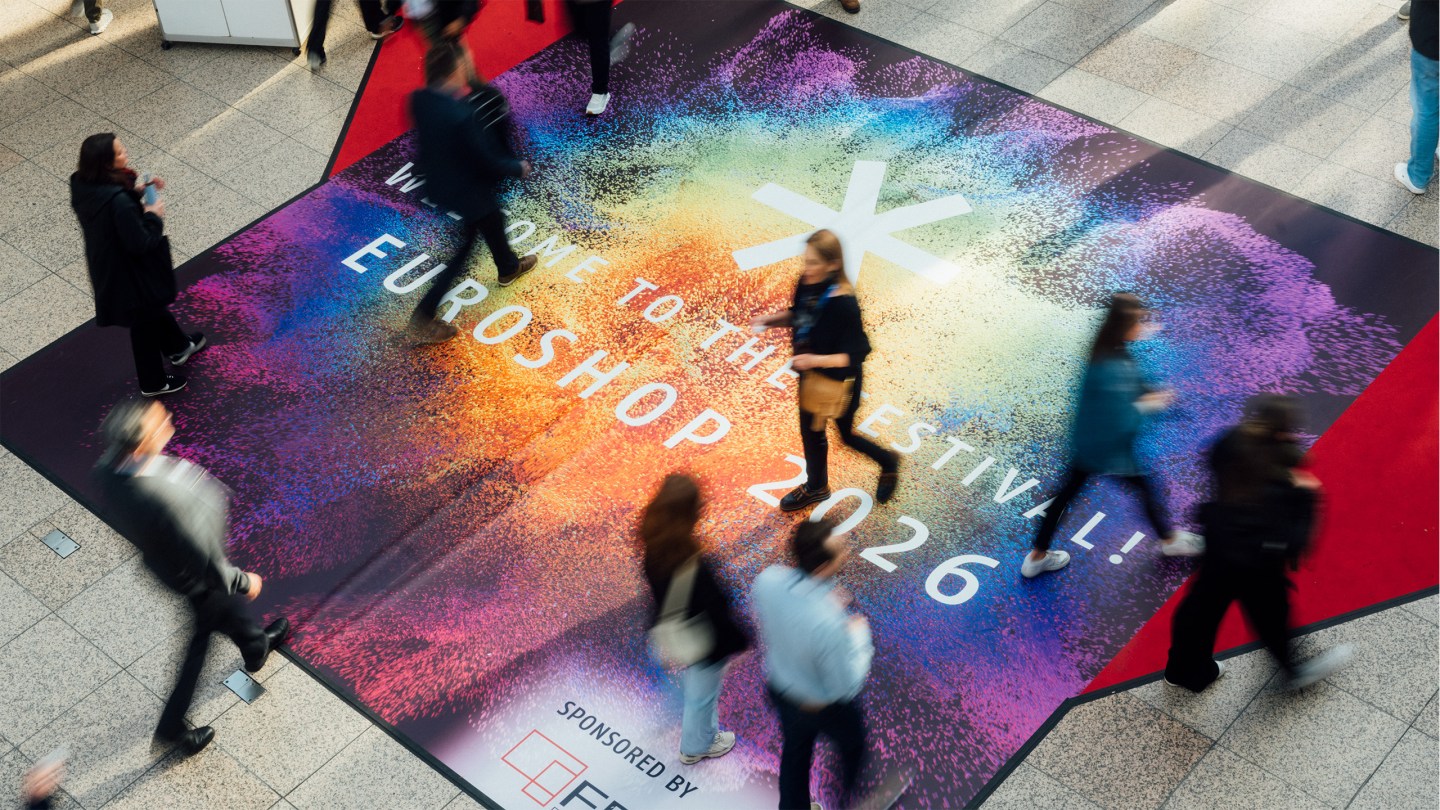
Euroshop’s PR department knows how to spin a tale. The website that the retail trade fair has produced to mark its 60th anniversary places its emergence in 1966 alongside the release of The Beatles’ Yellow Submarine and England’s World Cup final victory over West Germany. But it also sketches a wider scene. In the postwar decades, shops underwent radical change as open shelving, new fittings and modern technology displaced cabinet-and-counter arrangements. That shift required a unified voice and a regular industry gathering to give it shape. To underscore the urgency, the original Euroshop organisers even issued a kind of manifesto – What Euroshop Wants – in Düsseldorf’s business newspaper Handelsblatt. “Anyone working in retail has to deal with the large number of trade fairs that they feel compelled to attend,” it read. “It is hardly surprising that for years the community has been calling for a consolidation of these fairs.”


That first edition brought together 333 exhibiting firms from 11 countries. This year’s tally – 1,840 exhibitors from 61 nations – is far larger on both counts, yet the fundamentals remain the same: Euroshop is still about showcasing the latest achievements in the sector. It’s also about networking (hold someone’s gaze for more than two seconds and an exchange of business cards will almost certainly follow), striking deals (Swedish photographic lighting company Profoto made a €100,000 sale just before we arrived) – and opening new markets.
Ana María López, a Colombian interior designer, has been coming to Euroshop for 20 years. During that time her Medellín-based company, Caja Blanca, has helped to introduce some of the exhibiting brands – Italy’s Poliform among them – to South America for the first time. This year she has brought her daughter, Sofía, who is also an interior designer. “This is a sort of family tradition now,” says Sofía, as the pair pause for lunch at the stand of L&S Lighting Intelligence, an Italian brand that, like many exhibitors at the fair, lays on a full kitchen service. Food, after all, is a remarkably effective way of whetting the appetite for doing business. Most tables are taken as L&S sales managers wax lyrical to potential buyers over pasta and wine but Ana María and Sofía eventually find free seats. “When my mother first started coming here, there was no interior design industry in Colombia to speak of,” Sofía says. “She thought it was very important for me to come too and get to know the latest innovations and trends.”
Those trends, even to a casual visitor, are immediately apparent: retail development is moving in step with the broader direction of travel in the modern world. Across 14 sprawling halls at Messe Düsseldorf, exhibitors emphasise their use of eco-friendly materials and production techniques, as well as their ever-deeper incorporation of AI – not only online but in physical spaces too. A product attracting a lot of attention is a plug-and-play device by Prague-based Minds & Models that scans customers for factors such as age and lifestyle to offer on-the-spot purchasing recommendations, depending on the shop in which it is installed. When tested by Monocle, the results were accurate if a little flattering (mid-thirties, athletic build, healthy lifestyle; the demo was for a grocery shop, so the recommendation was muesli). It is already used in a handful of locations in the Czech Republic, with plans for further expansion after being certified under the EU’s strict privacy rules.
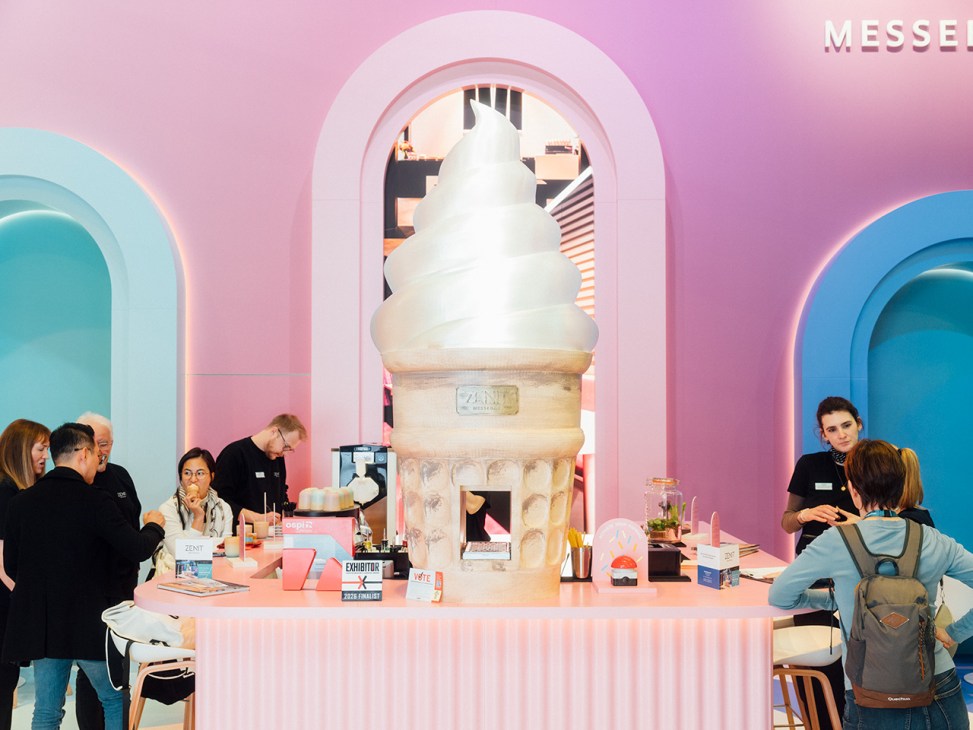
Elsewhere, the march of technology is evident in new refrigeration systems, rotisseries, cash registers and even – in an area devoted to branding and marketing – demonstrations of hologram advertisements. But cutting-edge R&D need not be quite so futuristic. In the lighting hall, Peter Haumer, the head of technical sales at Austrian company Lumitech, stands beside a display showing how various hues enhance specific goods: cold white for cosmetics; warm white for bread and pastries; and a red-pink tone for meat and poultry. “We’re highlighting the product because, simply put, the aim of the retailer is to sell,” Haumer says.
Yet lighting science can do more than boost sales. A freezer-cabinet LED developed by Lumitech can switch from 4,000 kelvin, or neutral white, to a proprietary colour called “natural meat”, which helps prolong the shelf life of produce by slowing photo-oxidation. Some German shops are already using it. “But you still have to check [the freshness] – we don’t want to manipulate the customer,” Haumer adds, as he flicks the switch back.
For all the innovation on show here, some things endure. No large store, however automated, can dispense with shopping trolleys – and in this, as in shelving and displays, Central European companies excel, drawing on longstanding manufacturing bases that stretch back to communist times. Grupa Kon-Plast from Poland specialises in plastic baskets – mostly handheld and midsized wheeled varieties – that it sells to supermarket chains and distribution firms in the EU, Georgia, Ukraine and the UK. Its chief executive, Henryk Kaminski, is beaming: proud that, since starting in the early days of Polish capitalism in 1992, he has weathered every storm and kept ahead of the competition. More at ease in German than in English, he raises his index finger and declares his company “Nummer eins” before waving goodbye.


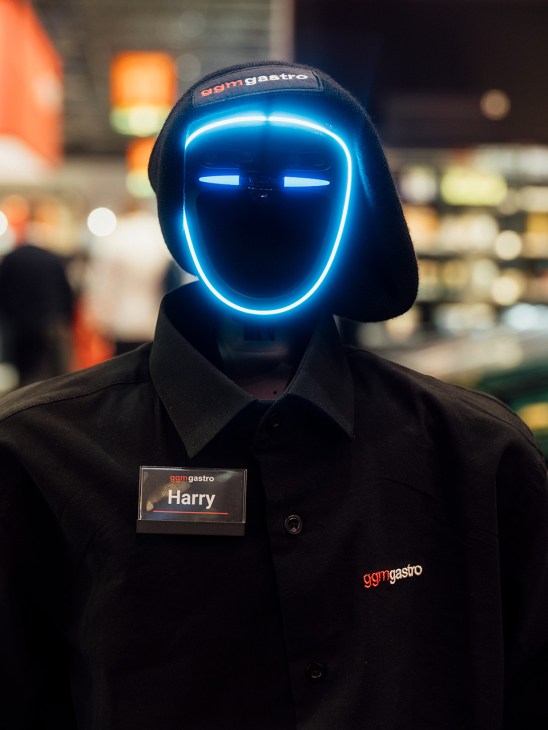
Equally indispensable are mannequins. In the hall, they stand slightly off to one side, eerily immobile as crowds swirl around them. The companies that make them are few and tend to be small, with unexpectedly rich histories. Hülya Meriç Korkmaz and her sculptor brother Hakan run Meriç Display Mannequins, a Turkish company started by their father Rafet, also a sculptor, in the early 1960s. She produces a photograph of him in Istanbul, taken by celebrated Turkish-Armenian photographer Ara Güler. This is the company’s eighth time exhibiting at Euroshop, so Meriç Korkmaz speaks from experience when she describes how mannequins, like everything else, fall victim to fashion and shifting sensibilities, waistlines narrowing and widening in turn. The harshest change, however, came in the 2010s when facial features began to disappear. “Before, you could generally understand the age of the mannequin from its face and makeup,” she says. “But now you cannot tell.” Faceless mannequins have made it easier for clothing brands to arrange their displays but they also ushered in fiercer competition for manufacturers who relied, as the Meriçs still do, on sculptural expertise.
While this particular trend is worrying – nobody wants to see storied companies vanish – one impression lingers after visiting Euroshop, especially for those who attend the fair in its entirety: that despite everything, analogue still defines the retail experience. As shops evolve, they remain real spaces that require physical things. And the manufacturers of those things still need, just as they did 60 years ago, a physical place to meet.
Euroshop at a glance
The fair was initially held every two years but later moved to a three-year cycle, on the grounds that meaningful innovation in shop design needs time. Will that dictum hold after 2029, when the next edition is due to take place?
Chinese manufacturers formed the second-largest national group of exhibitors after Germany, with 241 companies, dominating in areas such as point-of-sale hardware and electronic shelf labels.
One in five of this year’s 81,000 visitors came from outside the continent.
Visitor interest clustered around AI applications, energy efficiency and advances in modern LED lighting.
Düsseldorf established itself as an exhibition city as early as 1811, when it staged its first commercial expo under the patronage of Napoleon Bonaparte.