Novo Nordisk’s slimming down is symptomatic of Danish business naivety
We’re not ones for kicking folks when they’re down but things seem to be going from bad to worse for Danish pharmaceutical giant Novo Nordisk. The drugmaker was once Europe’s most valuable company thanks to its discovery of obesity treatment Wegovy. But since peaking in 2024, its share price has fallen by roughly two-thirds amid disappointing clinical trial results, a poorly handled change of CEO and mass redundancies. Increasing competition and a lack of control over copycat drugs produced by US compounders have also hit hard.
It was hoped that the approval of an oral version of Wegovy in December would help to pull the company out of its slump. Instead, more disappointment has followed. Novo’s next would-be breakthrough weight-loss treatment, Cagrisema, appears underwhelming, even before launch. A study published yesterday found it to be less effective than rival Eli Lilly’s Tirzepatide. Novo had been counting on Cagrisema to reignite growth in a market already unsettled by concerns over side effects and the tendency for users to regain weight after stopping treatment. By now, shareholders must be hoping for a miracle.
After announcing 9,000 redundancies in September in response to lowered growth forecasts and a rapidly changing market. The company’s decline has been as swift as it has been surprising – to the Danes, at least.
By late 2023, sales of Novo’s diabetes drug, Ozempic, and its obesity treatment derivative, Wegovy, helped it become Europe’s largest company by market capitalisation. The first shock to what had been a sky-rocketing share price appeared in December 2024 with disappointing trial results of its next-gen obesity drug, Cagrisema. Meanwhile, the company was failing to meet demand, allowing rivals such as US-based Eli Lilly to increase their market shares. Growing online sales of counterfeit drugs compounded the challenges.
In late 2024, I visited Novo to interview Dr Lotte Knudsen, who leads the team whose research resulted in Ozempic. She was deeply impressive but I did sense an odd complacency about Novo’s production bottlenecks, their rivals and those aforementioned counterfeiters. The prevailing attitude seemed to be that “there are plenty of fat people in the world to go round.”
A few months later, at a get-together at an ambassador’s residence here in Copenhagen, I shared my concerns for Novo with a former executive of the company. She grabbed my arm as if she were an escapee from a cult: “Yes, exactly,” she said. “But it’s worse than that.” She described an organisation that was reticent to the point of self-harm when it came to seeking leadership from outside of a small cabal of top-level executives, all of whom were Danish.
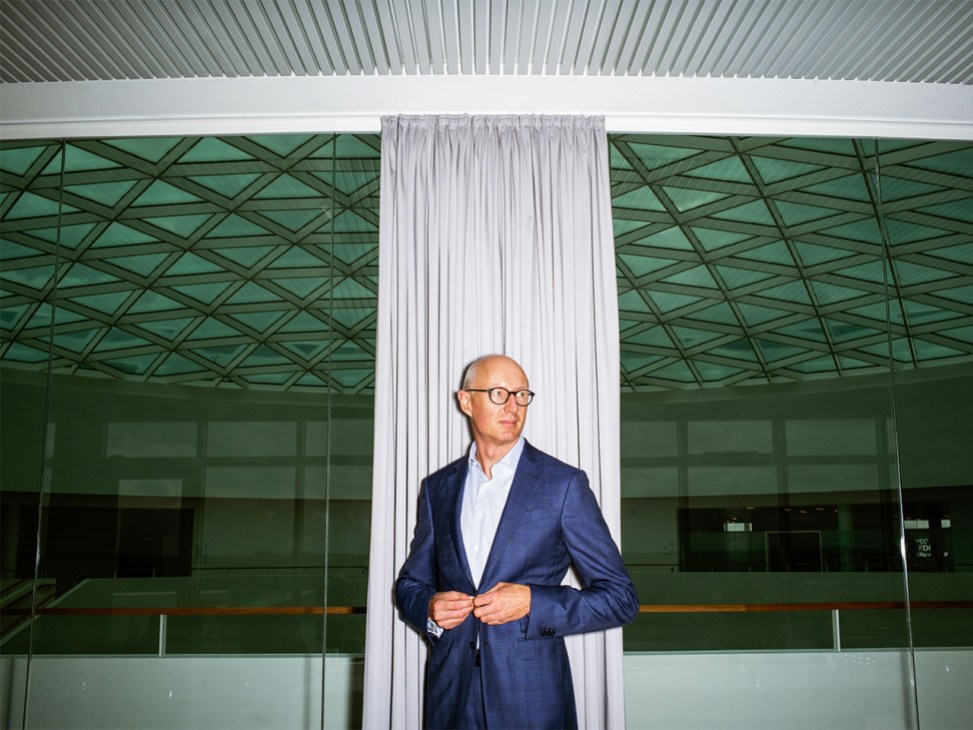
On one hand, it seems fair that Danish companies are led by Danes. After all, the Danes’ confident leadership style is sought after in neighbouring Sweden, which is often hamstrung by consensus-driven decision making. But Danish CEOs are a strikingly homogenous bunch: predominantly males in their 50s, they inhabit the same wealthy enclave on the coast north of Copenhagen and even have a de facto uniform: a navy, two-button suit, with no tie. (It’s perhaps a trivial point but their cultural hinterland seems mostly limited to cycling and running.) Mads Nipper, the former CEO of crisis-hit Danish energy company Ørsted, is a classic example. His replacement, Rasmus Errboe, is a mere 46 years old – but he too was promoted from within the company.
Here is the issue, though: Novo Nordisk is a profit-driven company but some of those profits (notably dividends) end up in a philanthropic foundation. Dr Knudsen proclaimed herself “a proud socialist”. Altruism and philanthropy are of course deeply admirable but one sometimes wonders if Danes are hungry or ruthless enough for the global corporate environment.
In May of last year, Novo’s board sacked its own identikit Danish CEO, Lars Fruergaard Jørgensen, without having a replacement lined up. Interviewed on Danish television on the day of his firing, he seemed in shock but assured the interviewer that he would handle his defenestration like “a professional” (odd that needed saying). Jørgensen maintained his belief that the US authorities would crack down on counterfeit products. To me this seemed somewhat delusional, given the same US authorities were hurling tariffs at the world, threatening Danish interests in Greenland and then cancelled Ørsted’s crucial Rhode Island wind-farm project, which resulted in the state-owned energy company’s share price plummeting to a record low.
Novo Nordisk finally appointed Jørgensen’s replacement – Mike Doustdar, an Austrian-Iranian company vice-president, is the first non-Dane to run Novo since it was founded in 1923. Although he sometimes wears a tie, things don’t seem to be looking up.
This article was originally published on 12 September 2025 and was updated on 24 February 2026 to reflect the result of the Cagrisema study.
Michael Booth is Monocle’s Copenhagen correspondent. For more opinion, analysis and insight, subscribe to Monocle today. To read Booth’s interview with the quiet scientist behind Ozempic, click here.