Tired of the same-old smartphone design? Try the Blackberry-inspired Clicks Communicator
London-based start-up Clicks is launching a satisfyingly simple phone that should be on every touchscreen hater’s shopping list. Meet the Communicator.
For a subset of push-button diehards, 4 January 2022 marked the end of an era: that day, Canadian communication technology company Blackberry took its legacy data servers offline, ending support for its once sought-after devices. There seemed to be increasingly few appealing options left for lovers of old-school keyboard phones.
Thankfully, change is afoot. Now, London-based start-up Clicks is launching a satisfyingly simple phone that bets on a significant number of people agreeing, with the benefit of hindsight, that Blackberrys represented the ideal form of mobile communication.
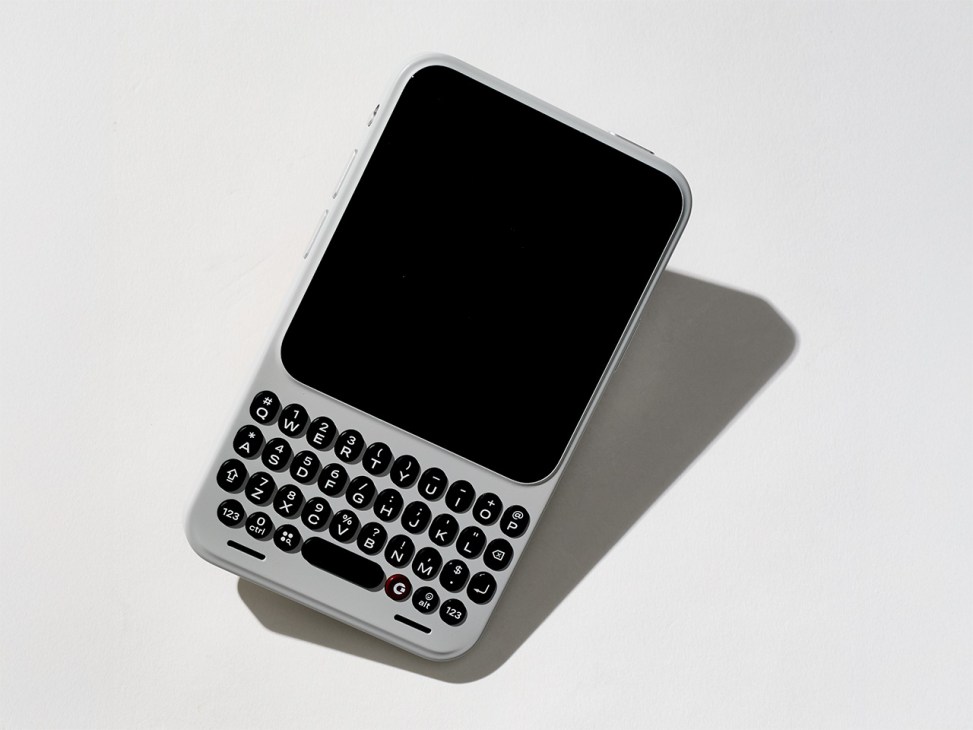
The Clicks Communicator looks tantalisingly like a 2014-vintage Blackberry Classic, with similar dimensions, a relatively chunky profile and an elegant, calculator-like version of the qwerty keyboard – which, as you might expect, is pleasingly tactile. These echoes of the Canadian company’s appeal are no accident. Ontario-based designer Joseph Hofer, who was the creative lead on the phone project, had previously spent a decade at Blackberry. “I never thought that I would design another phone because I didn’t like the direction that they were heading in,” he says. “On today’s devices, you might want to check the weather but somehow you’ll end up watching a reel.”
Clicks first began by producing attachable keyboards to touchscreen smartphones, and customers shared feedback that using physical keys changed the way they interacted with their phones. “People were feeling more intentional about what they were saying,” says Hofer. Studies have proven that handwriting is better than typing for retaining information; it makes sense that pressing on a real button, instead of swiping on a screen, would make some difference too.
Despite its nods to an analogue aesthetic, the Communicator is a digital device: the screen is touch sensitive and the phone runs on an Android operating system. What sets it apart from its touch-screen counterparts is its offer of tactile features such as a keyboard and a button for audio recording. “You can still doomscroll but there’s a little bit of friction there,” says Hofer.
Touch screens became the norm so quickly that it seems almost inconceivable that most of us were living without them some 20 years ago. Things could, however, flip the other way just as quickly. Their evolution over the past decade may come to be seen as an overshoot: think of how vintage typewriters are seeing an uptick in demand, with many craving a distraction-free machine that fulfils its brief without unwanted digital noise. The real wonder is that those buttons now seem like a radical idea.
clicks.tech
Comment from Richard Spencer Powell, Monocle’s creative director
As I hefted my old Bang & Olufsen TV down the stairs during a recent clear-out, a thought struck me: what is there left to design? Today, swipeable glass and the internet have put a brace on creativity and stripped out sensuality. Every new phone replaces another that looks like the last. Buttonless touch screens lack tactility and are inaudible when operated. That’s two of our primary senses turned off. To re-engage them, we need to be able to click, press and dial. In short, isn’t it time to revert to type?