

Maritime technology company Ulysses is building devices for where machines should replace humans: underwater
The California start-up is developing autonomous submersibles that can achieve far more than humans alone are capable of. We visit its HQ to see how its inventions defend coastlines from erosion and enemy invaders.
The HQ of Ulysses lies in the shadows of downtown San Francisco’s towers. Unlike the AI start-ups and trillion-dollar hyperscalers that are housed in slick offices nearby, this maker of autonomous subsea vehicles occupies an industrial warehouse with an interior that’s softened by vibrant art depicting the ocean. The company is working on a series of important but knotty issues associated with operating below the ocean’s surface. Currently, whether you’re trying to figure out why a subsea cable has stopped working or restoring a sea-grass meadow, you need specialist crews and costly surface-control vessels. Ulysses wants to replace this using autonomous vehicles.
The company was founded in 2023 by Akhil Voorakkara, Will O’Brien, Jamie Wedderburn and Colm O’Brien to solve an environmental problem – how to plant sea-grass seeds without putting someone in galoshes. Ulysses makes devices that are being sent on missions such as surveying, assessing broken pipelines and maritime defence. In April it announced a $38m (€33.4m) funding round, led by venture capitalists Andreessen Horowitz, and has already reported $5m (€4.4m) in sales.
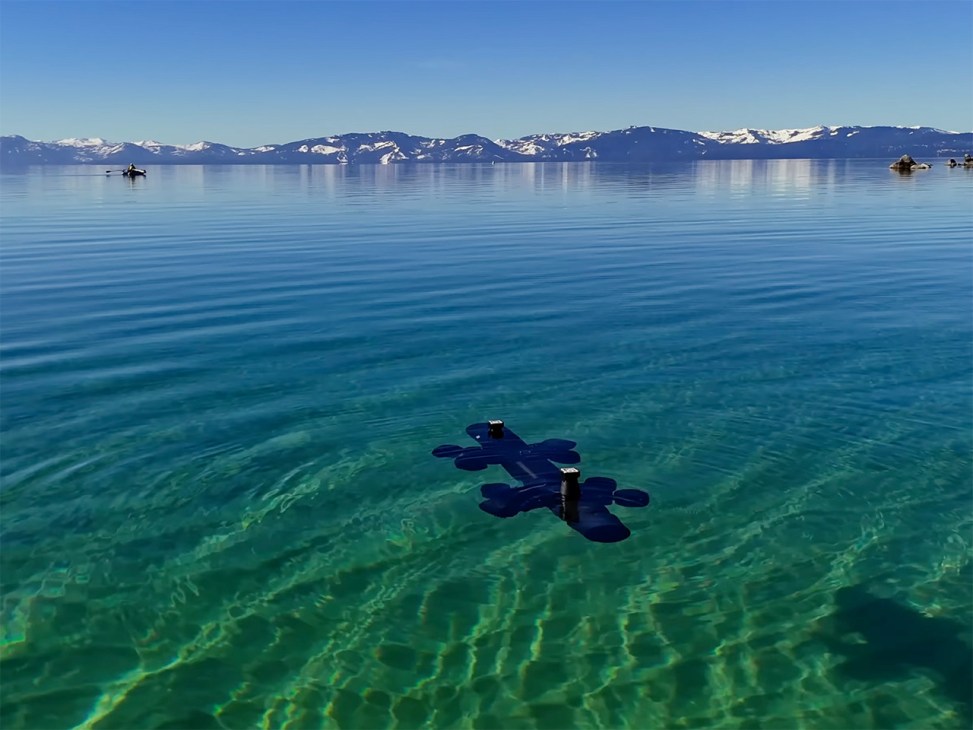
When Monocle visits, Wedderburn, the chief technology officer of Ulysses, takes us on a tour, showing us parts being made for a product called Mako, named after the shark species. “The person designing a component is also the one who is milling it,” says Colm, who serves as the company’s chief operating officer.


The Ulysses story began when Wedderburn was hiking with a marine-biologist friend who volunteered on sea-grass restoration projects in Scotland. The task involved wading through mud to plant individual seeds. Sea grass shelters fish, stores carbon and protects shorelines. Wedderburn thought that this could all be automated. His team’s first prototype had a patched-together collection of motors and pumps, plus a tank that was first tested with sesame seeds. Trials in Western Australia were fraught. “The mechanism was a disaster,” says Wedderburn. “It flooded and got corroded. But the robot itself worked really well.”
Though the robot functioned successfully and at a low cost, however, putting it to sea required a crewed boat. So Ulysses is also developing an unmanned surface vessel that can carry, launch and recover its underwater vehicles. The aim is to sell the entire system required to perform difficult work at sea without in-person human involvement. If successful, it could change how the ocean can be monitored and maintained. Ulysses wants to offer clients more than visual checks – including software that will allow a robot to repair, say, a leaking pipeline in the same way that current devices allow a surgeon to remotely operate on a patient. “We’re at the diagnostic phase right now,” says Wedderburn.
Back in the workshop, Colm details the lessons that he learnt while working with Red Bull Racing in one of the world’s most competitive arenas: Formula 1. He says that it taught him to keep improving a product even after it has been shipped. Ulysses trains engineers to make their own parts. This, says Colm, removes delays and lost information that can occur when work is passed between specialists. “It’s not a weeklong process that goes between three people,” he says. “It’s a one-day process and stays in one person’s head.” It’s also cheaper than buying parts from other countries, such as China.
Defence deals are increasingly important to the company, though the founders are clear about their red lines: the operative word is defence. Wedderburn says that Ulysses has already sold vehicles to the US Navy that can offer mine countermeasures, locate unexploded ordnance and, with partners, counter enemy unmanned vehicles. None were in any active combat zones at the time of our visit.
For Colm, the work requires more than enthusiasm for an engineering challenge. He’s frustrated by the public bombast and bluster of some defence-tech companies. “I would say that what’s missing in pop culture is a little bit of seriousness about what we’re building,” he says. That attitude extends to what the company promises customers. He says that clients are told that development is ongoing, rather than selling “vapourware” – claiming that products are more capable or reliable than they actually are. Even as Ulysses builds vehicles for customers, he says, “We’re not yet satisfied with our product.”
But serving several markets simultaneously does raise a question about Ulysses’s strategy. Is the core business thesis muddled? Conservation helped to start the company but generates less revenue than defence or commercial work. Colm doesn’t see that breadth as a distraction but rather as evidence of the technology’s usefulness. What Ulysses is building is a platform for doing physical work underwater, regardless of the specific environment in which it’s ultimately used. “We truly believe that conservation work is core to the business,” he says. Those who argue that Ulysses should concentrate on commercial projects or defence, he adds, “just do not understand the magnitude of the problem”.
In Western Australia, where the Ulysses tests began, the company’s work with the Ozfish Seeds for Snapper programme in Cockburn Sound has helped to produce four hectares of new sea-grass meadow. It’s a step change from what humans alone were able to achieve. Wedderburn plans to return to Perth with a larger seed tank and a new Mako hull for another planting trial. Ulysses might have found plenty of other work for its robot fleet but there are still meadows to restore.
theoceancompany.com