How the art world repackaged ‘cross-category collecting’ as a clever new trend
Buyers are bidding on old masters as well as postmodern pieces – sometimes at the same auction. But hasn’t it always been this way?
The more persuasive a narrative, the greater its power to mislead. For proof, consider the (allegedly) novel trend in my industry, the art world, for so-called “cross-category collecting”.
According to the slightly shaky theory, past generations only collected with a honed interest and tight focus on, say, contemporary portraiture or impressionism. The counterpoint, touted by art folk and auctioneers, is that over the past decade collectors and auctions have become less rigid and more eclectic. They have started, the hype masters continue, mixing art from multiple eras and collectable objects in many mediums into motley wholes. The main reason given? Smartphones, algorithmic newsfeeds and now generative AI’s worrying propensity to flatten reality. Technology, some critics say, is blending every historical epoch, genre and distinction into a smooth, easy-to-slurp slurry.
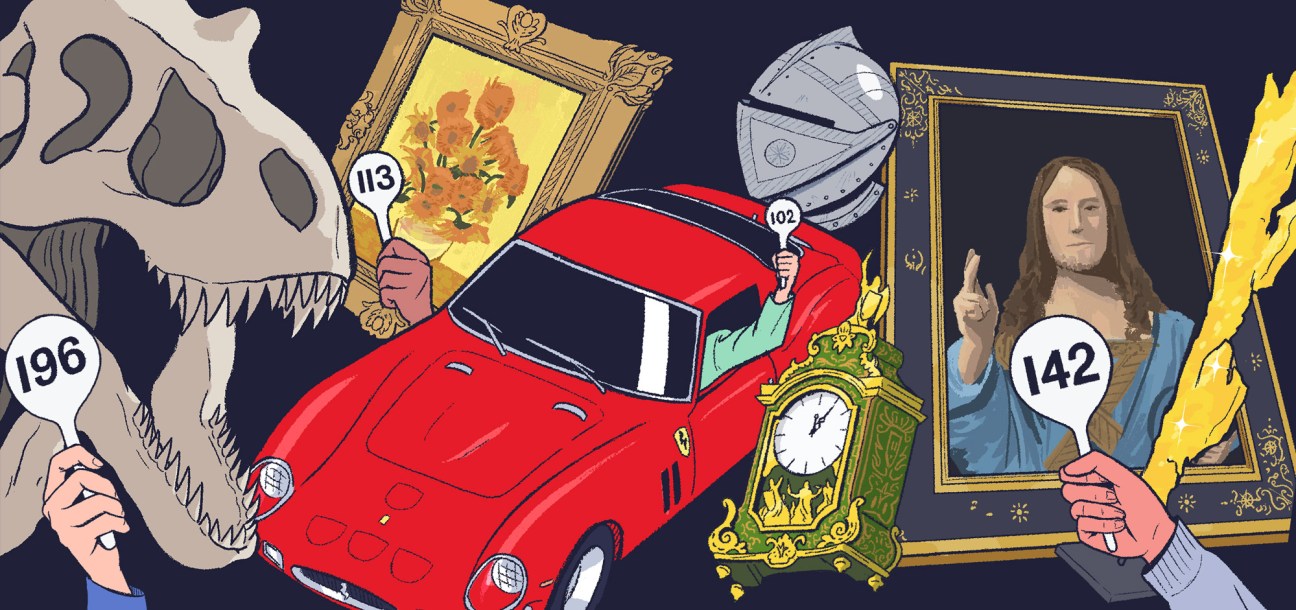
The narrative’s centerpiece was the sale of Leonardo da Vinci’s “Salvator Mundi”, which fetched $450m (€391m) in November 2017 and became the most expensive artwork ever auctioned. That happened, admittedly unusually, in a Christie’s sale nominally devoted to postwar and contemporary art. Since then, top auction houses have not only continued to selectively sell historical works in marquee weeks of modern and newer art but have also included more unorthodox rarities and sometimes frankly strange pieces, perhaps with an eye on social-media feeds or newspaper headlines. Examples include Christie’s taking bids for “Stan”, an almost complete Tyrannosaurus rex skeleton in 2020; Sotheby’s offering a 1962 Ferrari GTO in 2023; and Phillips consigning the “Thunderbolt”, which bore the faintly ridiculous and Instagram-ready description “the longest gold nugget ever found”, last autumn.
Meanwhile, prestigious galleries such as David Zwirner and Sprüth Magers have daringly presented thematic shows linking contemporary artists with old masters and antiquities. Art fairs have got in on the mixing and meddling too. Frieze Masters launched in 2012 as a historic complement to the brand’s original, contemporary fair. London’s Treasure House Fair emerged in 2023 as a one-stop shop for fine and decorative art, design objects and other collectables. Two years later, contemporary show Art Basel Paris gave the Gagosian gallery special permission to centre its booth on a Rubens painting. The 17th century is suddenly cool again.
This cross-category, mix-and-match momentum is certainly real but its newness is not. At least as far back as Rubens’ day, members of royalty and aspiring elites were assembling wide-ranging collections of art and artefacts from across epochs and cultures. Germanic Wunderkammern (cabinets of wonders) and Italian studiolos brought together human-made objects, marvels of natural history and scientific innovations. Empires ranging from the Mughal to the Qianlong added European prints, paintings, clocks and more to their holdings. People have always gravitated to works that they like rather than adhering to any rigid categories of movement or style.
Private capital certainly followed suit in the 19th century. The Rothschild banking dynasty’s opulent spending on fine art, decorative art, furniture and more from sundry eras and cultures established Le Goût Rothschild (“the Rothschild taste”). It doubled as a template for pushy American industrialists trying to buy their way to international respectability during the Gilded Age. Several contemporaries with revered art collections followed the time-tested strategy, from late Microsoft co-founder Paul Allen’s troves of historic guitars and early computing artefacts to Neue Galerie founder Ronald Lauder’s caches of arms and armour, classic cars and film memorabilia from Casablanca.
This raises the question: why are market forces presenting crossing categories as a fresh turn? Who gains by pretending it’s novel or interesting to like more than one thing? Technology probably plays a role – all context tends to be collapsed on small screens. But I also believe that, in this most disposable, machine-generated moment, Old-World craftsmanship – the allure of owning something that’s time-tested – has renewed appeal. In a small way, it can appease our anxieties about the future or position galleries as gatekeepers of a culture worth preserving. Plus, in an art world whose sales plateaued around 2014, the best story about the value of collecting is whichever one is the most convincing at the time.
About the writer: Tim Schneider is a writer, speaker and consultant on the business of fine art and collectables. He is the founder of independent art-industry newsletter and analysis publication The Gray Market.