The Venice Biennale jury resigns just days before the annual art festival is set to begin
There is disquiet among the gardens and waters of La Serenissima as protest grows against the inclusion of the Russian and Israeli pavilions.
This week sees the start of the Venice Biennale’s Vernissage – the preview week for press and VIPs – but there is disquiet among the gardens and waters of La Serenissima. The run-up to the “Art Olympics” has been dominated by an explosive row over who’s taking part. The resulting furore has now reached its crescendo: the entire Biennale jury has resigned and Alessandro Giuli, the Italian minister for culture, has launched an investigation into Russia’s pavilion.
Designed by Alexey Shchusev in the early 20th century, Russia’s pavilion is a grand, imposing building in Venice’s Giardini – prime real estate in Biennale terms. For the first time since the full-scale Russian invasion of Ukraine in February 2022, the building will be used to showcase the country’s chosen artists. (The exhibition, a performance titled The tree is rooted in the sky, conjures the image of a topsy turvy reality that feels particularly apt here.)
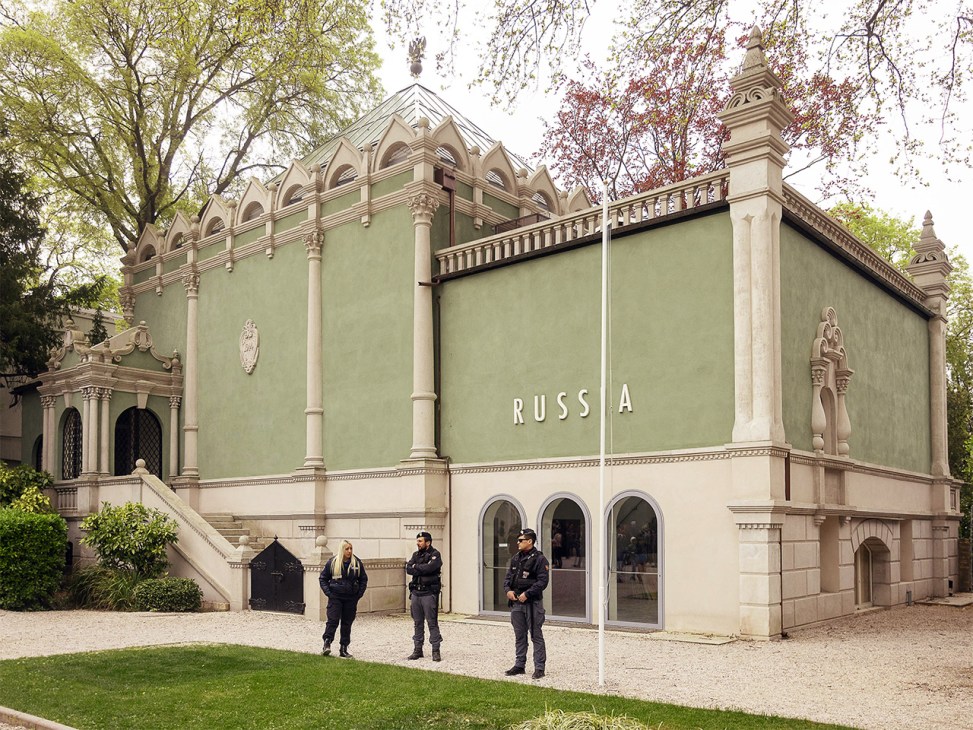
Russia owns its Giardini building and the Biennale’s constitution says that any country recognised by the Italian government is entitled to take part. To some extent, then, a country can decide how they participate and Russia’s absence in recent years (its artist and curator withdrew in 2022 and Bolivia used the pavilion in 2024) has been their choice. Now, not only Russia’s return but the inclusion of Israel in the event has caused consternation throughout the art world. For the five-person jury – tasked with giving prizes to the pavilions and appointed by the Biennale’s late curator, Kuyo Kouoh – the compounding controversies have clearly become untenable. What is unclear, and what will likely be at the heart of Giuli’s inquiries, is whether EU sanctions have been violated in the staging of Russia’s show.
The power of art to transcend or entrench political realities is always part of what makes the Venice Biennale the event that it is. But to witness such deep divisions – before even a single guest has disembarked the vaporetto – hints at something more profound. For the next six months, Venice will not only take the temperature of contemporary art in 2026; the city will also play host to a much bigger story about which conflicts and countries deserve uproar in the public imagination, and whether even egregious acts can be quietly forgotten with time. Over the coming months there will be much more than paintings and sculptures reflected in the waters of Venice.